Classrooms feel full of cell phones. The loud claim – that phones are a distraction in school – raises a...

Why Cell Phones Should Be Allowed in Schools for a Better Learning Environment
Almost every teen brings a cell phone to school, yet schools statewide and abroad now move from loose rules to tight limits or a full ban on cell phones. UNESCO counts 79 education systems with strict cell phone policies by late 2025, and state action surged again this year.
Table of Content
ToggleThe Shift Toward Phone-Free Learning Environments
New NCES data show that most school officials view cellphones in the classroom as detrimental to class outcomes, attributing this to lower performance. The debate now centers on results: some argue that cell phones should be allowed in school for accessibility and safety, while others favor a strict school cellphone ban to protect the learning environment.
What Students Actually Do With Phones at School
Even though schools restrict the use of cell phones, students continue to have their mobile devices with them. Cellphone usage in the corridors, during lunch, and between classes is revealed by a series of OECD surveys. The fact is that cell phones are ubiquitous, and daily implementation determines the outcome. Data at a glance:
- 59% of school students across the OECD report that classmates’ digital devices divert their attention in at least some math lessons.
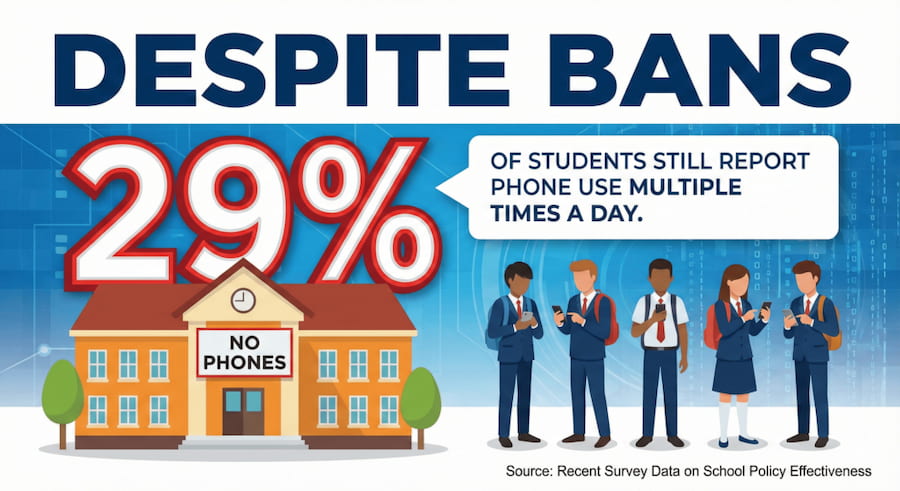
- In places where phones were banned, 29% still report cellphone use several times a day.

School phone policies often differ from daily practice. Because time is short, teachers usually rely on reminders rather than strict checks to restrict cell access. As a result, students use their phones during breaks, in cafeterias, and on buses.
However, phones provide study support when used with purpose. Many students use phones for educational apps, note organizers, and time trackers. Many students now use EduBrain homework helper, and are sometimes allowed to use these tools under guidance. With clear rules, cell phones can be used to shift from a distraction to a practical study aid.
Attention and Learning Environment: What Research Shows
Most U.S. school leaders say that phones in class make it harder for students to focus. Research supports that view: the risks associated with cell phone use in schools include lower scores, especially in math. The OECD found that distractions from phones in school hurt learning, while limited, teacher-guided use can help.
Many schools now try to find a middle ground, restricting cellphone use during the school day but allowing them for short academic tasks. Families also think about long-term goals, such as daily study habits.
| Source | Year | Key Point |
| NCES School Pulse | 2025 | More than half of U.S. school leaders say phones hurt performance |
| OECD PISA | 2023–2024 | Distraction lowers math scores; guided use helps learning |
It matters when clear rules are set at the school level. Schools that enforce limits experience less chaos and better concentration. Establishing a positive school culture means recognizing that excessive social media causes stress. While younger children benefit from strict limits, older students still need structure, though students are allowed to use devices for necessities like translation or a medical emergency.
Policy Landscape: U.S. States and Big Districts

Across the country, leaders push phone-free schools to protect attention during the school day while leaving room for cell phone use in schools when requested by teachers. Districts choose how to store devices so routines stay predictable.
- Florida (2023): First statewide instructional-time ban.
- California (2024): Requires schools to limit student cell phone access by July 2026.
- New York (2025): State leaders advanced a “bell-to-bell” plan through budget talks.
- LAUSD & D.C. Public Schools (2025): The nation’s #2 district and DCPS launched a phone-free model to curb usage in schools.
Rules about mobile phones in schools differ by location. When schools follow rules consistently, teachers can teach students effectively. Clear limits help balance lessons—keeping them phone-free when needed, and using cell phones only when it enhances the lesson.
When schools follow these rules consistently, classes run with fewer interruptions and students focus better. Clear limits help teachers use useful digital tools or learning games without losing attention in class. The main aim is balance, keeping lessons quiet and phone-free when needed, using technology only when it helps, and setting rules that families can follow at home.
International Perspective on Cell Phone Use
According to UNESCO, a greater number of countries are implementing restrictions on the use of mobile phones. The objective remains straightforward: maintain attention in class.
The OECD brings an important point: policies on cell phone access cannot solve the problem alone. If enforced inconsistently, the use of phones transfers to the home, and focus hardly changes. Many systems tie phone rules to well-being, citing mental health pressure and lost sleep. Strong policies still make room for teacher-led tools. After class, schools can point students to focused study aids so devices stay quiet during lessons but are useful when homework starts.
Many systems tie phone rules to well-being: leaders cite mental health pressure, social comparison, and lost sleep as real risks. Strong policies still make room for teacher-led tools when they add value, and they measure what happens next (grades, phone-related referrals, attendance), then adjust. After class, schools can point students to focused study aids that keep attention on task – say an AI helper for coding for step-by-step practice – so devices stay quiet during lessons and are useful when homework starts.
Pros and Cons of Cell Phone Ban
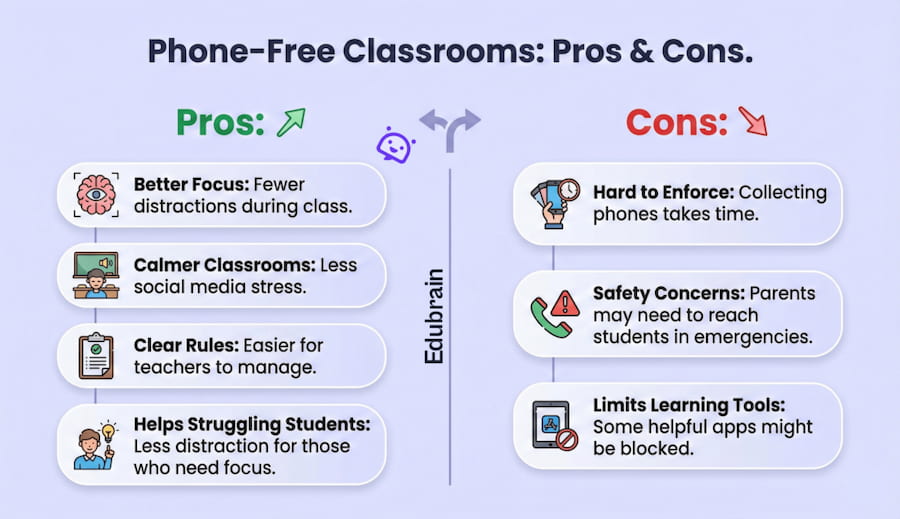
Parents and educators frequently weigh the pros and cons of a cell phone ban. Banning phones in school impacts learning, safety, and daily routines. When banned cell phones in schools are enforced during class, students focus better, reducing distraction and creating a calm environment.
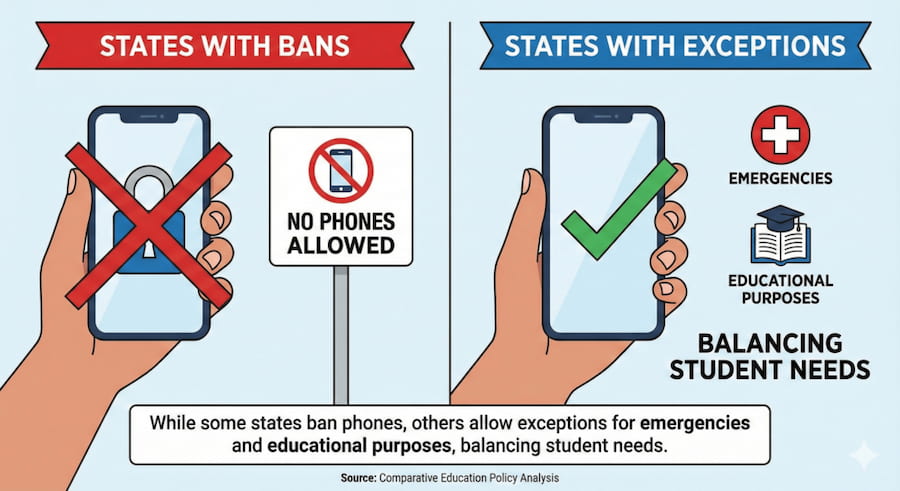
However, enforcing a ban on cell access is challenging. Collecting students’ phones takes time. Safety is a significant concern; in fact, the primary reason parents want kids to be able to have their phones is for urgent situations. In a school shooting or lockdown, phones help allow students to report safety issues.
Groups like the National Parents Union argue that a child’s school must allow students to report safety concerns directly to their families. Therefore, it is vital that schools may allow students to keep devices for emergencies. Strict prohibitions can hinder access unless schools must build in clear exceptions.

Implementation Models Schools Use
Policies are effective only if they fit the school community. Schools often decide on a range of time when phones should be put away to maintain concentration without completely closing off devices.
- Policy scope: instructional-time vs. bell-to-bell
Instructional-time bans cover lessons but allow cell access at lunch. Bell-to-bell bans run through the entire day to curb scrolling. In places where hallway drift is a growing concern, the tighter model tends to hold better.
- Storage choices and trade-offs
Many schools set their own policies: backpacks, caddies, lockers, or lockable pouches. High school teachers prefer whatever keeps routines simple. Caddies are cheap but add teacher handling; lockers and pouches cost more up front yet reduce day-to-day friction. Many educators prefer whatever keeps routines simple.
- Match the model to your campus
Smaller school campuses can often self-regulate. Large campuses usually need pouches to cut excessive cell phone usage. Phones also keep students connected after class, but the learning experience stays calm during it. Build clear carve-outs for any medical condition, translation needs, and documented emergencies. Parents still want a direct line in dangerous situations, so publish office contact steps and how emergency services fit in. Students still stay connected after class; the learning experience stays calm during it.
- Pilot, measure, adjust
To balance phones in classrooms, many schools start with pilot programs. They track data to see if students use devices appropriately. Short, teacher-led use is still allowed in the classroom when lessons require quick online checks. Some also use algebra AI to track study progress and guide better habits. Based on these findings, schools might shorten phone use during lunch or switch from caddies to lockable pouches. Short, teacher-led use is still allowed when lessons require quick online checks.
What Parents, Students, and Teachers Think
Support keeps climbing. In 2025, 74% of adults backed class-time bans in middle and high school. Parents say fewer interruptions help teachers. Teens feel split—some feel calmer without phones, others feel anxious. Teens and families feel split. Some students feel calmer without phones; others feel anxious. The mere presence of a device pulls attention back to group chats and messaging apps, so habits hinge on self-control and self-regulation – and on a clear school policy that sets expectations across classes. Quick takeaways:
- Schools need rules that work period by period, not just on paper.
- Safety plans must cover a natural disaster, medical alerts, and late buses.
- Other devices can be provided by the classroom to use if a lesson requires.
Despite wanting focus, teachers also want a lifeline for emergencies. A high school student or middle school students are sometimes allowed to use devices under strict guidance. Cell phones may be used to speed up learning after school hours. The use of cellphones in schools, when balanced prudently, results in policies trusted by families.
An efficient tool: physics AI – it provides detailed assistance, confirms the level of understanding, and is less distracting than open social media feeds. School districts that prudently balance the restrictions in the classroom with the intentional supports after school hours usually end up having policies that are trusted by families and followed by students.
Should Phones Be Allowed in School?
Many believe that cell phones can be useful, but some question whether cellphones be allowed at all. The evidence strongly supports that use during the school day should be limited. To give students the best environment, school settings should implement a targeted phone ban during lessons, though cell phones in the classroom for brief, teacher-directed activities can be appropriate.
To succeed: have clear rules, consistent enforcement, and simple exceptions for medical needs, translation, and emergencies. Monitor on-task time and cellphones in schools to evaluate progress. This combination keeps classrooms quiet while leaving space for technology to help when it truly matters.
Explore Similar Topics
Teachers face constant pressure across lesson plans, assessments, differentiation, parent messages, and admin tasks. Smart AI tools can cut routine...
Homework has been a cornerstone of education for generations. It has sparked endless debates among educators, parents, and students. Some...