In a world where technology increasingly defines our interactions, using AI for flirting is no longer a futuristic concept —...

Choosing an Undergraduate Major: Economics Degree vs. Finance Degree in Finance and Economics (Econ)
Everyone comes to the moment when they need to select an undergraduate major to study. It is one of the most significant decisions in a student’s journey.
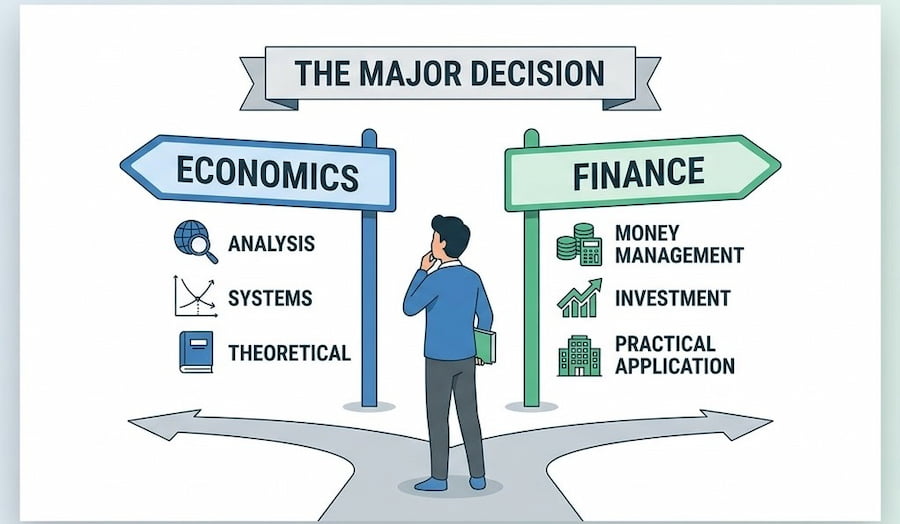
Finance and economics stand out among the various options due to their critical roles. They understand and manage the world’s resources, explaining how financial systems and markets work. Both disciplines offer unique perspectives on money, financial markets, and decision-making processes. Still, they differ in focus, methodologies, and career path options. So, which major should you choose?
I aim to clarify the distinctions between an economics vs finance path. After reading it, you’ll make an informed choice that aligns with your career aspirations. Are you drawn to the theoretical rigor of econ? Or are you interested in finance and its practical applications?

Table of Content
ToggleWhat Is a Finance Degree? (Undergraduate Finance)
First, we will distinguish the two fields. Let’s start with finance. Finance is the study of how to manage money. It generally involves acquiring, investing, and using financial resources.
It focuses on how individuals, businesses, and governments manage their finances. Finances include aspects such as banking, investment, credit, and the creation of wealth. What you learn in a finance program focuses heavily on the practical side of these concepts.
Finance professionals work with data to:
- Forecast future financial scenarios using modeling.
- Manage risk and make sound investment evaluation choices.
- Make strategic financial decisions to maximize financial growth and stability.
What Is an Economics Degree? (Undergraduate Economics)
Economics is a social science. It analyzes the production, distribution, and consumption of goods and services. It also explores how societies divide resources. Economics helps make decisions to meet the needs of the population, focusing on how economies work.
An economist will study supply & demand, market structures, and economic principles. Students can understand how economies function and develop strategies for improving economic outcomes through policy analysis. Economics programs offer a deep dive into how societies function.
Economics can be divided into two main branches:
- Microeconomics: The branch of economics that studies individual and business and financial decision-making.
- Macroeconomics: Examines broader economic factors such as inflation, unemployment, and national productivity.
Key Specializations for a Major in Finance and Economics
A finance major offers various specializations. It allows professionals to focus on specific aspects of financial management, often within a business school:
- Corporate Finance (and business finance)
- Investment Banking
- Financial Planning
- Risk Management and personal finance
An economics major also provides several specialization options. Future experts can concentrate on particular areas of interest during their degree program:
- International Economics and international finance
- Labor Economics
- Environmental Economics
- Econometrics and financial economics
Finance or Economics: Key Differences
Even from the definition, you can highlight the differences between the two majors. Although they both deal with resources and money, the fields of finance vs economics are very different in scope and emphasis.
Finance incorporates managing assets and liabilities, investment choices, and financial planning. It involves the practical application of financial principles to achieve specific goals. For instance, financiers increase a company’s profitability or manage personal wealth. Finance tends to be highly practical.
Economics is more theoretical and analytical. It seeks to understand how economic systems operate. Thus, it is the way to understand how various factors influence economic outcomes. Economic modeling helps develop economic theories to explain behavior and guide policy decisions.
The key difference lies in finance’s practical application versus economics’ theoretical exploration. Economics focuses on the broader social impacts.
| Aspect | Finance | Economics |
| Focus | Management of assets and liabilities. | Production, distribution, and consumption of goods and services. |
| Scope | Practical application of financial principles. | Theoretical and analytical study of economic systems. |
| Key Areas | Banking, investment, credit, financial planning. | Supply and demand, market structures, economic policies. |
| Primary Concern | Maximizing financial growth and stability. | Understanding economic behavior and improving economic outcomes. |
| Quantitative Analysis | High. | Moderate (High in econometrics). |
| Theoretical Analysis | Moderate. | High. |
| Specializations | Corporate finance, investment banking, financial planning. | International economics, labor economics, econometrics. |
| Career Paths | Financial analyst, investment banker, risk manager. | Economic analyst, policy advisor, research economist. |
| Tools and Techniques | Financial modeling, data forecasting. | Economic models, statistical analysis, policy analysis. |
| Approach | Practical and data-driven. | Theoretical and model-based. |
Which Major Is Harder: Degree in Finance or Economics?

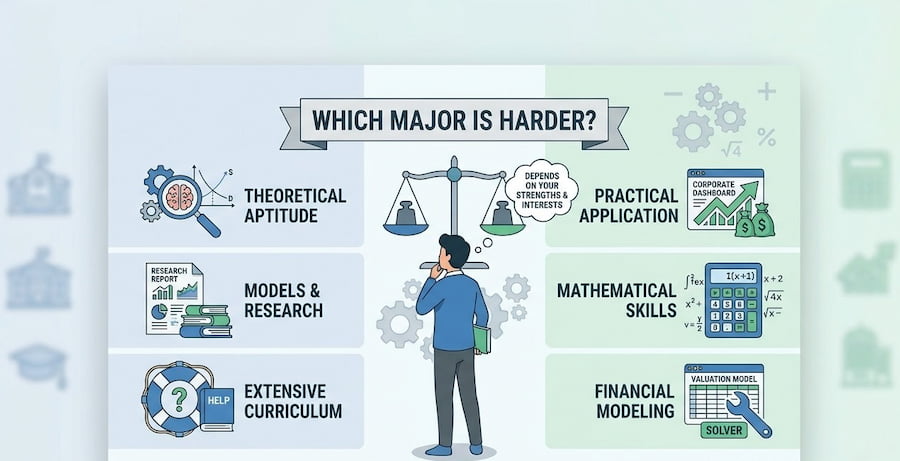
If you ask yourself, “Which undergraduate degree is harder?”, there is no particular answer. It depends only on an individual’s strengths and interests.
An economics degree might require a strong aptitude for theoretical analysis. Students must have a deep understanding of economic models. It often involves extensive economic research and data analysis. Students also do loads of economics classes and tasks. Luckily for them, they can access resources like an economics homework helper. Using it, their economic journey becomes easier and more engaging. Using it, their academic journey becomes easier.
While challenging, a finance course focuses more on practical applications. It requires skill in mathematical concepts, financial analysis, and modeling. Yet, nowadays, you can still find help with these tasks online. Yet, nowadays, you can still find help with these tasks. You may simply use a finance questions solver tool, and your life as a financier becomes much easier.
Students interested in math and financial markets may find finance programs more manageable. Whereas those with a passion for theoretical analysis may prefer economics.
Deep Dive into the Curriculum: The Classes You Will Actually Take
When I sit down with students who are torn between an economics vs finance degree, the first thing I do is open up the university course catalog. Titles and career descriptions are great, but your day-to-day life for the next four years will be defined by the syllabi sitting on your desk.
If you want to know what a major is truly like, you have to look at the classes. Both of these fields require a solid foundation in mathematics. I always warn my students: you cannot escape numbers here. Whether you choose finance or economics, you will likely share foundational classes in Calculus, Statistics, and Microeconomics during your freshman year. But once you hit your upper-level courses, the paths diverge significantly.
Coursework Comparison
| Year | Finance Major Curriculum | Economics Major Curriculum |
| Freshman | Intro to Business, Microeconomics, Calculus | Intro to Sociology, Microeconomics, Calculus |
| Sophomore | Financial Accounting, Managerial Accounting | Macroeconomics, Advanced Statistics |
| Junior | Corporate Valuation, Financial Markets | Econometrics, Game Theory |
| Senior | Options & Derivatives, Portfolio Management | Money & Banking, Behavioral Economics |
Inside the Finance Curriculum
When I look at a finance degree curriculum, I see a laser focus on the mechanics of money, corporate operations, and wealth generation. The classes are designed to teach you exactly how to evaluate a business and manage risk. If you choose this major, expect to take:
- Financial Accounting: This is the language of business. You will learn how to read, balance, and analyze balance sheets, income statements, and cash flow statements.
- Corporate Valuation: How much is a company actually worth? You will spend hours in Excel learning how to build Discounted Cash Flow (DCF) models to price out entire corporations.
- Options, Futures, and Derivatives: I often tell students this is where finance gets intense. You will learn about complex financial instruments used to hedge risks or speculate on market movements.
- Portfolio Management: You will learn the math behind diversifying investments to maximize returns while minimizing risk, analyzing concepts like the Sharpe ratio and the efficient frontier.
Why Choose an Economics Major?
After checking all the differences, you should concentrate on making the right choice. If you pursue a career in economics, it can be beneficial for many reasons. With an econ degree, you can:
- Gain a comprehensive understanding of how economies function.
- Equip graduates with the critical thinking skills needed to interpret complex data.
- Identify trends, and make informed decisions.
This major imparts a solid grasp of economic principles. It also fosters highly valued critical thinking and problem-solving abilities. Are undergraduate business programs in economics good? Yes! They offer a blend of theoretical knowledge and practical application. You can influence public policy, engage in cutting-edge research, or drive business success. Furthermore, an economics degree offers insights into societal issues.
Why Choose a Finance Major?
Does the finance industry drive you more? Opting for a major in finance offers practical and lucrative job opportunities. Professionals are in high demand due to their expertise in managing assets, investments, and risks.
Earning a finance degree provides a solid foundation. It equips graduates with the skills to navigate the complexities of financial markets. Thus, professionals can make sound financial decisions. Companies across various industries seek finance professionals to help:
- Manage financial risks.
- Forecast economic trends.
- Make strategic investment decisions.
Furthermore, the finance industry offers excellent salary growth potential and a strong job outlook.
Career Path, Salary, and Job Outlook Comparison
Finance graduates are essential to the success of businesses, while economists are crucial for public policy and macro-strategy. To help you visualize your future, here is a breakdown of common career paths, median salaries, and job outlooks (based on general Bureau of Labor Statistics data).
Salary and Job Outlook Matrix
| Career Path | Relevant Major | Median Salary (Approx.) | Job Outlook | Key Focus |
| Financial Analyst | Finance | $96,000 | Steady Growth | Corporate investment and modeling |
| Investment Banker | Finance | $100,000+ (plus high bonuses) | Highly Competitive | Mergers, acquisitions, and capital raising |
| Financial Planner | Finance | $95,000 | Faster than Average | Personal wealth and retirement planning |
| Economist | Economics | $113,000 | Steady Growth | Policy advising and systemic research |
| Economic/Data Analyst | Economics | $85,000 | Faster than Average | Forecasting trends via data analysis |
Career Path and Job Outlook for an Economist
The analytical skills gained make an economics major valuable in various sectors. According to the Bureau of Labor Statistics, the job outlook for an economist remains steady. Some common jobs include:
- Economic Analyst: Analyzing data to forecast trends.
- Policy Advisor: Developing and advising on economic policies.
- Research Economist: Researching to provide insights for decision-making.
- Academic Positions: Teaching macroeconomics or microeconomics.
Economists work in government agencies, research institutions, and universities. Other potential careers include consulting or public finance.
Career Path, Salary, and Job Outlook with a Degree in Finance
Finance graduates are essential to the success of businesses and individuals alike. If you go into finance, you will enjoy diverse prospects. Some popular career paths include:
- Financial Analyst: Evaluating data to help businesses with investment management.
- Investment Banker: Advising clients on mergers and investment banking.
- Financial Planner: Assisting individuals with personal finance and retirement planning.
- Risk Manager: Identifying and managing financial risks.
These professionals with a career in finance work in banks, corporate finance departments, and advisory companies. The salary and job outlook for a financial analyst or investment manager are often highly competitive.
A Day in the Life: What You Will Actually Do from 9 to 5
Whenever a student sits in my office, overwhelmed by the lists of career options in economics and finance, I tell them to stop looking at job titles and start looking at the daily lifestyle. The reality of what you do on a random Tuesday at 2:00 PM is often the deciding factor between these two paths.
Let me walk you through what a typical day actually looks like for a recent graduate in both fields.
A Day in the Life of a Financial Analyst
If you choose finance, prepare for a fast-paced, highly structured day driven by market hours and client demands.
- Morning (7:30 AM – 9:30 AM): Your day usually starts before the markets open. You will grab a coffee and immediately start reading financial news, think the Wall Street Journal or Bloomberg. You are checking overnight global market movements and reading up on the specific sector you cover (like tech or healthcare) to prepare for the morning team meeting.
- Mid-Day (10:00 AM – 2:00 PM): This is where your hard skills come in. You will spend hours staring at dual monitors, working heavily in Excel. You might be updating a Discounted Cash Flow (DCF) model because a company just released its quarterly earnings report. You are constantly crunching numbers to figure out if a stock is overvalued or undervalued.
- Afternoon (2:00 PM – 6:00 PM+): You are drafting pitch books or investment memos. You will likely sit in on calls with senior management or clients to defend your financial models. It’s high-pressure, incredibly data-driven, and focused entirely on the bottom line: How do we maximize profitability and mitigate risk right now?
A Day in the Life of an Economic Researcher/Analyst
If you choose economics, your day is usually less dictated by the hourly swings of the stock market and more focused on deep, long-term research and systemic trends.
- Morning (8:30 AM – 10:30 AM): Your day begins by reviewing massive macroeconomic data releases. Did the Bureau of Labor Statistics just drop the new inflation numbers? Did the employment rate shift? You are reading reports from the Federal Reserve or global think tanks to understand the current macroeconomic climate.
- Mid-Day (11:00 AM – 3:00 PM): Instead of Excel financial models, you are likely using statistical programming software like R, Python, STATA, or SPSS. You might be running complex regressions on a massive dataset to see how a new government tax policy will affect consumer spending over the next five years. The work is highly analytical, requiring deep focus and patience as you clean and interpret data.
- Afternoon (3:00 PM – 5:30 PM): You are writing comprehensive policy briefs or white papers based on your data. Instead of pitching a stock to a portfolio manager, you might be presenting a macroeconomic forecast to a government agency, a corporate strategy board, or a non-profit organization. The pace is more deliberate, and the focus is on the “why” and “how” of the broader economy.
When I frame it this way, the choice often becomes much clearer. Do you want the fast-paced, profit-driven environment of evaluating individual companies, or do you prefer the deep-dive, research-heavy environment of evaluating entire economic systems?
Post-Graduation: Certifications vs. Graduate School
Whenever students ask me, “What happens after I graduate?”, I have to give them a reality check. Your bachelor’s degree is just the starting line. One of the biggest differences between a finance and an economics trajectory is what happens in the three to five years after you leave the university. The credentials you need to climb the corporate or academic ladder look entirely different depending on which major you choose.
Let me break down the post-graduation landscape so you know exactly what you are signing up for.
The Finance Path: The World of Professional Certifications If you go into finance, your post-graduate life is heavily defined by professional certifications and licenses rather than immediate graduate school. In the finance industry, specific letters behind your name often carry as much, if not more, weight than a master’s degree.
- The CFA (Chartered Financial Analyst): If you want to work in investment banking, asset management, or equity research, this is the gold standard. I always warn my students: the CFA is notoriously brutal. It consists of three levels of exams, requiring roughly 300 hours of studying per level, usually completed while you are working a demanding full-time job.
- The CFP (Certified Financial Planner): If you are drawn to personal finance and want to manage wealth for individuals or families, you will likely pursue the CFP. It requires passing a rigorous exam and logging thousands of hours of professional experience.
- The MBA (Master of Business Administration): While many finance professionals do eventually get an MBA, they usually do it after working in the industry for three to five years. It is often used as a tool to pivot into a higher executive tier (like private equity or corporate leadership) rather than an entry-level requirement.
The Economics Path: The Graduate School Track If you choose economics, the professional landscape is much more academic. While a bachelor’s degree will land you a solid entry-level job as an analyst or consultant, I always tell my students the hard truth: to hold the actual title of “Economist,” you almost certainly need an advanced degree.
- Master’s Degree in Economics or Public Policy: If you want to work for a government agency, the Federal Reserve, or a major international organization (like the World Bank or the IMF), a master’s degree is often the minimum barrier to entry. These programs usually take one to two years and are highly quantitative.
- The Ph.D. in Economics: If your dream is to conduct high-level economic research, dictate national monetary policy, or become a tenured professor, you are looking at a Ph.D. track. This is a massive commitment, often taking five to six years of intense mathematical and theoretical research. Unlike the finance path where you earn a salary while studying for the CFA, the economics path often requires staying in academia full-time for much of your twenties.
When making your decision, ask yourself: do you want to spend your post-grad years studying for industry licenses while working on Wall Street, or do you want to spend those years in a graduate program defending a master’s thesis or doctoral dissertation?
Essential Hard and Soft Skills (and the Tools You Must Master)
Whenever I review resumes with my students, I notice a common mistake: they list their major but forget to highlight their specific technical toolkit. Whether you pursue a degree in finance or economics, graduating with just theoretical knowledge is no longer enough. You need to know the software, and you need to possess the right interpersonal skills to communicate your findings.
The Ultimate Student Toolkit
| Toolkit Area | Finance Major Focus | Economics Major Focus |
| Software / Hard Skills | Advanced Excel, Bloomberg Terminals, QuickBooks, Tableau | Python, R, STATA, SAS, SPSS |
| Analytical Focus | DCF Valuation, Risk Assessment, Portfolio Modeling | Statistical Regressions, Policy Forecasting, Data Cleaning |
| Soft Skills | High-pressure pitching, client relations, fast decision-making | Deep critical thinking, academic writing, public policy presentation |
| Output Format | Pitchbooks, Investment Memos, Spreadsheets | 30-page Policy Briefs, White Papers, Academic Journals |
Here is exactly what you will need in your professional toolkit for each path.
The Finance Toolkit: Hard and Soft Skills
If you go into finance, your technical skills need to be sharp, fast, and heavily focused on accounting and valuation.
- The Hard Tools: You must become an absolute master of Microsoft Excel. I don’t just mean basic formulas; I mean building complex financial models, using macros, and navigating without a mouse. Furthermore, you will likely need to learn how to navigate a Bloomberg Terminal, which is the industry standard for real-time financial data, trading, and news. Familiarity with SQL or Tableau for data visualization is also becoming a massive advantage for any aspiring financial analyst.
- The Soft Skills: Finance is a client-facing, high-stakes industry. You need exceptional presentation skills with finance education. When you are pitching an investment or explaining why a merger makes sense, you have to be confident, concise, and persuasive. You must thrive under pressure and be comfortable making swift investment decisions when millions of dollars are on the line.
The Economics Toolkit: Hard and Soft Skills
If you choose the economics major, your toolkit shifts from corporate valuation to heavy statistical and data analysis.
- The Hard Tools: You are going to move beyond Excel, and a finance degree could help. To succeed in economic research or policy analysis, you need to learn statistical programming languages. I always advise my economics students to learn R or Python. You will also use specialized econometric software like STATA, SAS, or SPSS to run regressions and analyze massive datasets. If you want to forecast inflation or labor trends, these are the tools that make it happen.
- The Soft Skills in Economics and Financial Path: While finance requires sharp pitching skills, economics requires profound critical thinking and exceptional writing abilities. You are not just making a quick buy/sell recommendation; you are writing comprehensive, 30-page policy briefs or research papers. You need the intellectual curiosity to look at a systemic problem (like housing affordability) and the communication skills to explain your complex statistical findings to lawmakers, corporate boards, or the general public who might not have a background in math.
Ultimately, I tell my students to look at the software: do you want to build DCF models in Excel to value a tech startup, or do you want to write code in R to analyze a decade of healthcare data?
Choosing the Right Undergraduate Finance or Econ Path
So, it is time to choose between a degree in finance or economics. Think about your interests, strengths, and career goals.
First, consider whether you prefer economics that studies theoretical nature or finance’s quantitative focus. Economics involves a deep dive into broad concepts. Do you enjoy understanding complex systems and policy analysis? Economics might be the right fit for you.
In contrast, a finance and economics degree leaning toward finance is more about practical application. Are you excited by financial markets? Do you see yourself advising businesses on financial strategies? A business school finance path is the better option.
Seek advice from professionals. Connect with an economist and a financial analyst. Both a finance degree and an economics degree offer rewarding paths. The right finance and economics choice depends entirely on your passions!
Explore Similar Topics
Finance is the study of money management and financial markets. The graduates of this major will earn skills valuable to financial-driven sectors....
When exploring fields in numerical analysis, finance and economics often emerge as leading options. But what’s the difference? If you...