

Asymptote Calculator
Understand Function Behavior With Precision

Automatic asymptote detection
The calculator identifies all asymptote types without manual algebraic manipulation.
Step-by-step analysis
It explains how limits behave near critical points and infinity.
Handles complex functions
Rational, exponential, and logarithmic expressions are analyzed with advanced methods.
Graph-based asymptote visualization
The calculator displays asymptotes directly on function graphs for clearer interpretation.
Limit-verified results
Detected asymptotes are confirmed through automated limit evaluation for higher accuracy.
From Function Input to Asymptote Detection: How the Tool Works






Featured in




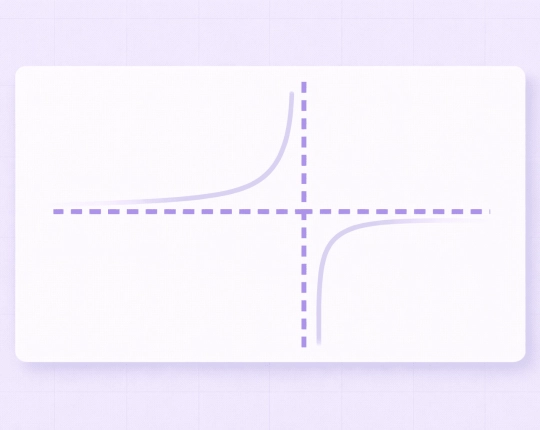
How Asymptotes Describe Function Behavior Near Infinity
An asymptote is a line that a graph approaches but never fully reaches. It describes the behavior of a function near undefined values or as the variable moves toward infinity.
Asymptotes help mathematicians understand long-term function behavior, discontinuities, and unbounded growth patterns.
For example, as \( x \to \infty \), a function may approach a constant value such as \( y = 0 \), forming a horizontal asymptote.
They are fundamental in algebra, calculus, engineering, and physics modeling.
A modern asymptote calculator evaluates these behaviors automatically using algebraic simplification and limit analysis.
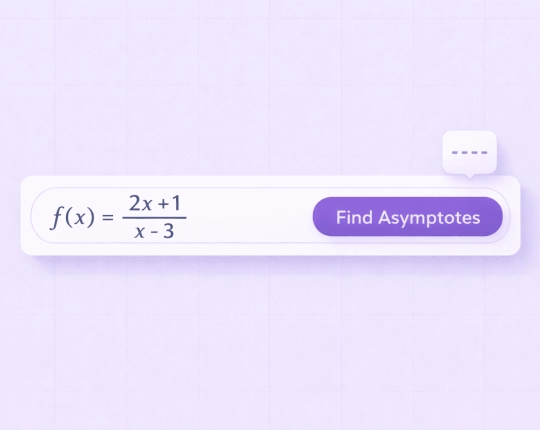
Types of Asymptotes
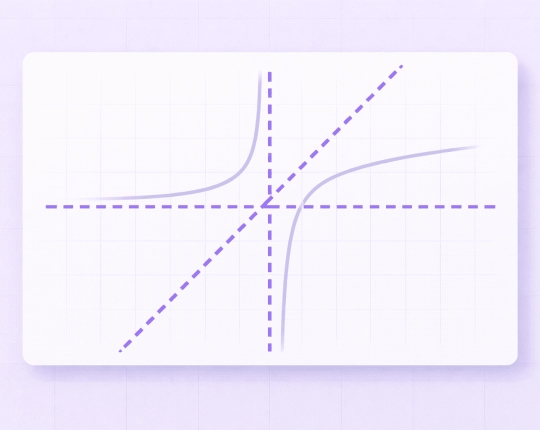
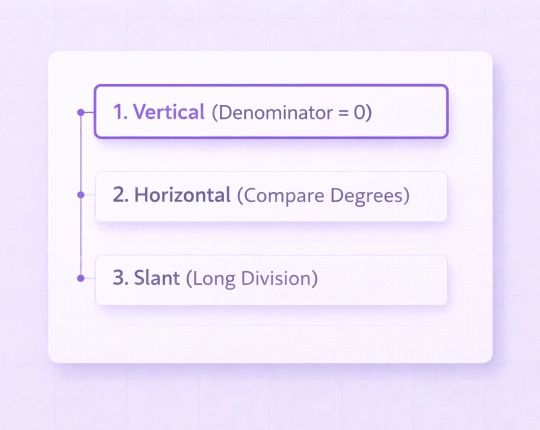
Functions may contain three primary asymptote types.
- Vertical asymptotes
These occur when a function becomes undefined, typically when the denominator equals \( 0 \). As \( x \) approaches that value, the function increases or decreases toward \( \infty \) or \( -\infty \). - Horizontal asymptotes
Horizontal asymptotes describe the behavior of a function as \( x \to \infty \) or \( x \to -\infty \). They reveal long-term output trends. - Oblique (slant) asymptotes
When a function does not level off horizontally, it may approach a diagonal line instead. These often appear in rational functions where the numerator degree exceeds the denominator degree by \( 1 \).
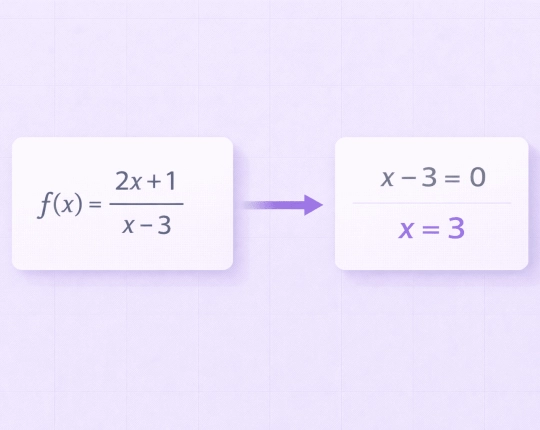
Vertical Asymptotes Explained
Vertical asymptotes form when division by zero occurs in rational expressions.
Example:
\( f(x) = \frac{1}{x – 2} \)
The denominator equals zero at \( x = 2 \), creating a vertical asymptote.
Near this value, the function outputs increase or decrease infinitely. A limit calculator with steps often evaluates left-hand and right-hand limits to confirm asymptotic behavior.
Horizontal Asymptotes and Limits
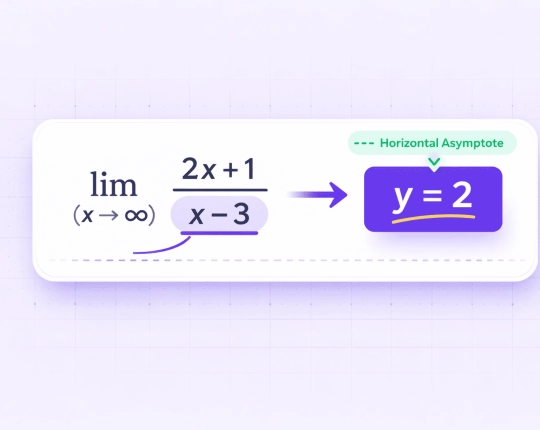
Horizontal asymptotes depend on how the numerator and denominator degrees compare.
Rules include:
- If numerator degree < denominator → asymptote at \( y = 0 \)
- If degrees are equal → ratio of leading coefficients
- If numerator degree > denominator → no horizontal asymptote
Oblique Asymptotes
Oblique asymptotes appear when the numerator degree exceeds the denominator by one.
To find them, polynomial division is required. The quotient (excluding the remainder) forms the slant asymptote equation.
This process mirrors techniques used in algebraic division and may involve derivative or growth analysis when studying curve behavior near the asymptote.
Asymptotes in Exponential Functions
Not all asymptotes arise from rational expressions. Exponential functions also exhibit asymptotic behavior.
Example:
\( f(x) = e^x \)
When \( x \) tends to negative infinity, the function tends to be equal to \( y = 0 \) but never achieves it.
The modeling of such behavior may involve calculators such as an exponential function calculator, a tool that can be used to model growth and decay curves, as well as the positioning of the asymptotes.
Role of Derivatives in Asymptote Analysis
While limits define asymptotes, derivatives explain how functions approach them.
A derivative calculator can determine slope behavior near asymptotes, revealing whether curves approach steeply, gradually, or with inflection changes.
This insight becomes valuable in curve sketching, optimization problems, and motion modeling.
Step-by-Step Example
Consider:
\( f(x) = \frac{2x + 3}{x – 1} \)
Step 1: Find the vertical asymptote
Denominator equals zero at \( x = 1 \) → vertical asymptote.
Step 2: Check horizontal asymptote
Degrees are equal → ratio of leading coefficients \( \frac{2}{1} \) → \( y = 2 \).
Step 3: Confirm with limits
Evaluating limits near infinity confirms horizontal behavior.
An asymptote calculator performs all steps instantly while displaying supporting logic.
Why Asymptotes Matter
Asymptotes reveal hidden structure in function graphs.
They help:
- Predict long-term growth
- Identify discontinuities
- Model physical limits
- Analyze rational equations
- Understand infinite behavior
In economics, the asymptote model shows diminishing returns.
In physics, they describe terminal velocity or wave decay.
In engineering, they help evaluate system limits.

Common Mistakes When Finding Asymptotes
Students often make recurring analytical errors:
- Ignoring removable discontinuities
Factored terms may cancel, eliminating false asymptotes. - Misreading degree comparisons
Horizontal asymptotes depend strictly on polynomial degrees. - Skipping limit verification
Not all infinite behaviors produce asymptotes. - Confusing slant and curved growth
Not every non-horizontal trend forms an oblique asymptote.
Automation through an asymptote calculator prevents these conceptual mistakes.
How the Asymptote Calculator Works
The calculator processes the function in structured stages.
First, it simplifies the equation algebraically.
Next, it evaluates denominator zeros to detect vertical asymptotes.
Then, it compares polynomial degrees for horizontal or oblique cases.
An AI math solver layer can interpret every step in natural language when advanced explanation is turned on, leading to better conceptual understanding.
Advanced Math Tools


Choose your plan
Free plan
- Unlimited use with ads included
- Free access to all AI tools
- Download all responses (answers, presentations, flashcards, etc.)
- Share responses with others
AI-Plus
- Expert reviews on discounted prices
- Ad-free experience to:
- AI detector
- Diagram generator
- PowerPoint generator
- Answer generator
- Flashcard maker
- Notes generator
- Research assistant
- Download all responses (answers, presentations, flashcards, etc.)
- Share responses with others
- Advanced reasoning
Expert help
- Presentations (human-made)
- Homework help
- STEM support
- Writing assistance
- Editing & proofreading

 Unlimited AI homework help

 Diagram Generator, Flashcard Maker, Notes Generator, Research Assistant, Answer Generator, AI Homework Helper & AI Detector