Many students say math is the subject they fear the most. Not because they never understood numbers, but because at...

The Best AI for College Students Specifically
The rise of artificial intelligence has been quick and undeniable. Every college student who has had to write papers with excellent comprehension and without plagiarism knows how difficult it can be to churn out multiple tasks in a short period. Luckily, though, there are more and more AI-powered tools like EduBrain and ChatGPT that have the potential to make students’ lives easier.
However, utilizing an AI tool is not as straightforward as it may seem. Although the software is designed to assist students in completing their work quickly, it can easily become overly automated. which leads to your work getting red-flagged and your learning going down the drain. This is why I’ve taken it upon myself to bring you the best AI tools available that are focused on helping students actually learn. I’ll also show how to use AI to improve learning and productivity, not just give it orders.
Table of Content
Toggle1. EduBrain – The Top AI Tool for Students
EduBrain isn’t just any other AI tool. It is designed specifically for students who want to not only get their work done but also learn. Instead of just solving your tasks, EduBrain will also give you step-by-step explanations so you can understand how the problem has been solved. In this way, the tool allows students to enhance their critical thinking skills, maintain academic integrity, and gain personalized learning experiences while getting professional tutoring.
This AI tool can help you write papers, generate outlines, make complete presentations, explain complex topics, create mindmaps, and do much more.
Example Use
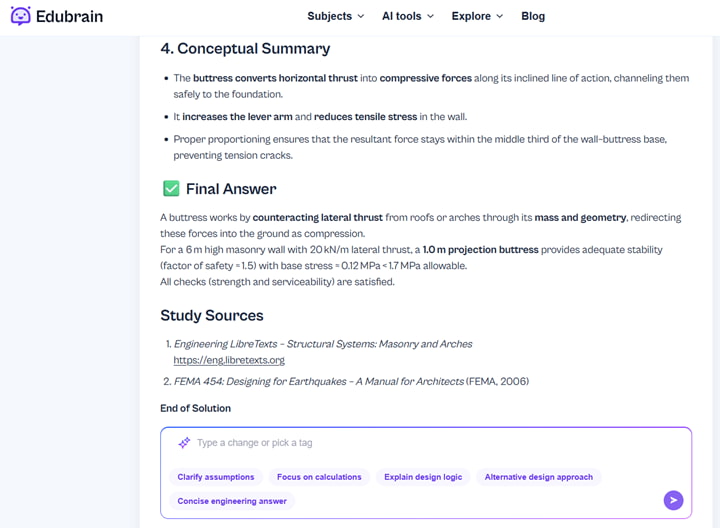
I used EduBrain to explain to me how an architectural buttress works. This involved choosing Architecture as my area of study and then typing in my question. The response I received included everything from the definition to the formula for calculating loads. The fact that EduBrain even included the study sources that it used cements it as my top recommendation.

Who It’s For
EduBrain is perfect for nearly all kinds of students. It suits learners who want an AI tool built with coursework in mind, rather than just casual conversation. It takes AI homework help, teaching and learning to the next level and is helpful for students who need a helping hand with their tasks.
2. ChatGPT – Accessible Artificial Intelligence To Help Students Improve
Whenever we talk about mainstream AI technologies, ChatGPT has to come up as a successful case study. It has quickly become the most used AI tool in higher education, and enables students to get help with pretty much any subject they can think of.
I enjoy using ChatGPT, particularly because of how easy it is. There’s no real learning curve, and a number of smartphones integrate it within their OS now, enhancing its accessibility even more. With ChatGPT, you can:
- Simplify complex theories
- Write essays
- Break down difficult math problems
- Generate study guides
- Summarize long papers
- Brainstorm ideas
- Generate quick visuals
If you’re a STEM student, you can even get help with coding and debugging. It works in real-time, almost like talking to a friend, and is definitely one of the top productivity tools out there.
Example Use
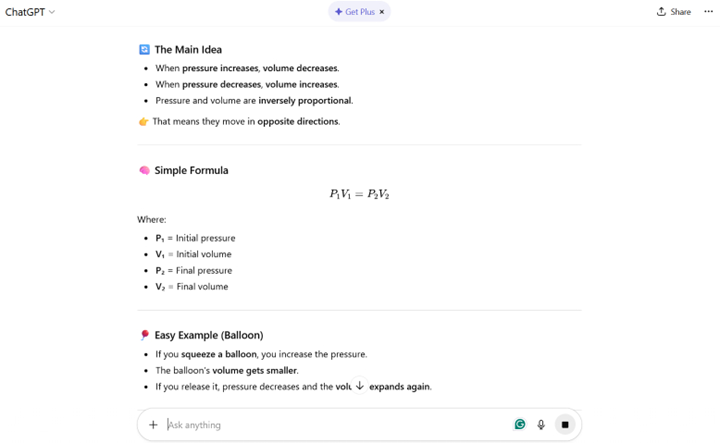
I asked the tool to explain Boyle’s Law to me in very simple terms, using a bulleted format. The result took mere seconds and explained the main idea behind the law as well as the formula, with examples. It then asked me if I wanted a practice question to understand the law in more detail, and upon my consent, provided a task with a step-by-step breakdown.

Who It’s For
Students who want an easy-to-use, reliable, and seamless tool that they can use on the go. It gets bonus points for its image generation technology, which gives students instant visuals for presentations, moodboards, etc.
To stay ahead of AI detection while polishing your essays, using a reliable humanizer AI is essential for any college student looking to maintain a natural and authentic writing style.
3. Grammarly- A Writing Companion For Every College Student
While a writing assistant may not scream “future of AI” with everything happening in the world of artificial intelligence right now, it’s still an essential tool for students. Within this category, I think Grammarly is the best tool that helps students enhance clarity, tone, grammar, and structure.
A lot of people think that Grammarly only helps fix your spelling mistakes, but it does much more. Students use it to improve sentence structure, adjust tone, suggest better words, and detect plagiarism.
Example Use
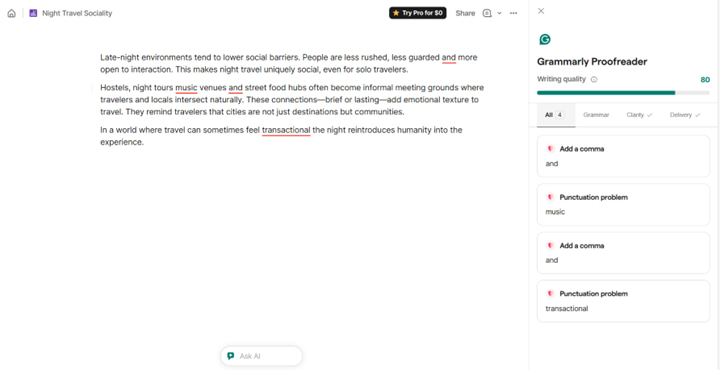
Giving Grammarly a few sentences, I got instant recommendations on how to improve the grammar. It identified punctuation problems and also gave me a writing quality score. To accept its grammatical changes, I just needed to click on the recommendations, and the text got updated automatically. The whole process felt very seamless, improving my writing quality score in seconds.

Who It’s For
Students who have a lot of writing tasks and need help with improving their texts. This is among the top AI tools for college students who aren’t native English speakers, making it easier for them to submit better writing.
4. Notion AI – The Best AI Tool for Organization and Management
This software is my pick if you’re looking for organization. It may not be considered among the most intelligent tutoring systems out there, but it’s a great way to speed up routine tasks, manage deadlines, and organize notes.
Whether you want to summarize lecture notes, convert messy notes into structured outlines, draft project plans, or help manage research databases, Notion AI is one of the leading tools that can help.
Example Use
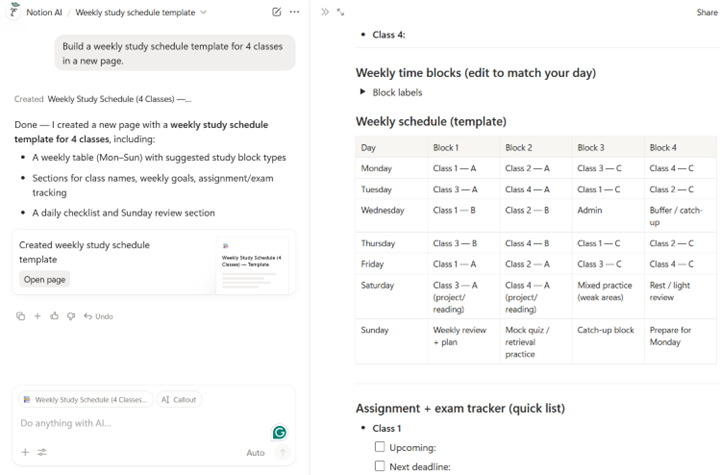
I asked Notion AI to create a weekly study schedule for 4 different classes. The results took a while longer than I would have liked, but the detail with which it created a study plan for me was commendable. It even created an exam tracker and a daily checklist to make sure I stay updated on my progress.

Who It’s For
Students who have multiple tasks to juggle at the same time, especially those with internships and extracurricular activities to manage.
For college students tackling complex math problems, using a reliable fractions calculator can simplify equations and ensure accuracy in every assignment.
5. Wolfram Alpha – Among the Best AI Tools for Students of Math
I’ve tried to find the best AI tools for math students, and have found none that can beat Wolfram Alpha. This is the software I’d recommend for those looking to deepen their knowledge of subjects like physics, economics, and statistics.
With its AI-generated step-by-step solutions to your problems, graph visualizations, statistical computations, and formula breakdowns, Wolfram Alpha changes the way students tackle complex topics. You’ll get actionable steps for dealing with problem-based courses like calculus, linear algebra, and others. Use of AI tools like this really showcases the true power of AI in education, helping students learn and gain actionable insights at the same time.
Example Use
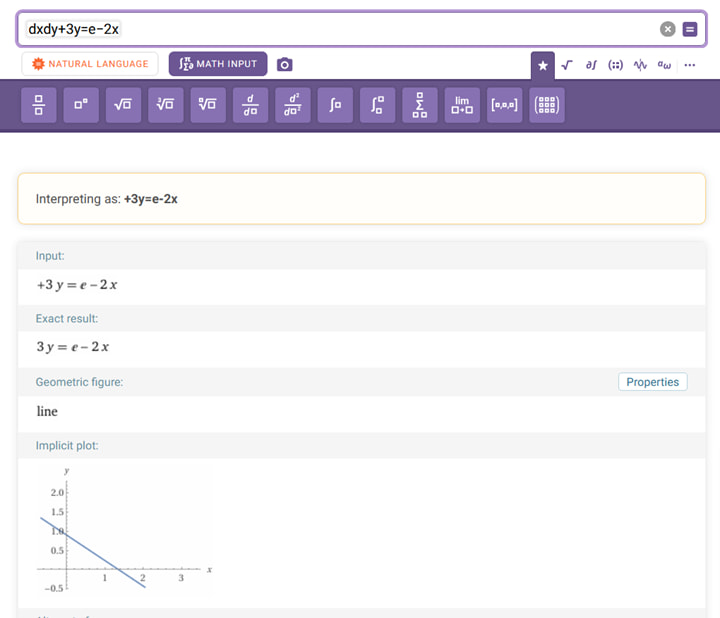
I gave this tool a college-level differential equation with no context. The result was several pieces of information about the equation, including a plot diagram and the exact result. The solution at the end included an option to provide a step-by-step breakdown of the process, which was helpful for actually understanding how the math works.

Who It’s For
Learners who are in math-heavy courses and are in need of AI tools that support their learning with AI algorithms designed specifically for dealing with numbers and data.
6. Otter.ai – A Tool that Helps Students Enhance Accessibility
With so many fast-paced lectures going on, it’s often tough for students to keep track of everything being said. Access to AI-powered tools that help you with lectures is powerful. That’s the reason I recommend Otter.ai as one of the best learning management systems that support diverse learning needs.
This rather new AI can be used to provide real-time lecture transcription, so students can easily go over lectures after the fact. The transcripts are searchable and offer speaker identification to help individualize the text in case of multiple speakers.
Example Use
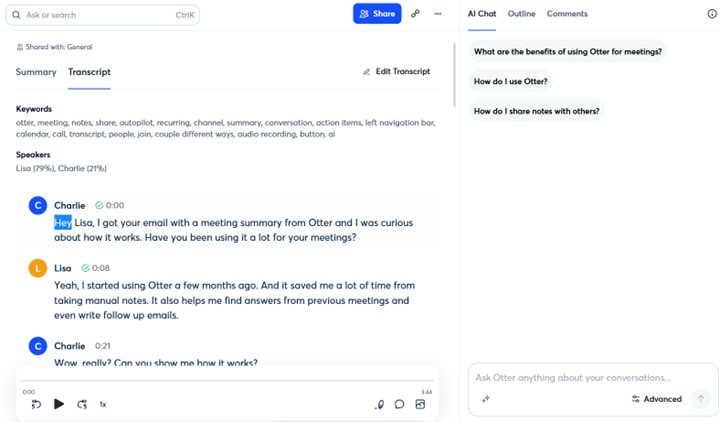
I tested Otter’s transcription and was happy to see how well it structures the notes. It not only separated the speakers’ statements but also added timestamps and a total percentage of who spoke how much. The fact that Otter can automatically start tracking online meetings in software like Google Meet and Teams means that I could just have a regular meeting and get the whole thing converted into text in the background.

Who It’s For
Students who learn better by reviewing text rather than listening verbally, have attention challenges, and want searchable lecture archives. College students need adaptive AI tools for education that improve efficiency seamlessly, and Otter.ai is an excellent option.
Choosing the Right AI Tools for Education and Productivity
I’ve followed all the major trends in AI, trying to figure out how students can use AI tools effectively as the technology improves. A lot of the time, learners don’t put enough emphasis on figuring out which AI-driven software actually supports their research and study goals, and instead go with the most popular AI they’ve heard about. The fact is that the best tool for you depends on your academic situation and individual learning styles. However, here are a few scenarios to help you pick the option with the right AI capabilities:
- If you write a lot, EduBrain and Grammarly are a great choice.
- If you need an accessible assistant, ChatGPT, Google Gemini, or Microsoft Copilot are contenders.
- If you’re in STEM, EduBrain and Wolfram Alpha are unbeatable.
- If you’ve got too many courses, Notion AI is a powerful tool for organization.
- If English isn’t your first language, Grammarly offers excellent writing guidance and support.
- If you struggle with attention, Otter.ai can help a lot with exam preparation.
Use AI for Research and Study with Academic Integrity
It is extremely important to remember that when it comes to AI, tools can support learning but never replace it. Universities are increasingly allowing the use of AI tools, but also keeping a close eye on their abuse. AI-generated content, when used word-for-word, is not allowed. There’s a growing number of AI recognition software that tells your professors exactly how much artificial intelligence you’ve used.
So, how can students complete their tasks with AI without falling prey to these issues? Here are a few tips:
- Use the tools for brainstorming and understanding, rather than generating final content.
- Don’t submit work that’s fully created with such tools.
- Make sure to cite the tools you’ve used when required.
- Understand and follow your institution’s guidelines regarding how students interact with AI.
When used the right way, artificial intelligence is great at providing students with the support they need. However, the same machine learning algorithms can land you in trouble when used irresponsibly.
For college students tackling complex calculus or advanced mathematics, using a series calculator can significantly simplify the process of finding sums and analyzing convergence.
Final Thoughts on AI Productivity Tools
Artificial intelligence has quickly transformed higher education in a few years’ time. While at first, students began using AI software to improve their writing, the technology has gone far beyond that. Tools like EduBrain offer a complete learning suite, helping learners improve critical thinking and understanding instead of just doing their tasks for them. Wolfram Alpha is great for math students, whereas Otter.ai is perfect for capturing lectures.
To find the right option that works for your needs, it’s a good idea to use available free versions first. A little experimentation is all it takes to discover the software that can enhance your academic experiences, whether you’re a part of virtual classrooms and collaborative platforms or a physical classroom.
Explore Similar Topics
Artificial intelligence (AI) is transforming educational technology. This change is particularly notable in mathematics. Traditional teaching methods now integrate with...
Artificial intelligence is no longer a novelty for students. It’s part of their routine. It shows up when an essay...