

Many students say math is the subject they fear the most. Not because they never understood numbers, but because at...

Pros and Cons of Homeschooling: What to Expect Before You Leave School
Before you choose homeschooling, check the constraints: time, energy, and money.
Done well, it fits. Done without a plan, it can create daily conflict and burnout. The point of this article is to help you decide without guessing, using real numbers, planning steps, and the trade-offs that show up in a normal week. While homeschooling offers personalized learning, parents may sometimes need extra support with technical subjects, which is where a reliable math solver can help students master complex equations and stay on track with their curriculum.

Table of Content
ToggleHomeschooling in the U.S.: the numbers (what “instruction at home” includes)
The National Center for Education Statistics reports that about 5.2% of children ages 5–17 received academic instruction at home during the 2022–23 school year, up from 3.7% in 2018–19. Source: IES/NCES (Sept 17, 2024).
NCES also notes that in 2022–23, about 3.4% were reported as homeschooled, and 2.5% were enrolled in full-time virtual education (parents may classify situations differently, so don’t treat these as perfectly clean categories).
Instruction at home (selected years)
| Measure | 2018–19 | 2022–23 |
|---|---|---|
| Instruction at home (total) | 3.7% | 5.2% |
| Reported as homeschooled | — | 3.4% |
| Full-time virtual education | — | 2.5% |
This matters because some families think they’re choosing “homeschool,” but what they actually want is a virtual program. Those are different systems with different demands.
Pros and cons of homeschooling: why families switch (numbers, not slogans)
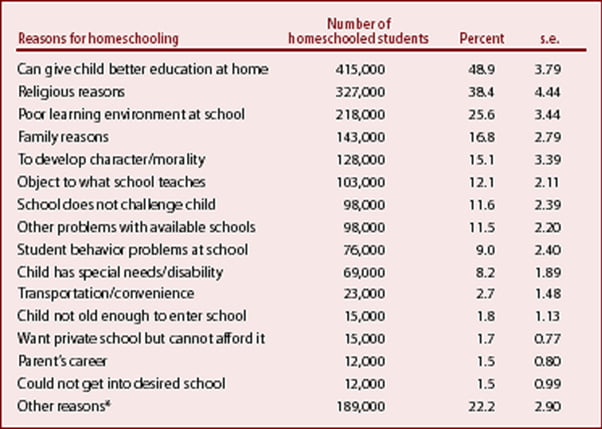
Parents can select multiple reasons. In 2019, NCES found that among homeschooled children, parents commonly selected the following reasons: concern about the school environment (80%), desire to provide moral instruction (75%), emphasis on family life together (75%), and dissatisfaction with academic instruction at other schools (73%).
When asked to pick the single most important reason, NCES reports: concern about school environment (25%), dissatisfaction with academics (15%), and religious instruction (13%).
Reasons parents give for homeschooling (NCES)
| Reason (multiple selections allowed) | % selecting |
|---|---|
| Concern about the school environment | 80% |
| Desire to provide moral instruction | 75% |
| Emphasis on family life together | 75% |
| Dissatisfaction with academic instruction | 73% |
Source: NCES, The Condition of Education.
- The practical takeaway: the “many benefits to homeschooling” people talk about are not one thing. A family leaving due to negative peer pressure needs a different plan than one leaving because the curriculum pace isn’t working.

Pros of homeschooling (what improves when it works)
1) You can tailor the curriculum to the learner
Traditional school is built for scale. Homeschooling can let you tailor a curriculum to a learning style, a pace, and unique needs.
That matters for grade levels where gaps stack fast (reading fluency, math foundations). It also matters for kids who need extra help but don’t get enough time in a traditional classroom.
2) A flexible schedule can reduce friction
A flexible schedule is “no schedule.” It’s moving difficult work to the time of day a child functions best. That can help during high school years when sleep cycles and workload change.
3) More depth, less seat-time overhead
Homeschoolers often spend fewer minutes on transitions. If you use that time well, you get a wider range of learning: longer projects, more repetition, and field trips that make topics stick.
4) A calmer learning environment (for the families who need it)
Some leave because the school environment isn’t working: safety, peer pressure, and constant conflict.
Homeschooling helps only when you rebuild structure—a schedule, rules, and follow-through.
Cons of homeschooling (where it breaks, fast)
1) Homeschooling requires planning like a real system
This is the main drawback. Lesson planning, selecting curriculum, and tracking progress are not optional. They are the job.
If a homeschooling parent is also working full-time, you have to be honest about what’s sustainable. Otherwise, the disadvantage isn’t academic. It’s burnout.
2) Socialization stops being automatic
Socialization isn’t “missing,” but it becomes a design problem. If you don’t plan social opportunities, they don’t appear by accident.
The fix is boring and effective: a weekly rhythm that includes time outside the family. Co-op classes, community clubs, sports teams, and consistent volunteer commitments can do that.
3) Documentation can bite later
If you return to regular school, apply for a program, or aim for a competitive career path, you may need proof: grading policies, a transcript, and record-keeping.
This isn’t about impressing anyone. It’s about avoiding panic later.
Homeschool vs public school vs traditional school (private): a clean comparison
This is not a moral ranking. It’s a fit check.
| Factor | Homeschool | Public school | Traditional school (private) |
|---|---|---|---|
| Curriculum | You choose; it can be tailored | district-set; standards-driven | school-set; varies |
| Support | parent-managed; outside help varies | Services vary by district | varies; may be limited |
| Pace | flexible | grade-level pacing | varies |
| Social opportunities | planned | built-in | built-in (often smaller) |
| Cost | can be low or high | usually free | tuition |
Many families land on hybrid models: one or two days in a group setting, the rest at home. Some people call these “homeschools” or learning pods. Just don’t assume a hybrid is easier. It can be, but it depends on logistics.

Curriculum and learning environment: how to keep it simple
If you’re a parent thinking, “I’ll just do what the school does,” that’s usually the one-size-fits-all mistake. School is designed around scale, not around your exact learner.
A basic approach that works for most homeschoolers:
- One spine curriculum for math
- One spine for reading/writing
- 1–2 electives that match interest (science experiments, history projects, art)
Keep it measurable. If you can’t explain what you covered in two sentences, it’s too messy.
Also, if you’re trying to homeschool your kids across multiple grade levels, simplify. Fewer moving parts win.
Grading, GPA, transcript, record-keeping (especially in high school years)
You don’t need to turn your home into an office. You do need a minimal system.
Grading (pick a method and stick to it)
If you decide to grade, use a simple rubric consistently. Don’t improvise a new standard every week.
GPA (only if you need it)
If you need a GPA for applications, choose a clear scale and keep it stable. Consistency matters more than “perfect” precision.
Transcript + record-keeping
A transcript is a structured summary: courses, credits, grades. Record-keeping is what makes it credible: reading lists, writing samples, lab notes, and test results.
Mini checklist (practical, not pretty)
- Course list mapped to grade levels
- Weekly plan + target school hours
- Assessment plan (quizzes, projects, tests)
- Portfolio folder (writing + math + labs)
- Activity log (internship, clubs, volunteer work)
While homeschooling allows for a customized curriculum, parents teaching advanced math can use a factoring calculator to help students break down complex algebraic expressions and verify their work.
Socialization and social opportunities: build a rhythm
If your child is leaving a setting with daily peers, you need replacements that are real, not occasional.
Options that scale:
- Co-op classes (science labs, debate, language)
- Community sports teams
- Library clubs and maker spaces
- Volunteer shifts are tied to a schedule
- Job shadowing or an internship for older kids
Peer pressure doesn’t disappear; it changes shape. Some kids feel relief. Some feel like an outcast. Treat that as a real transition issue, not a personality quirk.
Pros and cons (in real life): common mistakes and fixes

Mistake 1: You buy a curriculum and assume it runs itself
Fix: Lesson planning is still required. Keep it short and repeatable.
Mistake 2: You aim for “school at home” all day
Fix: focus on outputs, not hours. Shorter blocks with clear goals.
Mistake 3: You don’t track anything until you need a transcript
Fix: record-keeping starts week one. Keep it minimal.
Mistake 4: You rely on vibes for progress
Fix: use simple checks: weekly writing sample, monthly math benchmark, reading log.
If you’re considering homeschooling: a 2-week trial plan
This is the fastest way to find out if the idea survives reality.
Days 1–2: Set scope
- Pick two core subjects + one elective
- Set start/end times for the day (no drifting)
Days 3–7: Run a normal week
- Teach, then adjust based on what fails
- Track time, outputs, and friction points
Days 8–10: Add community
- Identify one reliable social opportunity
- Try one group activity that isn’t “once a month.”
Days 11–14: Audit
- What improved academically?
- What got worse at home?
- What would make this sustainable for years of homeschooling?
If you began homeschooling because your child’s learning environment wasn’t working, this trial forces you to prove you can build a better one. While homeschooling offers a personalized learning environment, mastering a new language can be challenging without immersion, which is why using a dedicated Spanish helper can provide the extra support students need to excel in their bilingual studies.
Explore Similar Topics
Artificial intelligence (AI) is transforming educational technology. This change is particularly notable in mathematics. Traditional teaching methods now integrate with...
Homework has been a cornerstone of education for generations. It has sparked endless debates among educators, parents, and students. Some...