

ACS Citation Generator
Are you sure you you want to delete all the citations in this list?
A Citation Workflow that Keeps ACS Rules Consistent

Search with Strong Identifiers
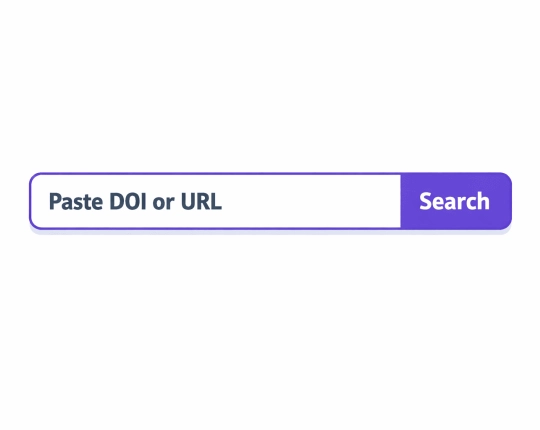
A solid result often starts with one clean identifier. Use a DOI for journal articles, an ISBN for books, an ISSN for journals, or a URL for web pages. Many tools pull metadata from that input, then format the entry in ACS style.
Stable Numbering from First Cite to Final Draft
ACS numerical style links every source with one number. Once a source gets a number, that number stays the same each time you cite the same work again. That single rule saves many edits during late draft changes.
Choice of In-text Format without A Mixed System
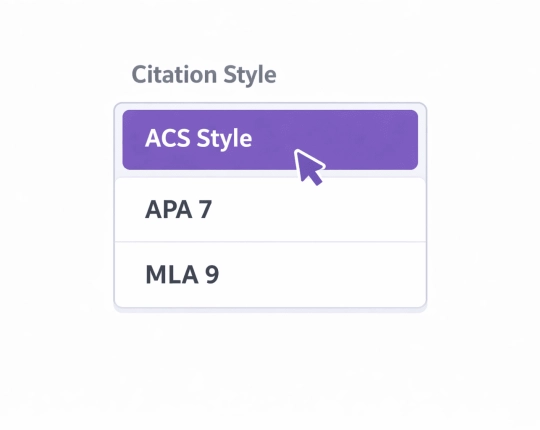
ACS allows more than one in-text approach. Most students pick either superscript numbers or italic numbers in parentheses, then keep the same method across the whole document. A mix creates confusion and often triggers corrections.
Clean Handling of Multiple Sources in One Spot
Sometimes one sentence needs more than one source. Numerical ACS style supports comma lists and ranges, so a set of citations still stays readable (for example, a range with an en dash).
Fast Copy and Paste With A Review Step
Generators can move fast, yet a short check still matters. Many pages that offer an ACS citation generator also tell users to review fields, then copy the final reference into the document.
Who Gains The Most from An ACS Citation Generator
Anyone who cites chemistry sources can benefit, yet some groups feel the impact more than others. ACS style often appears in chemistry courses and chemistry journals, so the same problems show up again and again.
Lab Report Students
A lab report tends to cite methods, spectra, handbooks, and prior studies. The numbered system helps when the report has short paragraphs with many claims. One renumber pass beats manual edits across a full reference list.
Thesis and Dissertation Writers
Long projects face one repeated pain point: new sources arrive late. Numerical order by first appearance can shift after one moved paragraph. A generator, combined with a strict “one source, one number” rule, reduces chaos.
Research Group Members
Group drafts often pass between people. One person cites with superscripts, another with parentheses, then both formats land in the same file. Pick one in-text system at the start, then hold that line across all sections.
Anyone Who Cites Web Pages or Datasets
Chemistry work often points to database records, supplier data, or lab safety pages. ACS references for web sources can require an access date, so the entry stays clear even if a page changes later.
How ACS Citations Work in Practice
ACS style comes from guidance by the American Chemical Society and related publication rules. In most student papers, the “numerical” approach is the default: in-text numbers point to a numbered reference list.
The Reference List Follows First Appearance
For numerical ACS, the reference list runs as one consecutive series, based on the order each work first appears in the text. Move a paragraph that contains the first mention of a source, and the numbering can change.
In-text Citations Use Numbers, Not Author Names
In text, you place the relevant number either as a superscript or as an italic number in parentheses. Choose one format and keep it across the full paper.
Repeated Citations Keep The Same Number
A source keeps its original number each time it appears again. No new number for the second mention. That rule helps readers track a source across multiple sections.
Multiple Citations Stay in Numerical Order
For more than one citation in the same place, list them in numerical order. Some guides also show ranges for consecutive sources.

How to Cite Common Sources with ACS Format
A good ACS format citation generator like that of Edubrain can cover many source types, yet the same key fields matter across formats: author, title, container (journal or book), year, and identifiers like DOI or URL where relevant.
- Journal articles. They often work best with a DOI, since the DOI points to a specific item even when journal sites change. If a tool retrieves odd metadata, fix author initials, journal title, year, volume, and page range before copy.
- Books and book chapters. Books often rely on ISBN metadata, yet editions and editors can complicate results. Check publisher, place, edition, and chapter pages when the source is a chapter within an edited book.
- Web pages. These often need an access date in the reference entry. That access date makes sense when the content can change without notice. Check the organisation name when no clear individual author appears.
- Patents and technical reports. Patents and reports often have long titles and formal identifiers. A generator may find part of the data, yet a manual check still helps, especially for issuing body, report number, and year.
- Videos and other media. Some tools also support videos and other online media. After the generator output, confirm the platform, title, and date fields, since media pages often store dates in more than one place.
What to Check Before The Final Copy
An ACS citation generator free page can still return messy fields. A fast review prevents the most common problems.
- Author names and initials. ACS commonly uses surnames plus initials. If a generator pulls full first names, trim where the chosen format requires initials.
- One in-text system across the full document. Superscript numbers and italic numbers in parentheses both exist in ACS guidance. Pick one early and stick with it.
- Number order after edits. After big structural edits, the first appearance of sources can shift. Recheck that the reference list order still matches the order sources first appear in the text. ACS publication guidance also stresses numbering by order of first citation.
- Missing data rules. If a web page has no author, many guides suggest the organisation name as author, or the title as the first element when no organisation fits. If a date is missing, an access date can cover web sources, while other sources may use “n.d.” based on guidance.
Common Mistakes and Fast Fixes
Small citation issues tend to multiply near the final draft stage. This quick table shows the most common ACS problems and the simplest way to fix each one.
| Common Mistakes | How To Fix It |
| Mixed citation styles in the same paper | A draft can start with parenthetical numbers, then later a co-author adds superscripts. Replace one system so the paper reads as one voice. |
| New numbers for repeated sources | Some drafts assign a new number each time a source appears. ACS numerical style does the opposite: the first number stays. Fix that first, then the rest becomes easier. |
| Weak metadata inputs | Title searches can return close matches. A DOI, ISBN, ISSN, or URL tends to produce a cleaner match, so start there where possible. |
| Incorrect order in the reference list | Alphabetical order belongs to author-date variants, not the numerical system most students use. If the paper uses numbers in text, the list usually follows numerical order by first appearance. |
Explore More Citation Styles



 Unlimited AI homework help

 Diagram Generator, Flashcard Maker, Notes Generator, Research Assistant, Answer Generator, AI Homework Helper & AI Detector