

APSA Citation Generator for Political Science Papers and More
Are you sure you you want to delete all the citations in this list?
Benefits That Matter In An APSA Citation Generator

Better Page Consistency
When you use a clear author-date system, Edubrain keeps citations uniform throughout your paper, which results in a clean, professional document where readers can easily track sources.
Accurate Page References
You can add page numbers for quotes, tables, or specific claims that ensure precise citations. These guide readers straight to the exact part of a source.
A Readable Reference List
Alphabetized entries and standardized author names make the reference list organized and easy to scan, even when it includes many sources.
Multiple Source Types Handled Smoothly
Including books, articles, reports, and websites in a single bibliography keeps the list cohesive and reliable, no matter the variety of sources.
How to Use the APSA Generator
The Edubrain APSA generator is easy to use. Here’s how it works:
- Start from a reliable source identifier.Use a DOI, ISBN, or stable URL to pull accurate source details. If no identifier exists, a title search can work, but check the match quickly.
- Create one reference entry per source.List each source once in the reference list and reuse it wherever it appears. This applies to the main text, notes, and figure or table references to keep entries aligned.
- Apply one in-text habit consistently.Place author names either in the sentence or in parentheses with the year. Keep the same approach across the draft, especially in collaborative work, to prevent formatting drift.
- Store, export, and separate projects.Save sources in projects or folders to keep work organized across papers. Export to a word processor to finalize edits without rebuilding the reference list.
Who Gains The Most From An APSA Citation Generator
Some writers handle APSA rules every week. For them, a generator cuts down cleanup time and keeps the paper consistent. Let’s see which categories benefit the most from it:
- Political science students: Course papers often mix journal articles, books, and policy material. APSA author–date citations show up again and again, so one small format slip can repeat across pages.
- Journal submission authors: APSA journals follow author–date, not notes plus bibliography. For that reason, complete publication details matter early, not only right before submission.
- Group projects: A shared APSA citation generator like that of Edubrain keeps one format for every source.
- Writers who cite web sources and government material: Many pages list an organisation as author, or show no person name. APSA allows organisation authors and clear fallbacks when no author appears.

How APSA Citations Appear Inside A Paper
Parenthetical Citations Sit Near The End Of The Sentence
APSA style places a citation in parentheses near the sentence end, before punctuation in most cases. With quotation marks, the citation sits after the closing quotation mark and before the punctuation.
Author And Year Stay Close, With No Comma
The base form uses author last name plus year, with no comma between them. If the author name appears in the sentence, the year follows in parentheses.
Multiple Sources Share One Set Of Parentheses
When a sentence points to more than one source, APSA shows the sources in one set of parentheses, separated by semicolons, and the set follows alphabetical order.
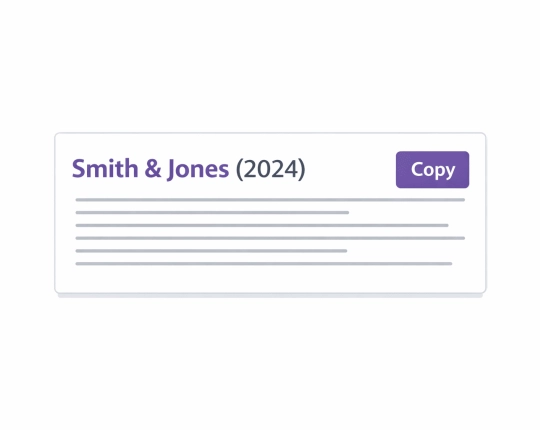
APSA Citations For Common Source Types
APSA citation style follows Chicago author–date logic in most cases, with APSA-specific details for political science work. That means the same core fields show up across formats: author, year, title, and source.
- Journal Articles. Check author order, year, article title, journal title, volume number, issue number, page range, and DOI or URL.
- Books. Confirm author, year, title, city, and publisher. Edited books add editor details for chapters.
- Chapters In Edited Books. Verify chapter author and title, book editor, book title, publisher details, and page range.
- Websites. Check author as a person or organization, publication date when present, page title, site name when it fits the source, and URL. For sources with no author, APSA guidance allows the organization as author, or the title as the first element when no organization fits.
- Government Documents And Reports. An agency name often acts as the author. Long agency names can use an acronym after a first full citation, per common APSA guide practice.
Reference List Structure For APSA Style
This table sums up the key reference list rules in APSA style. It shows the main case, the rule you follow, and a short example so you can check your references fast before final copy.
| Case | Rule | Example |
| Name Format And “And” Usage | The first author name appears inverted in the reference list (last name first). Additional authors do not use inversion, and APSA asks for and rather than “&” before the final name. | Smith, John, and Maria Lopez. |
| “Et Al.” In The Reference List Has Limits | APSA guidance avoids et al. in a reference entry unless a work has ten or more authors. In that case, list the first seven, then use et al. | Smith, John, Maria Lopez, …, and et al. |
| Organization As Author | When a source comes from an organization and no person author appears, list the organization as author, even when the same organization also acts as publisher. | World Bank. 2021. Title. |
| Title As First Element When No Author Exists | If no author, editor, translator, or sponsoring organization appears, start the reference entry with the title. | Title of Report. 2019. |
Explore More Citation Styles



 Unlimited AI homework help

 Diagram Generator, Flashcard Maker, Notes Generator, Research Assistant, Answer Generator, AI Homework Helper & AI Detector