

System of Equations Calculator
Solve Equation Systems With Confidence

Multi-equation solving
Solve two, three or more equations at the same time without substitution.
Step-by-step solutions
The calculator describes elimination, substitution, or matrix techniques that are involved in the process.
Supports linear and nonlinear systems
Solve simple linear equations and quadratic or higher-order systems.
Handles multiple variables
Solves systems with two or more unknowns in a single calculation.
Classifies solution types
Identifies unique, infinite, or no-solution systems automatically.
Introduction to the System of Equations Solver






Featured in




What Is a System of Equations?
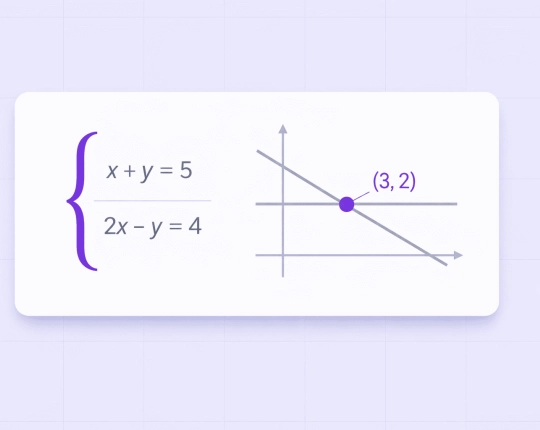
A system of equations is a collection of two or more equations that share common variables. The objective is to find values that satisfy all equations simultaneously.
Example:
\( x + y = 10 \)
\( x – y = 2 \)
The solution must satisfy both equations at the same time.
A system of equations calculator determines this intersection automatically.
Systems appear in algebra, economics, engineering, and data modeling, where multiple conditions must be satisfied together.
Types of Equation Systems
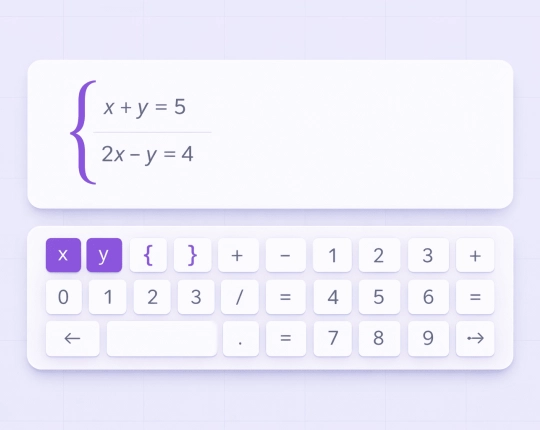
Most systems encountered in algebra are linear, meaning all equations form straight lines when graphed. Solutions occur where lines intersect.
- Linear systems
All equations form straight lines when graphed. Solutions occur where lines intersect. - Nonlinear systems
At least one equation includes powers, roots, or curves. Solutions may involve multiple intersection points. - Dependent systems
Equations represent the same line, producing infinitely many solutions. In these cases, both the coefficients of variables and the constant terms are proportional. - Inconsistent systems
Equations never intersect, meaning no solution exists.
The calculator identifies which case applies before presenting results.
Methods Used to Solve Systems
There are multiple algebraic approaches to solving systems of equations.
- Substitution method
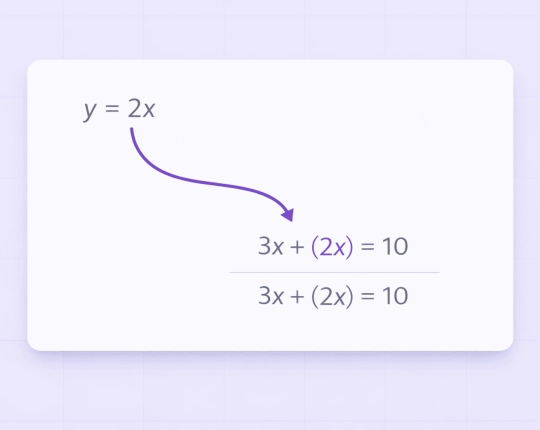
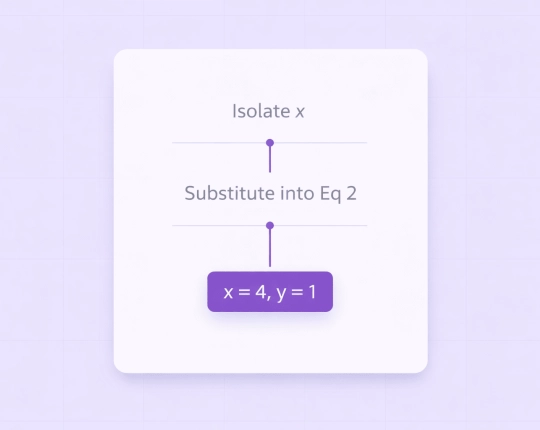
One variable is isolated, for example \( x = 5 – y \), and then substituted into another equation. - Elimination method
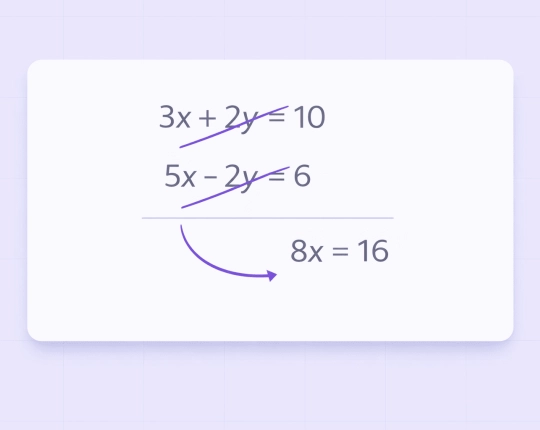
Equations are added or subtracted to remove one variable, such as combining \( x + y = 10 \) and \( x – y = 2 \). - Matrix method
Uses matrices and determinants, for example solving a system written as \( AX = B \) by computing \( X = A^{-1}B \).
A system of equations calculator automatically selects the most efficient approach.
Graphical Interpretation
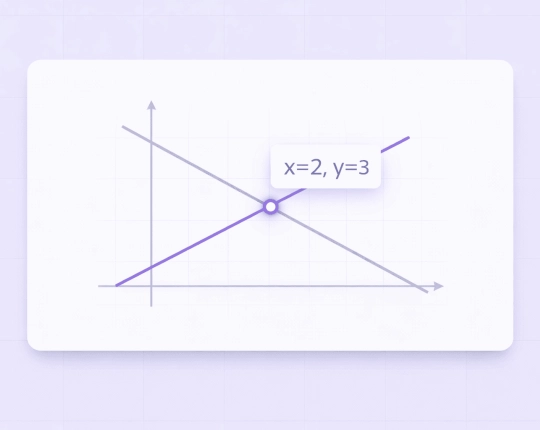
Graphically, each equation represents a line or curve. The solution to the system is the common point where the graphs intersect.
- One intersection (common point of two lines) → one solution.
- Multiple intersections → multiple solutions.
- No intersection (parallel lines or no common point) → no solution.
For example, two linear equations such as \( y = 2x + 1 \) and \( y = -x + 4 \) intersect at a single point that satisfies both equations.
Visualization helps students understand algebraic outcomes beyond symbolic manipulation.
Solving Linear Systems Step by Step
Consider:
\( 2x + y = 9 \)
\( x – y = 1 \)
Step 1: Add equations
By adding the two equations, you eliminate \( y \) and obtain: \( 3x = 10 \)
Step 2: Solve for \( x \)
Now you have a single equation involving one variable. Solve: \( x = \frac{10}{3} \)
Step 3: Substitute back
Substitute \( x \) into one of the original equations to solve for \( y \): \( y = \frac{7}{3} \)
This process gives a single (unique) solution to the system, as described in the previous section.
A system of equations calculator performs these operations instantly while displaying each algebraic step.
Nonlinear Systems
Nonlinear systems differ from systems of linear equations involving two or more variables. Nonlinear systems include powers or curves.
Example:
\( y = x^2 \)
\( y = 4x – 3 \)
Solving requires substitution and quadratic solving. In such cases, tools like a quadratic formula calculator with steps assist when polynomial equations emerge within the system.
These systems may produce multiple real or complex solutions. Nonlinear systems may also have an infinite number of solutions, and in some cases, you may be interested in finding integer solutions only.
Factoring in Equation Systems
Factoring simplifies polynomial systems before solving.
Example:
\( x^2 – 5x + 6 = 0 \)
Factoring gives:
\( (x – 2)(x – 3) = 0 \)
This reveals solution candidates directly. A factoring calculator accelerates this step when systems involve higher-degree polynomials.
Systems and Inequalities
Some real-world problems involve inequality systems rather than strict equations.
Example:
\( x + y \le 10 \)
\( x \ge 2 \)
Such models define solution regions rather than points. A dedicated inequality calculator visualizes these regions and complements system solving.
Real-World Applications
Systems of equations appear across industries.
- Economics
Supply and demand equilibrium models rely on solving systems such as \( Q_d = Q_s \). - Engineering
Circuit analysis and force distribution require simultaneous equations like \( V = IR \). - Computer graphics
3D rendering uses systems to calculate perspective and intersections of equations such as \( ax + by + cz = d \). - Statistics
Regression models depend on solving multiple variables together, often expressed in matrix form \( AX = B \). - Logistics
Optimization problems use equation systems to balance constraints such as \( x + y \le 100 \).
A system of equations calculator simplifies these complex evaluations.

Common Mistakes When Solving Systems
Students frequently encounter avoidable errors:
- Sign mistakes
Incorrect addition or subtraction alters elimination steps, such as miscalculating \( x – y \) when combining equations. - Substitution errors
Failing to replace full expressions, for example substituting only part of \( x = 5 – y \), causes invalid results. - Ignoring multiple solutions
Nonlinear systems such as \( y = x^2 \) may produce more than one valid answer. - Stopping too early
Partial solving leaves variables undefined, meaning a system like \( 2x + y = 9 \) and \( x – y = 1 \) is not fully resolved until both \( x \) and \( y \) are found.
Automation ensures consistent, validated outcomes.
Explore More Calculators


Choose your plan
Free plan
- Unlimited use with ads included
- Free access to all AI tools
- Download all responses (answers, presentations, flashcards, etc.)
- Share responses with others
AI-Plus
- Expert reviews on discounted prices
- Ad-free experience to:
- AI detector
- Diagram generator
- PowerPoint generator
- Answer generator
- Flashcard maker
- Notes generator
- Research assistant
- Download all responses (answers, presentations, flashcards, etc.)
- Share responses with others
- Advanced reasoning
Expert help
- Presentations (human-made)
- Homework help
- STEM support
- Writing assistance
- Editing & proofreading

 Unlimited AI homework help

 Diagram Generator, Flashcard Maker, Notes Generator, Research Assistant, Answer Generator, AI Homework Helper & AI Detector