
In a world where technology increasingly defines our interactions, using AI for flirting is no longer a futuristic concept —...

Accounting vs Economics: Which Path to Choose?
When exploring fields in numerical analysis, finance and economics often emerge as leading options. But what’s the difference? If you are weighing accounting vs economics, or trying to understand the difference between finance vs accounting disciplines, you are not alone. I’ve written this article while our team has been working on the new accounting AI homework solver tool. In this article, I’ll define both fields, compare their similarities, and explore the distinct career paths and potential earnings for professionals in each area.

The Essentials of Accounting
Most people interact with an accountant during tax season, but these professionals play a vital role year-round. An accounting career concentrates on the precise recording, analysis, and reporting of financial transactions for individuals or corporations. These records act as a historical snapshot and must follow generally accepted accounting principles (GAAP).
Modern accounting practices rely heavily on technology. Professionals use accounting information systems to track budgets, expenses, and revenues. The field’s core accounting focuses heavily on precision and compliance. To achieve this, the discipline is broken down into specific areas. These include financial accounting, which provides financial reporting to external shareholders, and managerial accounting, which helps internal leaders execute business strategies. Ultimately, this field focuses on the practical management of wealth and resources.
Accounting
Accounting is the backbone of any business. It provides the structured financial language necessary for organizations to communicate their health to stakeholders, regulators, and internal management. It ensures transparency and builds trust in the financial markets.
Accounting Majors
Accounting majors are heavily recruited straight out of college. Because every business, non-profit, and government entity needs financial oversight and tax assistance, graduates often have job offers lined up well before they even walk across the graduation stage.
Accounting Career
An accounting career offers remarkable stability. Even during economic downturns, businesses require tax preparation, audits, and financial restructuring, making accounting one of the most recession-resistant professions available.
Introduction to Economics
While accounting looks at precise financial records, economics studies how societies produce, consume, and distribute goods and services. An economist shapes economic policies, forecasts trends, and assesses regulatory impacts using complex economic data.
The discipline of economics include two primary branches. Macroeconomics focuses on the economy as a whole, addressing broad economic systems, efficiency, and inflation. Microeconomics concentrates on individual choices within the economy and how they influence the distribution of resources.
Understanding these economic concepts and applying economic theory is vital for predicting how changes in regulations might affect local, national, or global markets. For example, experts in international economics analyze cross-border trade and its impact on domestic financial markets.
Students comparing accounting vs economics often rely on an AI detector to ensure their research papers and comparative analyses maintain academic integrity and original thought.
Economics
Economics zooms out to look at the larger forces at play. It examines how human behavior, government policies, and global events influence the allocation of scarce resources. It is the study of choices and their consequences across different markets.
Studying Economics
Studying economics requires a high tolerance for ambiguity. You will spend your time looking at variables that constantly change, trying to map out logical outcomes for scenarios where human irrationality often plays a major role.
Table of Content
ToggleDifferences Between Economics and Accounting: What’s the Difference?
| Feature | Accounting | Economics |
| Core Focus | Practical management of wealth, exactness, and regulatory compliance. |
Theoretical analysis of resource allocation, production, and consumption.
|
| Scope | Micro-level: Company-specific financial accuracy and historical snapshots. |
Macro & Micro-level: Broad market trends, global patterns, and policies.
|
| Data Usage | Used to ensure exactness, audit trails, and adherence to rules (like GAAP). |
Used to test behavioral theories, build models, and forecast future market behavior.
|
| Degree Focus | Highly practical: financial reporting, taxation, and auditing standards. |
Highly analytical: statistical data, complex systems, and supply/demand forces.
|
| Typical Careers | CPA, Auditor, Forensic Accountant, Corporate Financial Analyst. |
Economist, Market/Risk Analyst, Public Policy Advisor, Strategy Consultant.
|
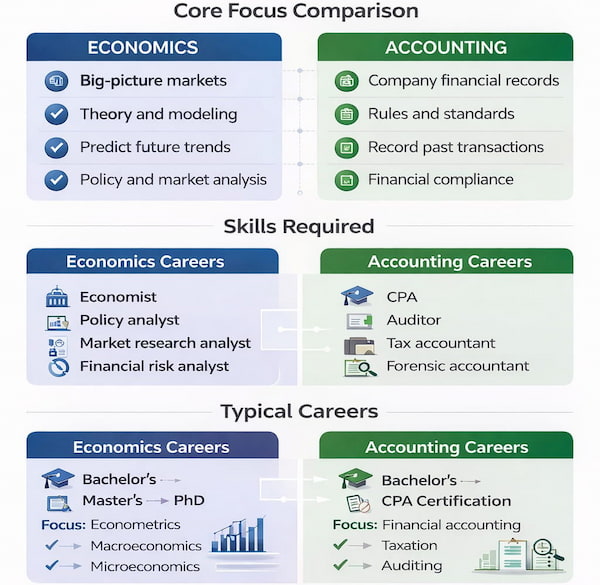
If you are wondering, accounting or economics: which is the right choice?, it comes down to their core application. While there is some overlap, as both require a strong understanding of financial principles, the differences between economics and accounting become clear in their daily responsibilities. The main difference lies in their scope: accountants handle detailed, historical financial operations, whereas economists use theory to project future market trends.
Regarding their roles, economics analyzes broad market trends and policies, while accounting manages detailed financial transactions. In terms of focus, economics looks at global patterns, supply, and demand, whereas accounting focuses on company-specific financial accuracy and compliance. When it comes to data usage, economics uses data analysis to test theories and forecast, while accounting uses data to ensure regulatory compliance and exactness.
Vs
When looking at the two fields vs one another, the distinction often comes down to rules versus theories. Accounting is governed by strict rules, compliance, and historical accuracy, while economics relies on behavioral theories and data to forecast future market behavior.
Analyst
The title of analyst is common in both fields but carries different daily duties. A financial analyst with an accounting background might dig into company spreadsheets to improve efficiency, while an economic analyst might evaluate how new trade tariffs affect industry-wide production costs.
Educational Trajectories of Accounting vs Economics
Choosing a major or degree program shapes your future. Whether you opt for a finance degree, an accounting degree, or an economics degree, the foundational skills required are similar: robust quantitative skills, basic math, and finance principles.
- Degree in Accounting:
Accounting degree programs prepare you for immediate, hands-on application. Accounting students take classes in financial statement analysis, taxation, and fundamental accounting courses. Because accuracy is paramount, students must develop strong attention to detail. Universities globally, from local state schools to institutions like Birmingham City University, emphasize these practical competencies.
- Economics Degree:
Studying economics is generally more theoretical. Economics students develop advanced analytical skills to evaluate broad trends like inflation, unemployment, and trade.
Both fields generally require a bachelor’s degree as a starting point. However, many students in accounting and economics pursue advanced qualifications. An accountant may seek certifications, while economists often pursue a master’s degree or Ph.D. to move into leadership or research roles.
While accounting focuses on tracking past financial transactions, economics often involves modeling future trends using calculus. For students analyzing complex economic growth rates or marginal costs, using a derivative calculator can help simplify the mathematical modeling required to understand these differences.
Major
Choosing your major is a significant milestone that shapes your daily university experience. If you thrive on exactness and balancing ledgers, lean toward accounting. If you prefer debating policy impacts and analyzing broad market trends, an economics major will keep you engaged.
Economics Degree
Earning an economics degree trains you to think critically about complex systems. You learn to build models, analyze statistical data, and understand the push and pull of supply and demand on both a macro and micro level.
Accounting Degree
An accounting degree equips you with highly practical, immediate skills. You learn the rules of financial reporting, tax regulations, and auditing standards, ensuring you are ready to step directly into a corporate finance or public accounting role.
Accounting Degree Programs
Modern accounting degree programs have evolved well beyond basic bookkeeping. They now incorporate data analytics, information systems training, and advanced forensic techniques to keep pace with the digital transformation in finance.
Degree Program
Whichever degree program you select, expect rigorous coursework. Both disciplines require a strong foundation in mathematics, statistics, and business ethics to prepare you for the challenges of the professional world.
Degree in Accounting
Holding a degree in accounting serves as a powerful professional credential. It signals to employers that you possess a strong work ethic, high attention to detail, and a deep understanding of the financial laws that keep a business compliant and profitable.
Career Paths and Opportunities

Both disciplines open doors to lucrative career opportunities. What specific jobs can you expect?
Accounting Jobs
Many accounting graduates enter the corporate world immediately, and specific accounting graduates pursue roles focused on precision and law. An individual might become a certified public accountant (cpa), ensuring corporate compliance. Accounting majors can also become a public accountant offering accounting services to various clients, an auditor conducting a rigorous audit to review company accounts, or specialize in forensic accounting to investigate fraud. A deep understanding of tax law is highly valued here.
Economics Jobs
Those who study economics often lean towards career paths in public policy, corporate finance, or consulting. You might work as a market research analyst, a risk analyst, or even a financial risk analyst. A specialized economist could work for the government or central banks, while a general analyst might advise private businesses on efficiency.
When looking at vs finance roles, you will find that careers in both fields are highly respected and essential to the business ecosystem.
Career Paths
The career paths for both fields diverge quickly after graduation. While accountants typically move through the ranks of public accounting firms or corporate finance departments, economists might find themselves in government agencies, think tanks, or strategy consulting firms.
Career Opportunities
Ultimately, the career opportunities in either field are vast and highly rewarding. Whether you want to advise government leaders on monetary policy or help a rapidly growing tech startup navigate its first public offering, both disciplines offer a front-row seat to the financial world.
Earnings and Prospects
When weighing accounting vs your other options, salary is naturally a factor. According to the Bureau of Labor Statistics, both fields offer competitive pay and stability.
A CPA or auditor can expect a solid starting wage, which grows significantly with experience and firm size. Economists, on average, have a higher median salary, particularly those working for the federal government or large international organizations. Both paths offer excellent benefits, but compensation ultimately depends on your education, location, and the specific quantitative or analytical demands of your role.
When comparing accounting and economics data, visualizing overlapping variables becomes much simpler if you use a radar chart maker to create clear, multi-axis diagrams.
Salary
Salary expectations in both fields are promising and scale well with experience. While economists often boast a higher median starting salary due to the advanced degrees typically required, accountants have massive earning potential once they secure their CPA and move into management.
Economics vs. Accounting: How to Choose
Deciding the right path depends heavily on your interests and career goals. Both economics and accounting offer unique, rewarding ways to achieve your broader career goals.
Do you prefer the certainty of exact numbers and ensuring compliance? If so, the traditional route leans toward accounting. If you thrive on theoretical models, analyzing global trends, and understanding how policies impact populations, an economics degree is likely the better fit. Whether you are driven by the micro-details of a corporate ledger or the macro-forces shaping the global economy, these professions provide the chance for a highly successful and meaningful career.
Frequently Asked Questions
What is the main difference in accounting vs economics?
Should I study accounting or economics?
What is the difference between finance vs accounting and economics?
Do I need to become a certified public accountant to have an accounting career?
What is the salary difference according to the Bureau of Labor Statistics?
Explore Similar Topics
Finance is the study of money management and financial markets. The graduates of this major will earn skills valuable to financial-driven sectors....
Exploring the universe and its mysteries has never been more accessible. With the advent of online education, earning a Physics...