“Help me find the cheapest pair of socks available online.” “Help me create my own language.” “Show me what my...

AI Makes Gen Z More Productive, but Also More Mentally Drained
There’s a new kind of tiredness. People call it AI brain fog.
It’s not like being worn out after a long run or a day packed with meetings. It’s not even the good kind of tired you get from real mental effort. Instead, it’s quieter and more confusing — the feeling of ending a light workday and still feeling completely drained.
You let AI draft your emails. You let it summarize your reports. You spent the afternoon prompting it for help. But by 6 pm, your mind feels like it’s been running in the background all day, with 20 tabs open and none of them fully loaded.
EduBrain, an AI-powered platform designed to support students with their academic journeys, set out to understand what this new kind of tiredness actually looks like in numbers.
Table of Content
Toggle5 Key Insights on AI Impact on Gen Z at Work
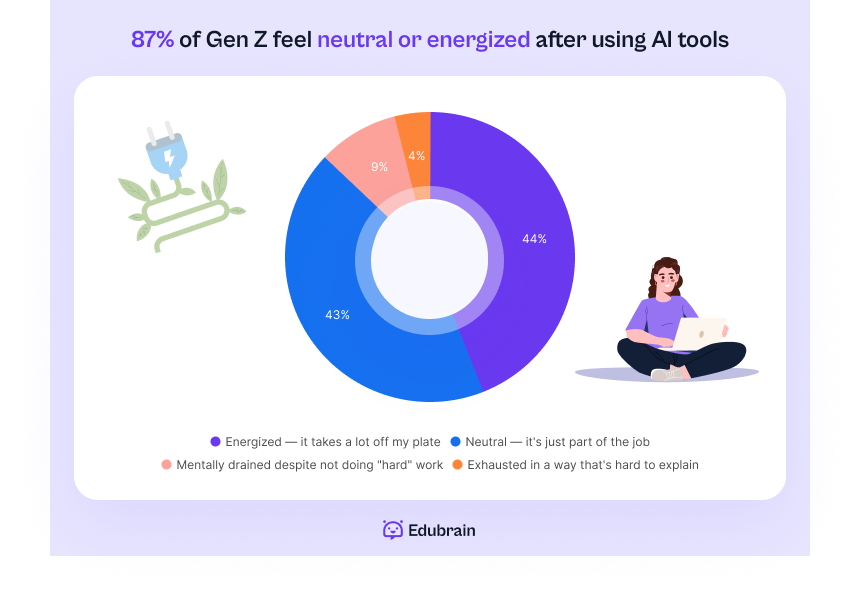
- 87% of Gen Z feel neutral or energized after AI-heavy work, but the symptom data tells a more complicated story.
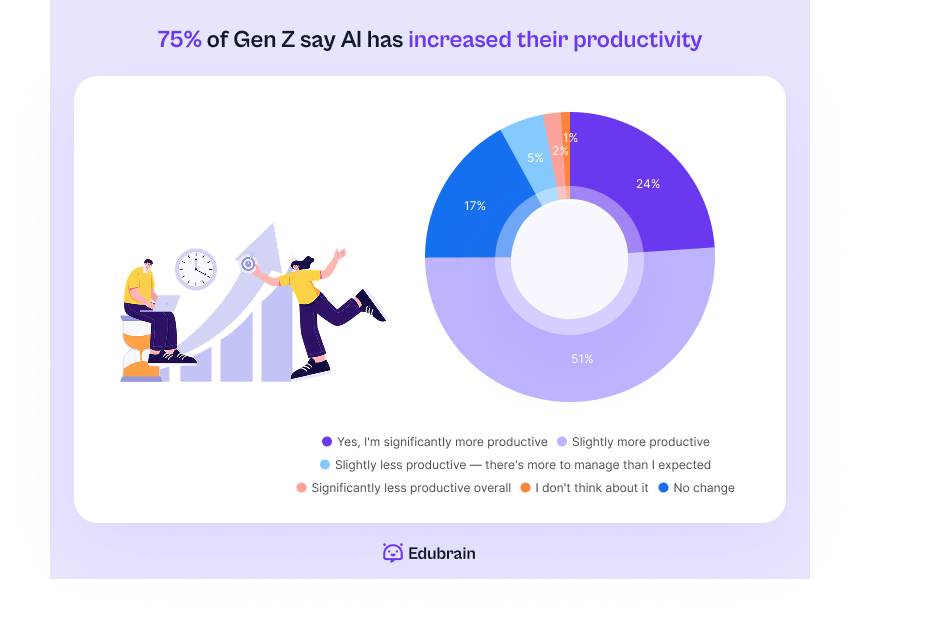
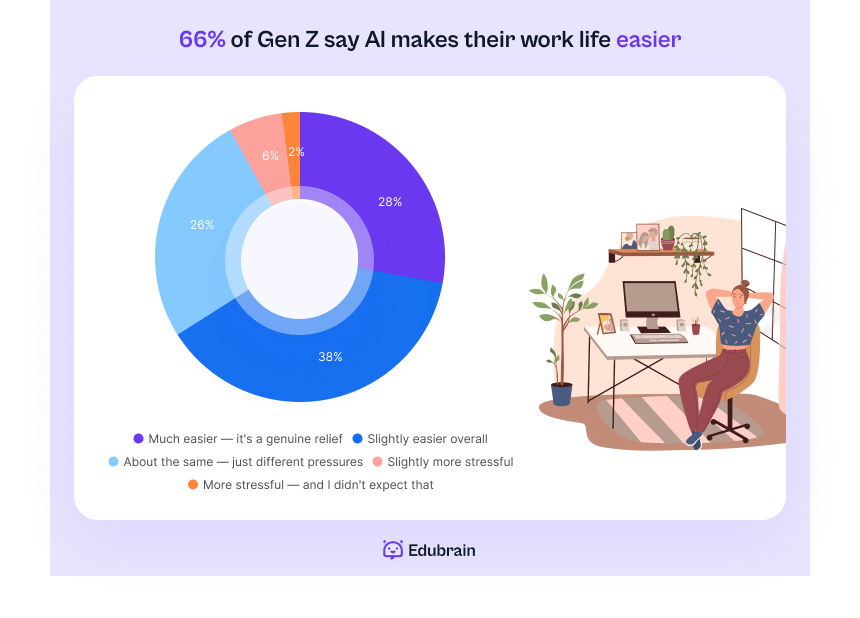
- 75% say AI has made them more productive; 66% say it makes work life easier overall.
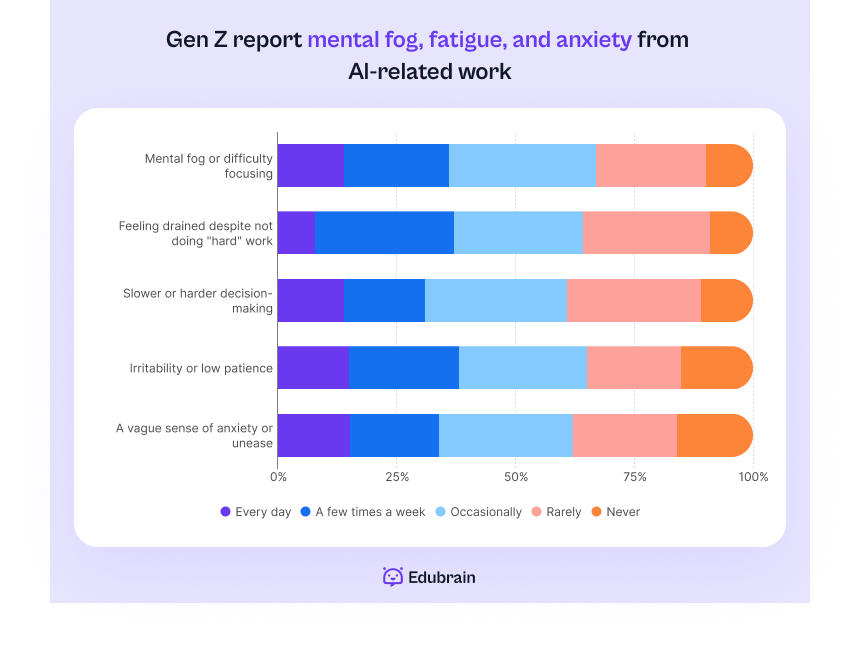
- 36% of Gen Z experience mental fog or difficulty focusing on a daily or near-daily basis as a result of AI-related work.
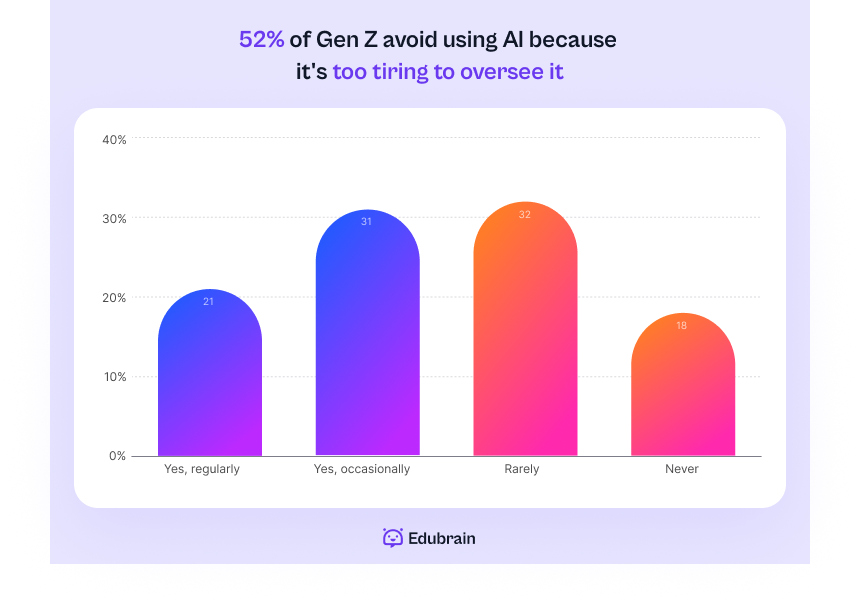
- 51% have avoided using AI specifically because they found it too mentally tiring to oversee.
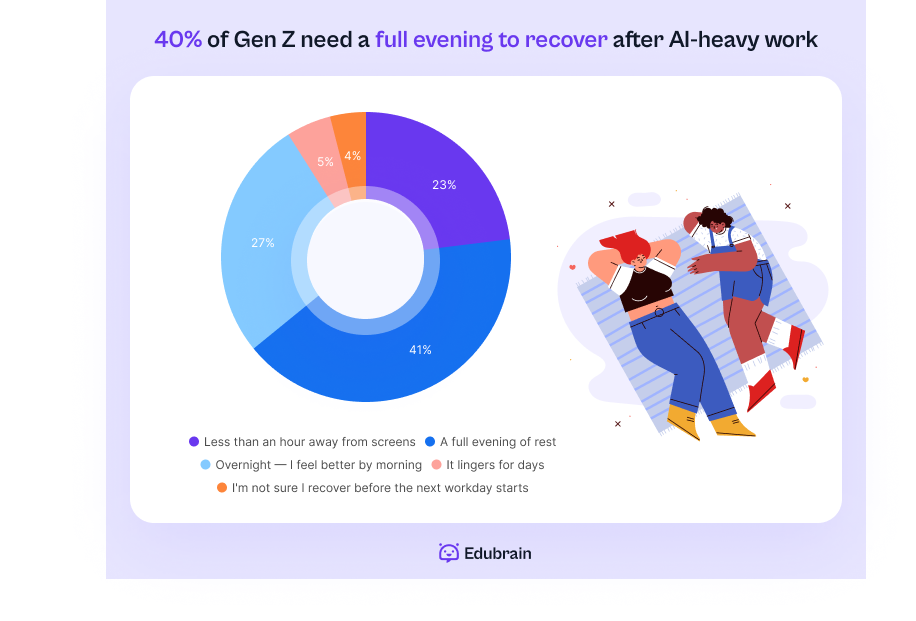
- 40% need a full evening of rest to recover after an AI-heavy workday.
🔍 EduBrain’s new survey of 3,000 Gen Z workers suggests the problem isn’t that AI doesn’t work. It’s that using AI has become another form of work. We wanted to see how these tools are changing how people think and feel at work (including productivity, efficiency, and mental well-being). Gen Z is not rejecting AI. They use it, they benefit from it, but they also feel the cost.
The Productivity Promise: Real, but Not the Whole Story
🤖 Let’s start with the good news: AI is actually working.
For Gen Z, this is not just another workplace tool that sounds impressive and then disappoints by Tuesday.
- 75% of Gen Z workers say AI has made them more productive.
- Of those, 24% say they are significantly more productive — not just a little, but in a meaningful way.
- Another 51% report being slightly more productive.
This matters because Gen Z isn’t just trying out AI from a distance. For many, it’s now a regular part of their workday. It helps cut blank-page panic, speeds up routine tasks, and makes boring admin work feel lighter.

The numbers about workload back this up.
- 66% say AI has made their work life easier.
- Of those, 28% call it a genuine relief.
- 38% say things are slightly easier overall.
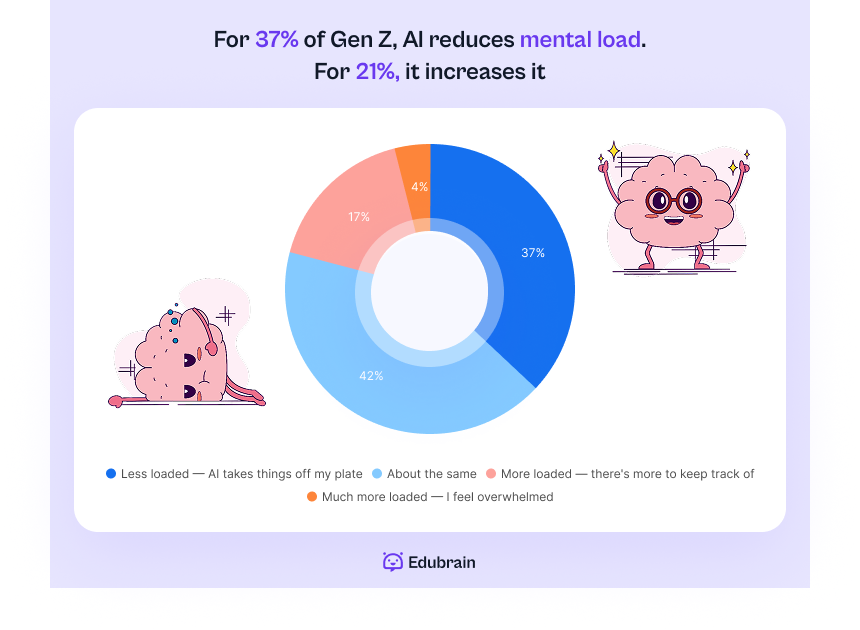
For the 37.2% who say AI has lowered their mental load, the change is practical. They spend less time on emails, summaries, formatting, and sorting through messy notes.

But here’s the catch: getting things done faster doesn’t always make work feel easier.
17% say their mental load has increased since they started using AI. The work itself isn’t harder, but AI brings a new kind of invisible work. It includes constant checking, correcting, figuring out what to trust, and fixing results that sound right but might be wrong.
⚖️ The real question isn’t whether AI helps, but what it costs and who will pay for it.

The Upside: AI Makes Gen Z Sharper in the Ways That Count
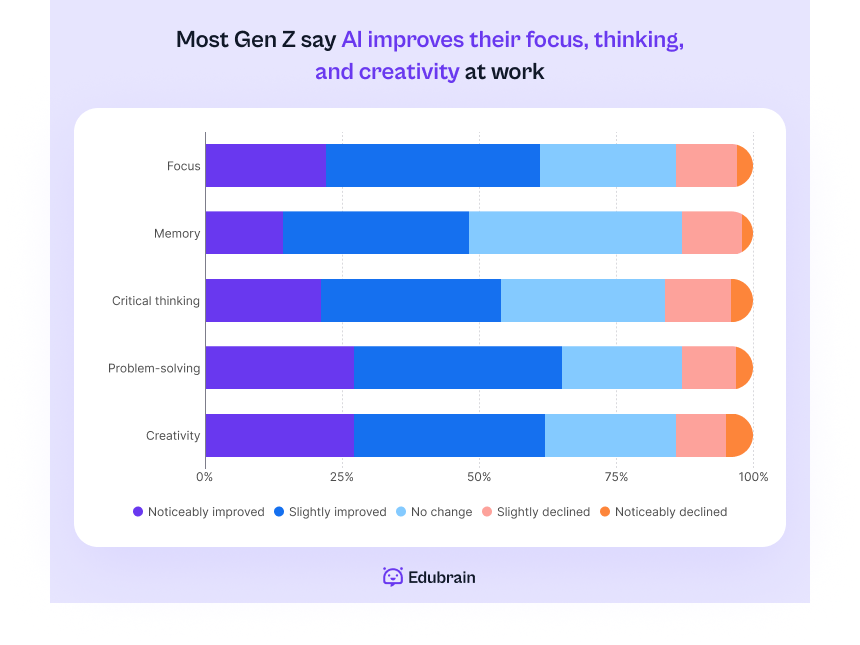
Before we talk about the downsides, it’s important to give AI some credit. For many Gen Z workers, AI isn’t making them less capable. Instead, it’s helping them improve the skills that matter most at work.
The biggest improvements are in problem-solving (65% reporting progress) and creativity (62%). These skills are especially valuable because employers say they want people who can connect ideas, solve tough problems, and think beyond the obvious.
Focus got better for 61% of people, and 54% saw an improvement in critical thinking. When used well, AI acts like a helpful co-pilot. It handles repetitive tasks, clears distractions, and lets people spend more time on the interesting parts of their jobs.

🧠However, memory is a weaker area. Only 48% said they improved here, which is the lowest among the five skills measured.
This makes sense. When AI remembers, summarizes, and organizes everything for you, it’s easy to stop keeping information in your own mind. It’s convenient, but it could become risky over time.
This is the trade-off to keep an eye on. Gen Z may be getting better at creative and analytical work. However, they start to rely less on deep memory, which helps knowledge last longer.
Even so, the overall picture is positive. Gen Z isn’t becoming less capable because of AI — they’re just developing different strengths. The question is whether workplaces know how to make the most of these new abilities.
Something Feels Off: The Symptoms No One Is Officially Reporting
Things get more complicated at this point. We asked Gen Zers about the cognitive and emotional symptoms they experience in AI-heavy jobs. Interestingly, their responses did not align with the positive headline numbers.
- About 36% say they deal with mental fog or trouble focusing almost every day.
- Roughly 37% feel worn out, even though they are not doing what they consider hard work as often.
- About 34% regularly feel irritable or less patient.
Another 34% say they often feel a vague sense of anxiety or unease, a feeling that does not have a clear cause. This may be the most unsettling finding.

Researchers call these symptoms cognitive fatigue from low-agency, high-monitoring work. When people hand off tasks to AI but still have to watch over, correct, and approve the results, it is mentally demanding (even if each task seems easy). Their attention is spread out in a way that doesn’t feel tiring at the moment. However, over the course of a day, it adds up and becomes hard to shake off.
It is notable that 87% of Gen Z say they feel neutral or energized after AI-heavy work, even though they often report these symptoms. This shows there may be a gap between how they see themselves and their actual mental state. Many may have gotten used to a constant level of tiredness, so it no longer feels unusual.
😵💫When exhaustion becomes normal, it stops feeling like a symptom. And it’s not OK.

The AI Hangover 40% of Gen Z Carries Into Tomorrow
If the symptom data is the diagnosis, the recovery data is the prognosis — and it is sobering. We asked how long it takes to recover after an AI-heavy day:
-
- 41% of Gen Z say they need a full evening of rest.
- 23% say they recover in less than an hour away from screens.
- 27% feel better by morning.
- 5% say the fatigue lingers for days.
- 4% are unsure they will recover before the next workday begins.
That means one in ten Gen Z workers deal with ongoing, unresolved mental fatigue. What’s worse, it brings yesterday’s AI-related stress into today’s work.

This is where the productivity story starts to wobble
🔋If a tool makes you 20% faster but leaves you 30% more tired the next day, it is not a real improvement.
Right now, most conversations about using AI at work focus on output: how many tasks get done, how much time is saved, and how many mistakes are avoided. Very few discussions look at input: how much energy workers have left at the end of the day, whether they start the next day feeling refreshed, and how ongoing fatigue affects retention, creativity, and judgment over time.
For organizations with Gen Z employees, this is a real issue. Burnout does not happen all at once; it builds up slowly, just like this kind of fatigue, until someone stops coming to work or loses motivation. Recovery data can serve as an early warning sign, but most employers are not yet paying attention to it.
AI Saves Time, Until You Have to Babysit It
Anyone who has asked AI for help, then spent the next 20 minutes checking whether the answer was real, will recognize this part.
- More than half of Gen Z workers (52%) have avoided using AI because they find it too mentally tiring to supervise.
- Of these, 20% avoid it regularly.
- 30.8% do so occasionally.
This is not just a small, skeptical group. It is the majority of the generation most comfortable with these tools. Nevertheless, they choose to avoid them in certain situations because the effort required to manage AI outweighs the benefits.

The open-ended responses show what this extra effort looks like in real life:
🟣 A quarter of Gen Z workers say that AI giving wrong information has made their jobs harder. This is the so-called hallucination problem, but described in everyday terms.
🟣 Another 12% point to the constant need to fact-check as the main issue. It is not just that AI can be wrong once; it could be wrong at any time. Accordingly, every result needs careful review.
This is the hidden cost that productivity metrics often miss:
- If AI helps finish a task 40% faster, but you have to review it twice as carefully as you would a human-written version, it might not save time at all.
The mental effort of reviewing (reading with doubt, spotting mistakes, and deciding what to trust) could be more tiring than just doing the task yourself. Gen Z has learned this through daily experience over the course of months.
Their choice to avoid AI is not fear of technology. It is a practical decision.
The Tools Arrived. The Support System Didn’t
Companies race to adopt AI, but many still treat the human side of AI work as an afterthought.
- When asked if their employer actively addresses the mental load from AI, 51% of Gen Z workers said no.
Some said their employer is aware but does little (22%), others said it hasn’t been considered (29%), and 10% said their employer is pushing for more AI use without recognizing the cost. Only 39% work at an organization that truly tries to manage the mental impact of adopting AI.
Researchers from Edubrain surveyed 3,000 Americans aged 18-28 to compile this study. Randomly selected participants were asked to discuss their experiences, with no emphasis on a specific gender, ethnicity, or social background.
Explore Similar Topics
Have you ever been to a puppy or kitty therapy session that brings the kind of pure bliss no other...
Performing calculations in your mind may be challenging for many. It may be doing sums in a short time, tip-calculating,...