Organic chemistry often has a reputation for being one of the most challenging subjects in the field of science. For...

How to Balance a Chemical Equation: Balancing Reactions Easily

Chemical equations must be balanced so that the law of conservation of mass is followed. This law states that matter cannot be created or destroyed in an isolated system. Therefore, no matter is created or destroyed in chemical reactions, and all mass is perfectly conserved in chemical reactions.
Learning to balance equations is a critical skill to have in chemistry. The process equalizes the number of atoms of each type of atom on both sides of the equation. It makes sure that the substances react fully without any atoms being lost or not being counted. People who work in chemical sciences need to know this method very well. It is the ground for stoichiometry and many other chemical calculations. If you are learning how to balance chemical equations, this guide will help you master the process.
Table of Content
ToggleComprehension of the Fundamentals
To balance a chemical equation might seem daunting initially, but it becomes manageable with practice. The essence of balancing equations lies in ensuring equal numbers of each element on each side of the equation. These are the steps to balance an equation:
- First, count the atoms on each side.
- Second, change the coefficient of one of the substances.
- Third, count the numbers of atoms again and, from there, repeat steps two and three until you’ve balanced the equation. Here is an example of a chemical reaction that needs balancing:
Here is an example of an unbalanced chemical reaction that needs balancing:
$$H_2 + O_2 \rightarrow H_2O$$
It sometimes gets pretty hard to get it right. If you feel like that, consider using an AI chemistry solver like Chemistry LibreTexts resources. Thus, you have everything in order. Visualizing each step can significantly improve your ability to grasp the necessary changes quickly. Remember, each equation solved adds to your foundation of knowledge.
Steps to Balance Chemical Equations
A vital skill in chemistry is the ability to balance chemical equations, which is done by carefully changing the numbers placed in front of the formulas. These numbers in front of chemistry formulas are called coefficients. They show how many molecules or moles are involved in the reaction. Never change a subscript, as that would change the chemical identity of the substance.
The goal is to ensure that the number of atoms for each element is the same on both sides of the chemical equation, adhering to the law of conservation. Let’s break down the steps involved.
Calculating Atoms
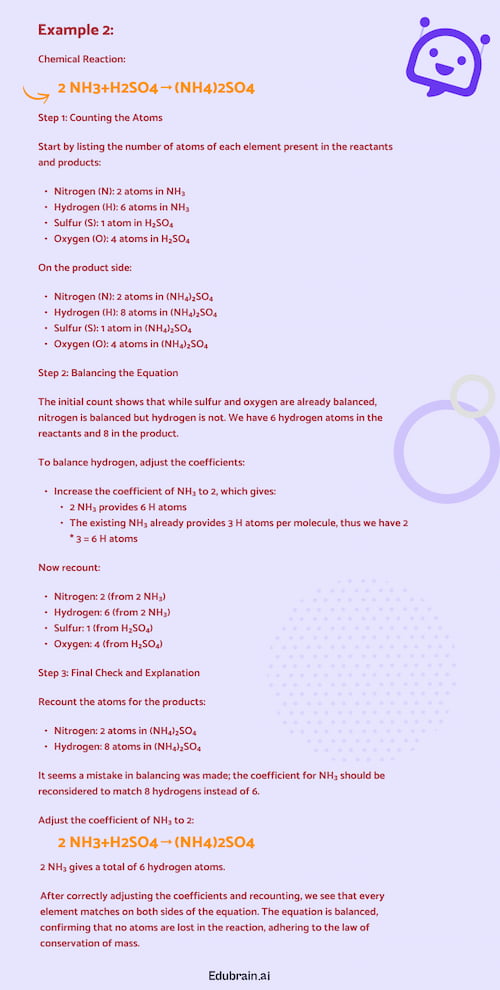
The first step is to list the number of each type of atom present in the reactants and products. For example, count the hydrogen atoms on the left side (the reactant side) and the one on the right side (the product side). This provides a clear initial view of which elements need to be balanced.
If you know exactly how many of each type of atom there are, you can change the coefficient without having to guess. This first step is necessary to correctly change the chemical formula and finally balance the chemical equation.
Variation of Coefficients
If the atoms aren’t balanced, the next step is to adjust the coefficients. This means changing the numbers before the chemical formulas. When picking new values, it’s best to begin by balancing the most difficult molecule, a polyatomic ion, or an element that appears only once on each side (focus on elements that only appear in one reactant and one product first).
You multiply the coefficient by the subscript to find the total number of atoms. To make sure that the balancing process is done completely, it is critical to think about how adding a coefficient affects the balance of other elements.
Recounting and Repeating
After adjusting, count the number of atoms of each element again. If any discrepancies remain, place a coefficient differently and repeat the process. This iterative process continues until the equation is balanced. At this point, it’s essential to be patient because jumping to conclusions too soon can lead to wrong balances. Every time the equation is changed, it gets closer to equilibrium.
Examples
To illustrate how to balance the equation, consider a simple chemical reaction: the combustion of methane.
$$CH_4 + O_2 \rightarrow CO_2 + H_2O$$
Starting simple, count the atoms for carbon, hydrogen, and oxygen.
- Reactant side: We have carbon atoms on the left (1 atom), h atoms on the left (4 atoms), and oxygen atoms (2 atoms).
- Product side: We have a carbon atom on the right (1 atom), h atoms (2 atoms in water), and oxygen (3 total).
The carbon atoms are already balanced (one atom of carbon on each side). To balance the two hydrogen atoms on the right with the four on the left, we place a coefficient of 2 in front of the $$H_2O$$
$$CH_4 + O_2 \rightarrow CO_2 + 2H_2O$$
Now we have four atoms of hydrogen on each side. Finally, we need to balance the oxygen atoms. We have two on the left and four on the right. We put a coefficient of 2 in front of the $$O_2$$
$$CH_4 + 2O_2 \rightarrow CO_2 + 2H_2O$$
The equation is now balanced.

Training Problems
Here are some practice questions to help you go about balancing equations.
Balance the equation for the reaction of iron (III) oxide with carbon monoxide to produce iron and carbon dioxide.
$$Fe_2O_3 + CO \rightarrow Fe + CO_2$$
Ensure that the atoms of each element (iron, oxygen, carbon) match on each side of the equation.
Determine the correct coefficients for decomposing potassium chlorate into potassium chloride and oxygen gas.
$$KClO_3 \rightarrow KCl + O_2$$
Adjust the coefficients to ensure that potassium, chlorine, and oxygen atoms on each side are balanced.
Provide the balanced chemical equation for the reaction of ammonia synthesis from nitrogen and hydrogen gas.
$$N_2 + H_2 \rightarrow NH_3$$
Balancing this equation involves careful attention to stoichiometry. To balance, you will need to add a coefficient to balance the hydrogen. You must use two molecules of hydrogen? No, you actually need a ratio. Try a coefficient of either 3 for hydrogen and a 2 in front of ammonia.
More Advanced Scenarios
Sometimes you need to balance complex reactions, like those involving an aqueous solution. For example, the reaction of an aqueous solution of sodium nitrate. Or perhaps you need to balance aluminum atoms and chlorine atoms in a synthesis reaction.
If you are struggling to balance the aluminum or balance the oxygen atoms, just remember the core rule: count the atom on the left and the atom on the right. If an equation is not balanced, you might need to add a coefficient of six, add a coefficient of four, or add a coefficient of 4 to fix it. Always double-check carbon and hydrogen and H and O atoms last.
Conclusion
Not only is balancing chemical equations a necessary skill, but it’s also a key part of getting a better knowledge of products of the reaction. It makes sure that the chemical equation for this reaction follows natural laws.
In order to balance properly, anyone can learn this important science skill by practicing and following the steps to balance: counting the atoms on each side, changing the coefficient (adding a coefficient), and recalculating. Doing practice problems will help you get better at learning how to balance chemical equations and boost your confidence.
Explore Similar Topics
The background of chemistry influences almost everything, from how we cook to how we use medicine. It is vital for...
Organic chemistry is often considered a tricky subject in college. It’s known for being challenging; many students might even need...