
Are you a high school student curious about chemistry? Many summer programs are available to help you explore this exciting...

Does Pass, Fail, or Affect GPA? How the Grading Option Will Impact Your GPA
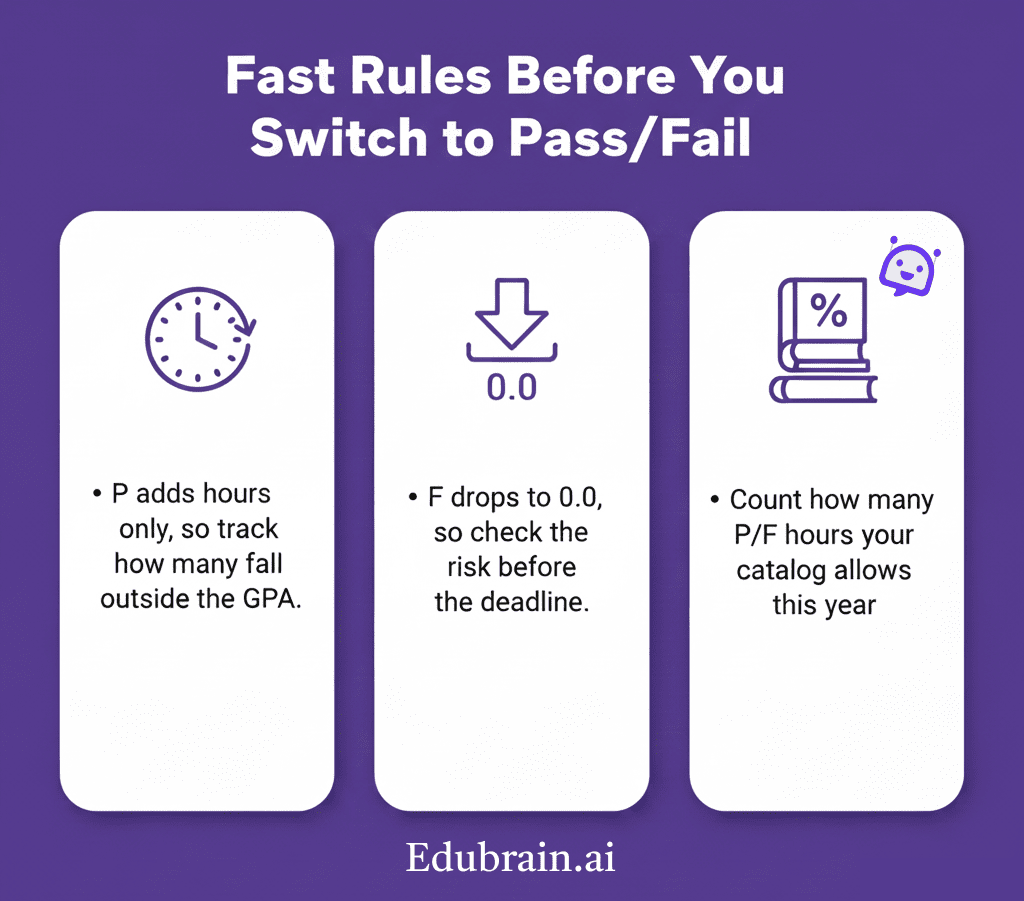
Students frequently ask if passing or failing has an impact on their GPA. Will it affect your GPA? A pass raises credit hours but does not affect GPA mathematics in the majority of catalogs. A failing grade, on the other hand, drops in at 0.0 and can quickly tilt a term.
This distinction in the grading system affects aid checks, major rules, and honors lists. While core modules require a traditional letter grade, some departments only accept passes in free electives. Graduate school admissions teams also take note of a transcript full of Ps, even if the cumulative grade point average appears to be acceptable. I lay out the guidelines for fail grading, identify typical pitfalls when taking a class, and provide straightforward examples that illustrate the trade-offs of the pass-fail system.
Table of Content
ToggleWhen Taking a Class Pass or Fail Affects GPA
Start with the basic math: GPA calculation equals quality points divided by graded credit hours. Under most policies, pass or fail works like this. A passing grade (P, PS, or PP) adds credit hours toward your total, yet it stays off the grade point average. However, a failing grade under P/F posts as 0.0, just like any other F, so it can lower your GPA. Because of that, many undergraduate students use P/F to cushion a tough class without the pressure, while they keep other modules for a traditional letter grade.

Even so, rules vary. Some faculties allow P/F only on an elective; others insist on a letter grade for core modules inside the degree program. Moreover, several schools cap the number of classes or P/F hours you can apply overall or within one or more courses in the major. Therefore, please review the catalogue and consult with an academic advisor before making any changes.
If grad school sits on your horizon, remember that admissions officers read your transcript context as well as your GPA. When the material feels heavy, tackle the root problem first. The AI photo solver lets you snap a question and see each step explained, so you grasp the method rather than hide behind P/F. In turn, you keep the safety net, yet you still aim for a strong letter grade where it matters.
Hidden Impacts Beyond GPA Calculation
Although GPA protection sounds fantastic, there are repercussions that go beyond the GPA. First, graded credits are important to the majority of honors lists. P/F hours don’t help you get over the Dean’s List requirement at the University of Washington, where students must post at least 12 numerically graded credits in a quarter. Similarly, Baylor treats P/F grades outside of a minimum of 12 graded hours.
Examine the academic record and the main rules now. Core or general education classes still need a final grade, and many schools only offer the grading option for specific courses. At American University, P/F is not included in the GPA and is limited to a small number of electives per degree. According to St. Lawrence, if graded units are below par, too many P/F selections may prevent a student from making the Dean’s List. P never enters GPA, but F does. What this means for you:
- An F under P/F counts like any F; a pass gives credit but will not boost your GPA.
- Some programs ban P/F in the major; others cap how many P/F hours apply.
- Transfer students and those on financial aid should confirm how P/F credits move across audits and aid checks, since many reviews prioritize graded hours and completion ratios.
Financial Aid and SAP Eligibility: Will P/F Put Aid at Risk?
SAP separates into two checks. The qualitative test starts by examining your GPA requirements. Second, pace is measured by the quantitative test. If you pass the class, it counts as both attempted and completed hours, so your pace improves, but most policies vary and do not affect GPA. A fail, on the other hand, will hurt your GPA because it is considered attempted but not completed and appears as a standard F in many catalogs. You should review the SAP page of your aid office and take note of any warning or appeal rules.
If you are losing grip on a math topic, it is better to master the skills first before using safety nets. An algebra homework helper dissects a problem into several small steps, explains the method, and keeps you moving through the syllabus. Consequently, you keep up with the pace of completion, ensure your eligibility, and still go for high grades instead of using the P/F option to conceal weak results.
How Grad School Committees Read P/F
Medical, law, and many graduate school programs do not copy your university’s rules. They concentrate on patterns and recalculate results using their own systems. A pass receives credit only and is worth zero points in the centralized GPA under pass/fail. A fail, on the other hand, appears like any failed class and lands at 0.0. To keep it clear, think in two tracks:
- AMCAS (medicine): P appears as credit outside the numeric average; only letter-graded course work earns quality points. An F counts as 0.0.
- LSAC (law): The summary uses its own scale. A fail in a P/F course still converts to 0.0.
- Most other graduate programs: They review the transcript and may recalculate key terms, especially prerequisites.
What does that signify for this term’s choices? First off, a few pass grades almost never jeopardize a high GPA, particularly when it comes to a general education requirement. Fit and rigor concerns are raised, though, when there is a significant P/F across core requirements or a major or minor requirement. Especially in science or math, school admissions tutors inquire as to whether you could receive a higher grade with a standard letter grade.
Therefore, use P/F as a safety net, not a shield. Keep a letter grade on classes that build your narrative, and place P/F on a true elective. If a topic starts to wobble, tackle the skills head-on. A tool like the Math AI assistant breaks problems into clear steps and helps you lock in methods before the deadline. In the end, this mix keeps your options open while your transcript reads as confident preparation for admission to graduate school.
Special Cases: How A Low Pass Grade Affects the Record
To allow students to continue, many college systems relaxed their guidelines, allowing for pass, low pass (LP), and no credit. LP remains a permanent grade on some campuses, such as UNC; it falls outside of the GPA but might not meet major or general education requirements. To put it briefly, failure still hurts; LP advances progress, but not averagely.
-
Why LP matters now
LP stayed out of GPA even though they frequently mapped to the roughly D range. For undergraduate students who need momentum but also need to safeguard their future options, that little adjustment makes a big difference. However, some schools cap the number of LP/P credits that count toward completion.
-
A Smarter Way to Decide
Before toggling a tough class to P/LP, seek academic advising or speak with an advisor to try to strengthen your grasp of the material. For example, the calculus homework solver breaks problems into clear moves, so you keep learning while you weigh choices, and you stay ready when a course later demands a traditional letter grade.
When Choosing P/F Makes Sense
Although P/F is by no means a bad option, its applicability depends on the specific situation. Choosing P/F can protect your GPA if you take a class without needing it for your major, and you already have a solid collection of letter grades. However, you are usually better off with a letter grade when a course is necessary to develop a skill. Use this quick check before you switch:
- Elective or requirement: Many catalogues allow P/F only outside of your major. Courses that count towards a major or minor often need standard grades.
- Honors target: Some colleges exclude P/F from cum laude thresholds, so you may lose eligibility.
- SAP pace and aid: A Pass boosts completion pace. An F will absolutely impact your GPA.
- Next steps after graduation: Programs want letter grades in prerequisites. Too many P marks in core science can raise fit questions.

And if you think that a technical module might result in a P/F grade, then you should first improve your skills. An AI solver for computer science explains an algorithm and code traces one by one, thereby deepening your understanding and allowing you to retain a grade to fulfill the area that is important.
Worked Example: The Letter Grade vs. Pass Grades Math
Take a 15-credit term with five classes. If all five stay letter-graded, and you earn A, B+, B, C+, and C, the GPA is the average: $(4.0 + 3.3 + 3.0 + 2.3 + 2.0) \div 5 = 2.92$.If one class switches to P/F and you pass it, only four grades enter the calculation, raising the average to $(4.0 + 3.3 + 3.0 + 2.3) \div 4 = 3.15$.
However, this narrower base means each grade holds more weight. If the B turns into a C, the new average is $(4.0 + 3.3 + 2.0 + 2.3) \div 4 = 2.90$, a sharper drop than before. And if a Pass does not land, many schools count the course as 0.0, which will dramatically reduce the entire term’s GPA impact.
Because of this, P/F works best when you already feel steady in the rest of your schedule. The choice should protect your GPA, not mask a pattern of weaker performance. If trouble comes from specific choke points, support that clarifies the method can make a direct difference. A geometry AI solver shows each step and highlights the exact point where the logic falls apart. So, you keep total credit hours and letter grades on the board in courses that count toward your major or minor requirements.
Conclusion
P/F can be a great tool to manage course load, but the decision must be made with a clear intention. Speak with your academic advisor to discuss how it fits your path. A Pass only adds credit, and a Fail accounts for zero. That difference has an impact on term averages, honors rules, and aid checks. A couple of grades in elective courses as a “Pass” generally do not change the appearance of a record, but a number of pass grades in courses that count toward your major can obscure the level of your preparation.
The easiest way is to retain letter grades in courses that develop the main skills for your future, and employ P/F only when it is necessary. If a course is making you feel uncomfortable, then you should work on the skills so that the transcript reflects consistent effort and completion, rather than work that has been avoided.
Explore Similar Topics
Homework has been a cornerstone of education for generations, sparking endless debates among educators, parents, and students. Some see it...
Almost every teen brings a cell phone to school, yet schools statewide and abroad now move from loose rules to...