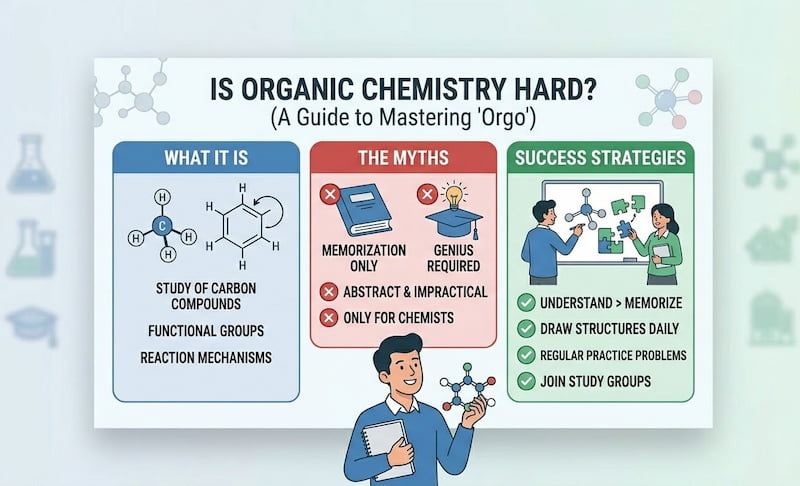
Organic chemistry is often considered a tricky subject in college. It’s known for being challenging; many students might even need...

What Makes Organic Chemistry So Difficult?
Organic chemistry often has a reputation for being one of the most challenging subjects in the field of science. For many students, just hearing the phrase “organic chemistry” or “orgo” can evoke feelings of anxiety and dread. This view comes from the subject’s complexity. Generally speaking, it involves understanding complex reaction mechanisms, and 3D molecular structures.
Is organic chemistry hard? Or is its bad reputation just a result of misconceptions and fear of the unknown?
I will explore that burning question. I’ll discuss the skills and right mindset needed to master organic chemistry and become an organic chemist, as well as share strategies for improving learning.
Table of Content
ToggleWhat Is Organic Chemistry?
Organic chemistry is a branch of chemistry that focuses on the study of carbon-containing compounds. It studies carbon and its compounds, looking at how a carbon atom interacts with elements like hydrogen, oxygen, nitrogen, sulfur, and halogens. This branch of chemistry is unique because carbon atoms can form stable bonds with one another, creating complex structures. These range from simple molecules, like methane or 1-propanol, to large macromolecules, like proteins and DNA.
Organic chemistry explains carbon-based compounds’ structure, properties, composition, chemical reactions, and synthesis. These organic compounds are the foundation of life on Earth, forming the basis for all living organisms and many synthetic materials.
At its core, organic chemistry is about understanding how organic molecules interact, react, and change. It involves learning about every essential functional group. They are atom groups in molecules that determine their reactions.

Common Misconceptions About Organic Chemistry
Organic chemistry often has the mystique of being one of the most daunting subjects in science. A mix of misconceptions fuels this reputation. These misconceptions can intimidate students taking science classes before they even begin their studies. Knowing these misconceptions can help demystify the subject and encourage a more confident approach when you learn organic chemistry.
1. Organic chemistry is all about memorization.
A common myth is that organic chemistry is just about trying to memorize a massive list of reactions and mechanisms. While the subject requires a lot of memorization, it is mainly about understanding patterns and chemical principles that govern chemical behavior. Using flashcards is great, but going beyond basic rote memory is essential.
2. It’s only relevant for a chemist.
This field is key to many disciplines, including biology, medicine, pharmaceutical science, and engineering. Pre-med students taking the MCAT must know it inside and out. Students need to learn how drugs interact with the human body. It is one of the most important subjects in medical school. Engineers may also need to know about organic compounds when working with materials and polymers.
3. It’s too abstract to be practical.
A common myth is that organic chemistry is too abstract and theoretical, with little practical use. In reality, organic chemistry is deeply connected to everyday life. From the food we eat to the medicines we take and the materials we use, organic chemistry plays a crucial role in the world around us.
4. You have to be a genius to understand it.
Success in any chemistry course, like in any tough subject, requires dedication, practice, and a will to engage with the material. With good study habits, and proper resources, anyone can develop a solid understanding. Students also need to learn that they don’t have to do it alone; using a motivated tutor can heavily impact your success.
5. All organic chemistry professors are intimidating.
The belief that all professors are tough and unsupportive can increase anxiety and inflate the perceived failure rate of the class. Undoubtedly, some professors have a rigorous style when teaching organic chemistry. However, many are passionate about their field and want to help students learn, especially contemporary branches like green chemistry. Remember that building a good relationship with your professor can improve your learning. For this purpose, don’t be afraid to utilize office hours and seek help to show you’re extremely interested.
What Makes Organic Chemistry So Difficult
Organic chemistry is one of the hardest science subjects, not only in medical school but also in general. What makes organic chemistry so difficult? It is known for being tough for several reasons:
- Complex structures and strict nomenclature (like IUPAC rules).
- Reaction mechanisms and complex pathways (like identifying a nucleophile).
- High volume of material.
- Organic chemistry requires both memorization and deep understanding.
- Fear of failure and negative mindset.
Indeed, courses in organic chemistry are often tough to navigate. But knowing why studying it is hard can help students. As a result, they can then approach it with the right approach.
Organic Chemistry vs. General Chemistry vs. Physical Chemistry
Organic, physical, and general chemistry are three key branches of chemistry. They provide essential knowledge for medical school students and professionals in the sciences. While both are integral parts of an education, they differ significantly in scope, focus, and the skills they require.
1. Scope and focus to master organic chemistry
General chemistry courses, also known as inorganic chemistry, are often the first step in medical school or college. They provide a broad overview of chemical principles and cover many topics: atomic structure, periodic trends, chemical bonding, stoichiometry, thermodynamics, kinetics, equilibrium, acids and bases, and basic reactions. Inorganic chemists use basic chemical principles, which apply to all areas of chemistry.
Physical chemistry studies the physical principles that govern chemical systems. It uses physics and chemistry to study matter’s behavior at all scales.
In contrast, organic chemistry is very different. It studies carbon compounds and their reactions. It explores molecular properties, reactivity, and synthesis. It emphasizes carbon’s role and ability to form diverse, complex structures. It also studies stereochemistry, looking closely at concepts like chirality and mirror images. This focused scope is what makes organic chemistry more detailed than the broader survey of general chemistry. If you need help with chemistry assignments, you can always use AI to solve organic chemistry questions based on the latest research.
2. Types of reactions and mechanisms
In general chemistry, students learn about chemical reactions like acid-base, redox, and precipitation reactions. The focus is on predicting the products based on the reactants. Chemical mechanisms are usually limited to simple descriptions.
Organic chemistry, however, is heavily centered on reaction mechanisms. Students learn to analyze reactions in organic chemistry at a molecular level. They focus on the movement of electrons, the formation and breaking of bonds, and the intermediates that form.
3. Learning approach and cognitive skills
General chemistry often requires a mix of memorization and math. Students must remember basic facts and principles. Physical chemistry is more theoretical and quantitative, using mathematical models.
In organic chemistry classes, the emphasis shifts more toward critical thinking and pattern recognition. Memorization is still needed, especially for reaction types. But the success of organic chemists relies on understanding and applying concepts to new situations. You cannot simply memorize a single formula or equation; you must recognize patterns in chemical reactivity and use these patterns to predict the behavior of unknown compounds.
4. Course structure and assessment
Chemistry classes vary in how they test you. An exam question in general chemistry often includes multiple-choice calculations. Assessments in organic chemistry are often more challenging. They may include complex problem-solving questions requiring you to predict products.
Physical chemistry focuses on mastering math and using it to solve chemical problems. Students must use math to describe chemical behavior and predict outcomes. If they need help, they can use a chemistry problem solver.
On the other hand, organic chemistry courses usually involve a more in-depth exploration of fewer topics. Assessments in organic chemistry are often more challenging. They may include complex problem-solving questions. These require a deep understanding of different mechanisms. They also require the ability to predict products and apply concepts to new situations.
5. Application and relevance
General chemistry is the starting point for further study in any specialized branch. Organic chemistry is vital for fields that study or manipulate carbon-based compounds, like pharmaceuticals and biochemistry.
Physical chemistry studies the basic rules of chemical behavior. It is relevant to all areas of chemistry and many related fields. It explains chemical reactions, energy changes, and molecular interactions. It is key to new analytical methods, like spectroscopy and computational chemistry, which are used to study chemical systems in detail.
Organic chemistry is vital for fields that study or manipulate carbon-based compounds. These include pharmaceuticals, biochemistry, materials science, and environmental science. It is also essential for understanding the chemistry of life, as all biological molecules are organic compounds.
Strategies for Success in Organic Chemistry
Organic chemistry is seen as a tough science course. Its difficult concepts require a lot of critical thinking. The good news is that many students can succeed and excel in this subject. Here are some effective strategies to help you master organic chemistry:
1. Understand, Don’t Memorize
While you must memorize the basics for every functional group and reagent, relying only on rote memorization can be limiting. To truly succeed, understand the principles and patterns behind organic chemical reactions. Knowing why a reaction happens will help you apply these concepts to new problems. For example, don’t just memorize the steps; understand why an electron moves the way it does.
2. Practice Drawing Structures and Mechanisms
Visualization is a key skill. It means understanding molecules in 3D. Practice drawing molecular structures and organic reactions regularly. Drawing Lewis structures, resonance forms, and curved arrow mechanisms quickly and accurately will solidify your understanding.
3. Regular Review and Practice Problems
This subject builds on itself. Regularly reviewing your class notes and textbooks is crucial. Additionally, doing practice problems is essential for testing your knowledge. Additionally, practice problems are essential for mastering organic chemistry. Solving various problems reinforces learning. It also lets you apply concepts in different contexts. Besides, it prepares you for exams, where you must solve problems quickly and accurately.
4. Use Multiple Resources
Don’t hesitate to explore resources beyond your textbook. Try online forums, online help platforms, online resources like tutorial videos, and educational websites. Some college students find that video lectures or various authors’ explanations can clarify complex topics. They present information in a more digestible way. Don’t hesitate to explore resources beyond your textbook. Try online forums, online help at Edubrain, educational websites, and study groups.
5. Learn the Language of Organic Chemistry
Organic chem has its own language. It has specific terms, common abbreviations, and nomenclature rules. Correctly reading and writing chemical names is key. It has common abbreviations, nomenclature rules, and the meanings of symbols in reaction mechanisms. Correctly reading and writing chemical names and structures is key in organic chemistry. It helps you communicate ideas and avoid common mistakes.
6. Stay Organized and Keep Up With the Material
Courses move quickly. Make a study schedule. Don’t just try to cram and memorize a formula right before the test. Organic chemistry needs a deep application of concepts, which takes time to develop. Make a study schedule that allows you to review notes regularly, complete practice problems, and read ahead in your textbook. Don’t cram for exams! Organic chemistry needs a deep understanding and application of concepts. This takes time to develop.
7. Join Study Groups
A collaborative study group can be incredibly beneficial. Working with peers lets you discuss how a strong base might interact in a specific environment and share problem-solving approaches. Teaching concepts to others is also a great way to reinforce your understanding. Thus, make sure your study group remains focused and productive. Avoid turning them into social gatherings.
8. Seek Help When Needed
Don’t hesitate to ask for help if you struggle. Use a tutor or help sessions your institution offers. Asking questions early can prevent small gaps in knowledge. Take advantage of your instructor’s office hours, tutoring services, or help sessions your institution offers. Asking questions early can prevent small misunderstandings from becoming larger gaps in knowledge.
9. Develop Critical Thinking and Problem-Solving Skills
Organic chemistry isn’t just about learning facts. When faced with a problem, think through each step. Students must analyze why some approaches work, and others do not. Focus on understanding the logic behind chemical reactions and mechanisms. When faced with a problem, think through each step. For example, you can use balancing equations steps. Analyze why some approaches work, and others do not. This kind of analytical thinking is crucial for success in organic chemistry and will also benefit other areas of science.
10. Stay Positive and Persistent
Maintaining a positive attitude is key. Everyone struggles with difficult concepts at some point. Stay focused on your goals, and keep pushing forward. With consistent effort, you will succeed! The truth is everyone struggles with difficult concepts at some point. Celebrate small victories along the way, and don’t be too hard on yourself if you make mistakes. Stay focused on your goals, and keep pushing forward. With consistent effort and the right strategies, you can master organic chemistry!
These strategies will help university and college students. They are to build a strong base in organic chemistry and improve their understanding and skills. Eventually, it will help them excel in a tough but rewarding field.
Summarizing: Is Organic Chemistry Really That Hard?
Organic chemistry is known as one of the toughest branches of chemistry. How “hard” it is can depend on several factors. It is a complex subject that requires a deep understanding of intricate concepts. What makes organic chemistry manageable is the right approach.
Effective strategies, strong visualization skills, a proactive study group, and a positive attitude are key to success. Ultimately, while organic chemistry may be challenging, it is not insurmountable!
Explore Similar Topics
The background of chemistry influences almost everything from how we cook to how we use medicine. It is vital for...
Are you a high school student curious about chemistry? Many summer programs are available to help you explore this exciting...