

ASCE Citation Generator
Are you sure you you want to delete all the citations in this list?
Build ASCE citations that survive review
If you’re writing in civil engineering, ASCE citations are one of those “small” details that can eat time fast. ASCE style works when both parts match: in-text cite and reference entry (same author, same year).
Use the best input you have—DOI, ISBN, or the exact URL
Use one clean identifier whenever you can:
- DOI for journal articles
- ISBN for books
- Direct URL for online material (the exact page you used)
- Title search when you have nothing else (but verify the result carefully)
Cleaner input usually means fewer near matches and fewer manual fixes later.
Keep author–date details aligned
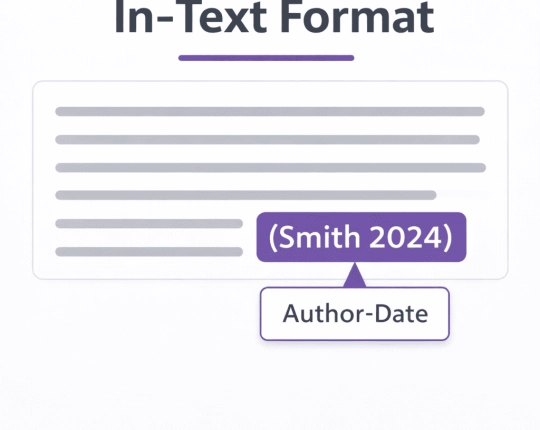
ASCE uses author–date: (Last name Year) in text, full entry in the reference list. Common patterns look like:
- One author: (Smith 2004)
- Two authors: (Smith and Jones, 2004)
- Three or more authors: (Smith et al. 2004)
A generator can format the structure, but you still need one consistency rule: the same author and the same year must appear everywhere.
Copy a reference entry that matches ASCE expectations
Before you paste, scan the fields that most often break ASCE references:
- Author spellings and order
- Publication year
- Full titles (article + journal / book + publisher)
- Volume/issue and page range
For web sources: URL + accessed date when required
What an ASCE citation generator does
ASCE citations have two linked parts:
- In-text citations (author + year)
- An alphabetical reference section with complete entries
The reference list is usually alphabetical by the first author’s last name, and ASCE expects all authors listed in each entry. For standards or anonymous reports, you can alphabetize by the issuing institution.
So the workflow that holds up is boring but effective:
generate → verify → paste
.
How ASCE citations fit inside a real paper
In-text citations
ASCE in-text citations are built around last names + year:
- Keep the same spelling of the surname every time.
- Use et al. consistently for 3+ authors.
- If you cite multiple sources together, keep your ordering consistent with your guide.
Reference list
Your reference list should:
- Include every source cited in the text
- Be alphabetical by first author surname
- Use complete publication details so the reader can locate the source
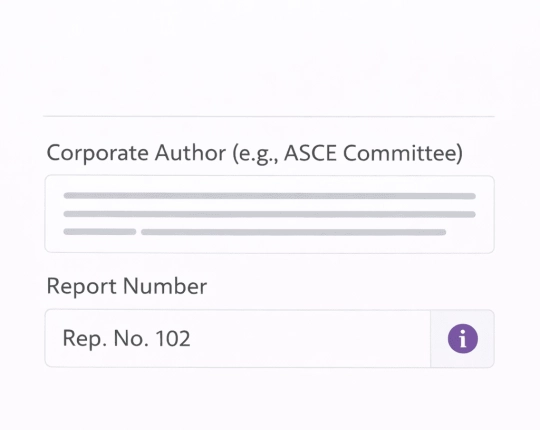
If you’re working with corporate authors (agencies, firms, standards bodies), keep the institution name stable. Don’t alternate between abbreviations and full names.
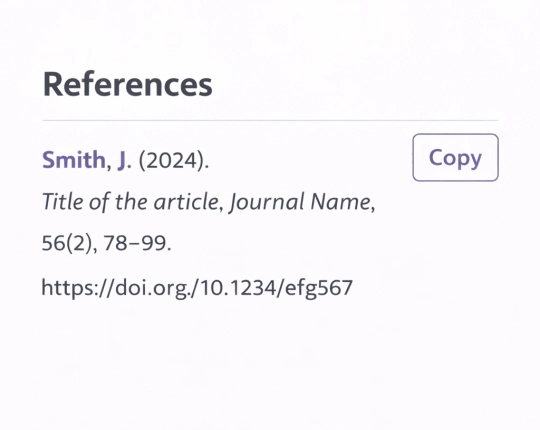
Quick steps in EduBrain
Create an ASCE citation
- Select ASCE as the citation style
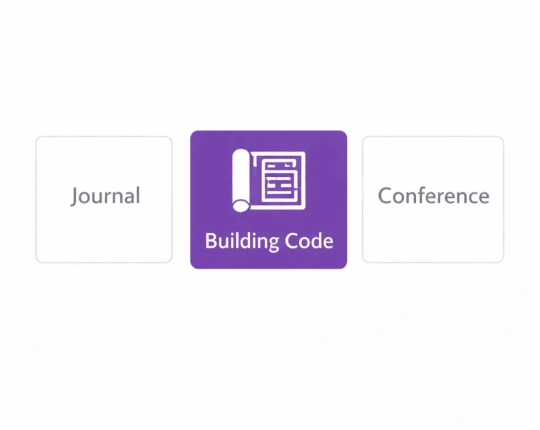
- Choose a source type (Journal article, Book, Website, Report, Conference paper, Other)
- Use Auto when you have DOI / ISBN / URL
- Switch to Manual when metadata is missing or clearly wrong
- Copy the text citation and the reference list entry into your draft
Manual entry is common for conference PDFs, scanned chapters, institutional reports, and pages where author/year published fields are hidden.
Checks before you copy
A generator formats fast. It can also repeat the same mistake across the whole reference list. Do a short scan:
- Authors:confirm surnames + initials, and keep the same order
- Year:use the year for the version you actually used
- Titles:keep article titles and publication titles as shown in the source
- Journals: confirm journal title + volume(issue) +page range (pp.)
- Books:confirm publisher and publication location when required
- Web pages:confirm publishing year + URL +(accessed date)
when your guide expects it
Two checks keep the whole process clean: cite credible sources, and ensure the information presented matches your argument (same author, same year, same work).
If you cite film, an online image, or social media profiles as other content, use ASCE web format: author/organization + year + URL, plus (accessed date) when required; if the author line lists other credible individuals, keep the names exactly as written.
ASCE citations by source type
Journal articles
Use DOI when possible, then verify the core fields:
- Authors
- Year
- Article title
- Journal title
- Volume(issue)
- Page range (pp.)
Books and print government reports
Books typically need:
- Authors
- Year
- Title
- Publisher
- City/State of publication
Government reports are often cited under the issuing body as the author (institution name first).
Web pages and online material
Web references often fail because the author/date is unclear. ASCE web formats commonly include:
- Author (person or organization)
- Year of publication
- Page/document title
- URL
- (accessed on)
If there is no person author, use a corporate author (ministry/agency/company) and stay consistent.
Conference proceedings
Proceedings entries usually need extra context:
- Paper author(s)
- Year
- Paper title
- Conference/proceedings title
- Publisher (or sponsor) + location
- pp. range (or eLocator)
If your output looks “too short,” it’s usually missing one of those fields.
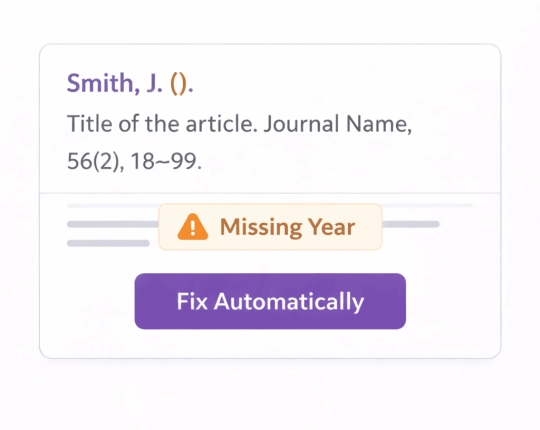
ASCE citation examples (templates you can copy)
Use these examples as templates. Replace author surname, author initial, year published, venue/source title, and pp. range. If pagination is missing, keep the article number and total pp. range.
- Example 1 — Journal article
AuthorSurname, A. A. and AuthorSurname, B. B. (year published). “Article title.” Journal Title, Vol. X(Issue number), page numbers. DOI. - Example 2 — Conference paper/proceedings
AuthorSurname, A. A. (year published). “Paper title.” Proceedings publication title, conference location, page numbers. - Example 3 — Book
AuthorSurname, A. A. (year published). Book title. Publisher, City/State. - Example 4 — Chapter in an edited book
AuthorSurname, A. A. (year published). “Chapter title.” In Book title (Ed. EditorSurname, E. E.), Publisher, City/State, page numbers. - Example 5 — Standard / code/agency report
Organization (year published). Report or standard title. Publication title, report number (if shown), URL (source published), (accessed date). - Example 6 — Website
Organization or AuthorSurname, A. A. (year published or publication date shown). “Page title.” Website name, URL (source published), (accessed date). - Example 7 — Thesis / technical document
AuthorSurname, A. A. (year published). Title. Institution, City/State.
Common ASCE citation mistakes and quick fixes
Small errors multiply when your reference list grows.
- Wrong item pulled by title search → switch to DOI/ISBN/URL, or confirm venue + year manually
- Author name mismatch → match the PDF title page/header and reuse that exact surname spelling
- Missing pages → add the page range (or article number format if your source uses that)
- Web entry missing accessed date → add (accessed …) when required
Conference details missing → add conference name/acronym, issuing organization/sponsor, and page range

ASCE citation style format checklist (civil engineers use this a lot)
ASCE citation style is an author–date citation style, but the ASCE style format still depends on consistent fields. Before you paste, check source credibility and make sure the year published matches the version you actually used.
- Confirm author surname spelling and author initial formatting.
- Confirm year published (not a repost year).
- Confirm proceedings title (journal/proceedings/report title).
- Replace “pages” with page numbers or page range (and keep it consistent).
- For websites, add a posted date if a date is shown; otherwise, follow your guide.
Save the entry, then create citations the same way across the draft (one bibliography / one References list).

ASCE vs APA format, MLA, and Chicago style (quick note)
ASCE is not APA, MLA, or Chicago style; those styles format dates and references differently. If your course says “American Society of Civil Engineers,” follow the American Society of Civil Engineers rules and keep one citation style throughout.
If you used Citation Machine before, compare the output fields: author surname, year published, venue title, and pp. range.
The fastest win is to fix those before you paste.
Many citation tools support APA style, MLA (Works Cited), and the Chicago Manual, but ASCE has its own rules. The main ASCE requirement is consistency: one citation style and one bibliography for the entire draft.
Explore More Citation Styles



 Unlimited AI homework help

 Diagram Generator, Flashcard Maker, Notes Generator, Research Assistant, Answer Generator, AI Homework Helper & AI Detector