

Definite Integral Calculator
Evaluate Definite Integrals With Precision

Step-by-step solutions
The calculator describes antiderivatives, substitutions, and evaluation steps while building deeper mathematical intuition.
Supports complex functions
Polynomial, trigonometric, exponential, logarithmic, and rational functions are fully supported. Integrals involving rational expressions are simplified using decomposition into partial fractions before evaluation. Advanced integrals involving special functions are also supported.
Area under the curve visualization
Displays bounded regions to illustrate integral results graphically.
Numerical approximation support
Applies numerical methods when exact integration is not possible.
Bounded integral evaluation
This methodology is applied when limited information exists about the target population, and it is assumed that the population follows a normal distribution with a zero mean and constant variance (SChildren, 2017).
Definite Integral Calculator Usage






Featured in




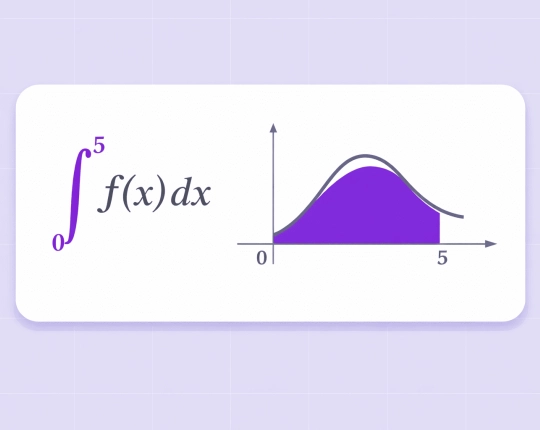
What Is a Definite Integral?
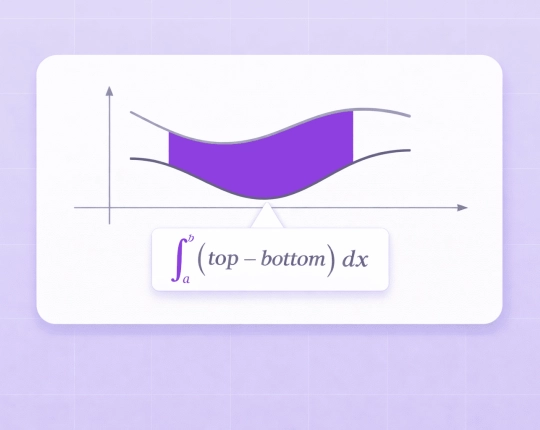
A definite integral is used to compute the value of a given function at two points. It is geometrically an area under a curve within given limits.
General form:
\( ∫ₐᵇ f(x) dx \)
Where:
- \( a = lower bound \)
- \( b = upper bound \)
- \( f(x) = function \)
This expression can be calculated exactly to a definite integral calculator, bypassing any error of manual substitution.
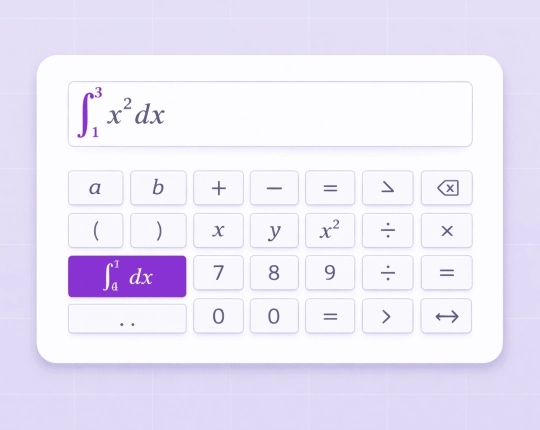
Definite vs Indefinite Integrals
Indefinite integrals
Represent general antiderivatives and include a constant of integration.
Definite integrals
Give a given numerical figure due to limitations imposed.
To bring in a wider symbolic integration limitlessly, such tools as an integral calculator with steps extend their functionality.
Fundamental Theorem of Calculus
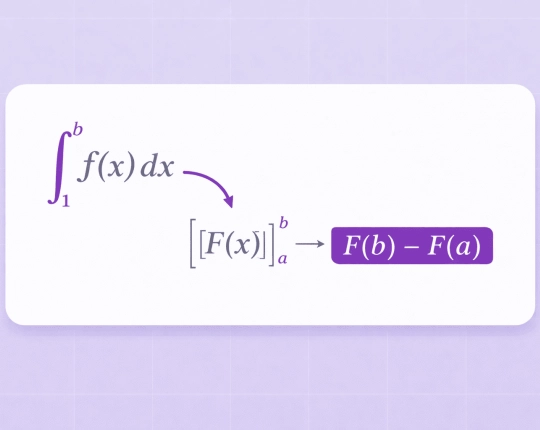
The definite integral is dependent on the Fundamental Theorem of Calculus.
It states:
\( ∫ₐᵇ f(x) dx = F(b) − F(a) \)
Where \( F(x) \) is the antiderivative of \( f(x) \).
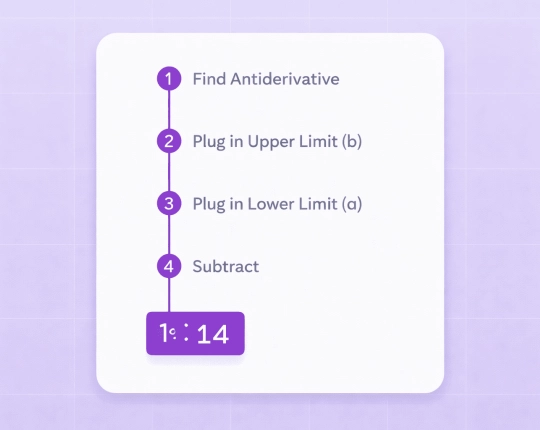
This means integration can be solved by:
- Finding the antiderivative
- Evaluating it at bounds
- Subtracting results
A definite integral calculator performs this automatically.
Geometric Interpretation
Definite integrals measure the area under curves.
- Positive area lies above the \( x \)-axis.
- Negative area lies below the \( x \)-axis.
- Net area reflects signed accumulation.
This concept applies in physics (displacement), economics (profit), and engineering (work calculations).
Guided Integral Solution From Function to Result
Evaluate:
\( \int_{0}^{2} x^2 \, dx \)
Step 1: Find an antiderivative
\( \int x^2 \, dx = \frac{x^3}{3} \)
Step 2: Apply bounds
\( \left(\frac{2^3}{3}\right) – \left(\frac{0^3}{3}\right) \)
Step 3: Simplify
\( \frac{8}{3} \)
A definite integral calculator executes each step instantly while showing substitutions.
Substitution Method
Some integrals require substitution to simplify evaluation. This method is one of the most widely used integration techniques in definite calculus. In more advanced cases involving radicals, square roots, or quadratic expressions, trigonometric substitution may be applied to transform the integral into a solvable form.
Example:
\( \int_{0}^{1} 2x (x^2 + 1)^3 \, dx \)
Let \( u = x^2 + 1 \)
Then \( du = 2x \, dx \)
The integral transforms into:
\( \int u^3 \, du \)
This simplification makes evaluation manageable. Calculators apply substitution automatically when patterns match.
Definite Integrals and Derivatives
Integration and differentiation are inverse operations.
If:
\( F'(x) = f(x) \)
Then:
\( \int f(x)\, dx = F(x) \)
A derivative calculator can be useful for checking antiderivatives or for analyzing rates of change that involve definite integrals.
Inappropriate Limits and Integrals
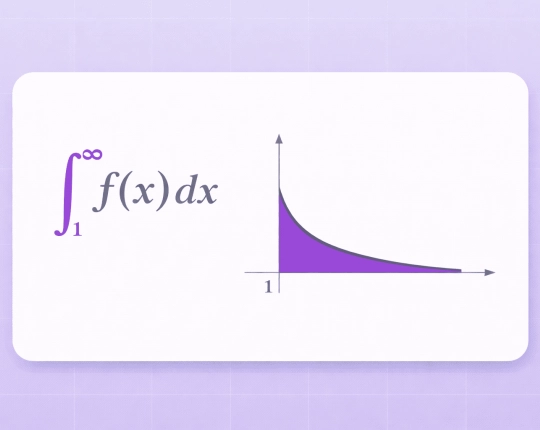
Some definite integrals have infinite limits or discontinuities.
Example:
\( \int_{1}^{\infty} \frac{1}{x^2}\, dx \)
These require limit evaluation rather than direct substitution. A limit calculator supports convergence analysis in such improper integrals.
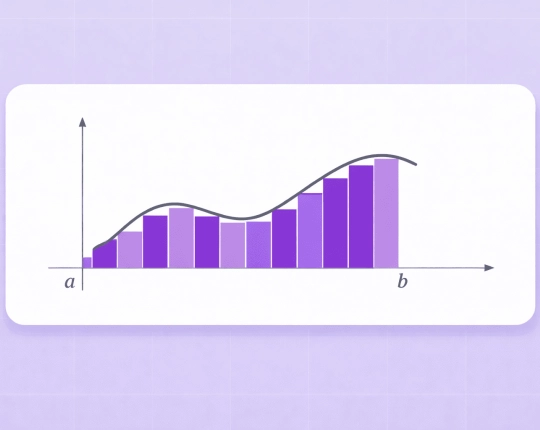
Numerical Approximation Methods
Not all integrals produce simple antiderivatives. In such cases, numerical approximation methods apply:
- Trapezoidal rule
- Simpson’s rule
- Riemann sums
A definite integral calculator switches to numerical evaluation when symbolic solutions are impractical.
Applications of Definite Integrals
Definite integrals power many scientific and professional calculations.
- Physics
Work, energy, and displacement rely on bounded integration. - Economics
Consumer surplus and cost accumulation use area modeling. - Engineering
Load distribution and structural analysis require integrals. - Medicine
Drug concentration over time involves integral modeling. - Statistics
Probability density functions rely on bounded integrals.
Automation ensures accuracy across these applications.
Common Mistakes in Definite Integration
Manual solving introduces frequent errors:
- Forgetting bounds substitution
Stopping at the antiderivative produces incomplete answers. - Sign misinterpretation
Negative area may be misread as positive. - Incorrect antiderivatives
Derivative mistakes propagate into integral results. - Limit misapplication
Improper integrals require convergence checks.
A structured definite integral calculator prevents these issues.
How the Definite Integral Calculator Works
The calculator processes integrals through symbolic and numerical engines.
- First, it identifies the function structure.
- Next, it computes the antiderivative using algebraic rules.
- Bounds are substituted, and the difference is evaluated.
- If symbolic integration fails, numerical approximation methods apply.
- To include more complex explanations, a built-in AI math calculator displays the steps followed, justifies the logic of substitutions, and plots the area under curves.
Explore More Calculators


Choose your plan
Free plan
- Unlimited use with ads included
- Free access to all AI tools
- Download all responses (answers, presentations, flashcards, etc.)
- Share responses with others
AI-Plus
- Expert reviews on discounted prices
- Ad-free experience to:
- AI detector
- Diagram generator
- PowerPoint generator
- Answer generator
- Flashcard maker
- Notes generator
- Research assistant
- Download all responses (answers, presentations, flashcards, etc.)
- Share responses with others
- Advanced reasoning
Expert help
- Presentations (human-made)
- Homework help
- STEM support
- Writing assistance
- Editing & proofreading

 Unlimited AI homework help

 Diagram Generator, Flashcard Maker, Notes Generator, Research Assistant, Answer Generator, AI Homework Helper & AI Detector