

Exponential Function Calculator
Analyze Exponential Growth With Precision

Instant exponential evaluation
Calculate exponential expressions without manual power expansion.
Supports growth and decay models
Analyze increasing and decreasing exponential behavior in real scenarios.
Step-by-step equation solving
The calculator explains exponent rules and equation transformations.
Graph visualization support
Displays exponential curves to illustrate growth and decay trends.
Logarithmic conversion solving
Applies log rules to isolate variables in exponential equations.
How to Use the Exponential Function Calculator






Featured in




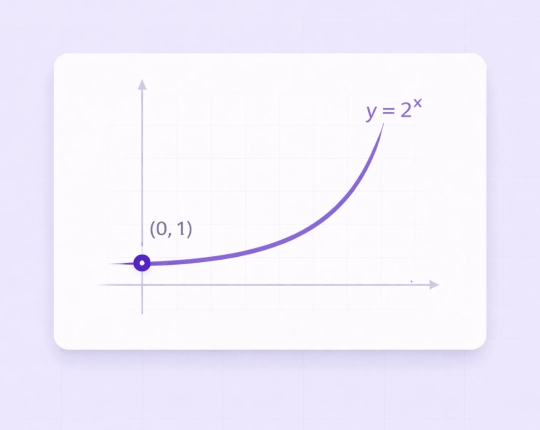
What Is an Exponential Function?
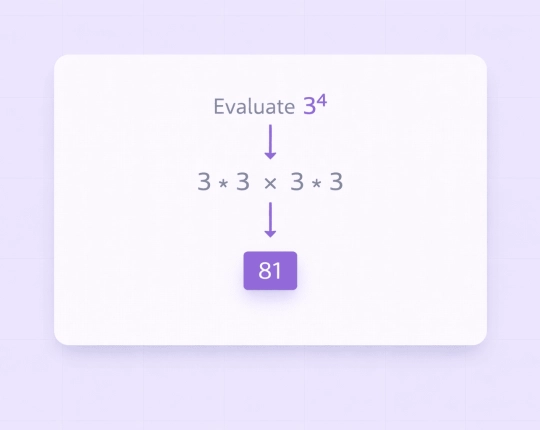
An exponential function is an expression where the variable appears in the exponent rather than the base.
General form:
\( f(x) = a \cdot b^x \)
Where:
- \( a \) = initial value
- \( b \) = growth or decay factor
- \( x \) = exponent (time or position)
Unlike linear functions, exponential functions grow or shrink at accelerating rates. An exponential function calculator evaluates these changes instantly.
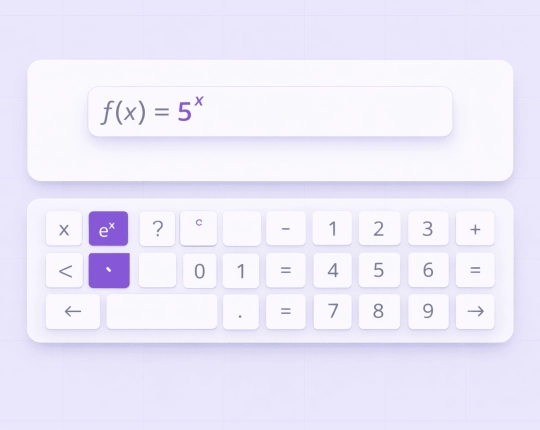
Exponential Growth vs Decay
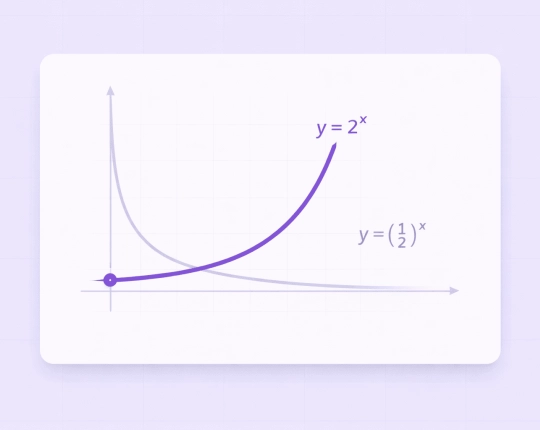
Exponential growth occurs when the base is greater than \( 1 \).
Example:
- Population increase
- Compound interest
- Technology adoption curves
Exponential decay occurs when the base lies between \( 0 \) and \( 1 \).
Example:
- Radioactive decay
- Depreciation
- Cooling processes
The calculator identifies whether the function represents growth or decay automatically.
Understanding the Exponential Equation Formula
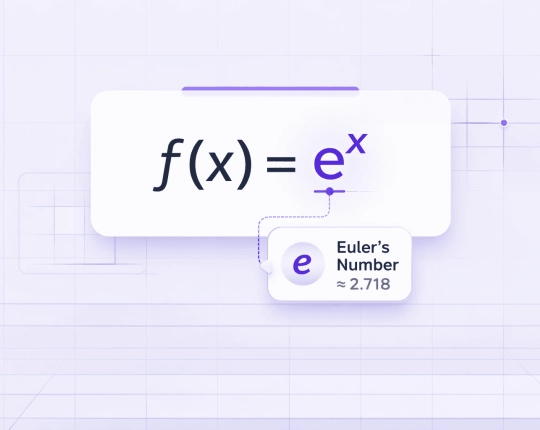
The standard exponential equation formula appears as:
\( y = a \cdot e^{kt} \)
Where:
- \( e \) = Euler’s number \( (\approx 2.718) \)
- \( k \) = growth/decay constant
- \( t \) = time
This model appears in finance, biology, and physics. The calculator evaluates such equations while preserving precision in exponential constants.
Solving Exponential Equations
When variables appear in exponents, algebraic solving requires logarithms, which act as inverse functions of exponential expressions.
Example:
\( 2^x = 16 \)
Rewrite as:
\( x = 4 \)
More complex equations require logarithmic conversion. For example, solving \( 3^x = 7 \) requires taking logarithms to isolate \( x \).
In such cases, integration with a logarithm calculator helps isolate unknown exponents efficiently.
Exponential Functions and Sequences
Exponential patterns also appear in multiplicative sequences.
Example:
\( 2, 4, 8, 16, 32 \dots \)
Each term multiplies by a constant ratio, which can be written in function form as \( a_n = 2^n \) (for an appropriate starting index).
Evaluating such structures often overlaps with tools like a sequence calculator, which identifies patterns and predicts future values.
This connection bridges algebraic functions with discrete mathematical modeling.
Graph Behavior of Exponential Functions
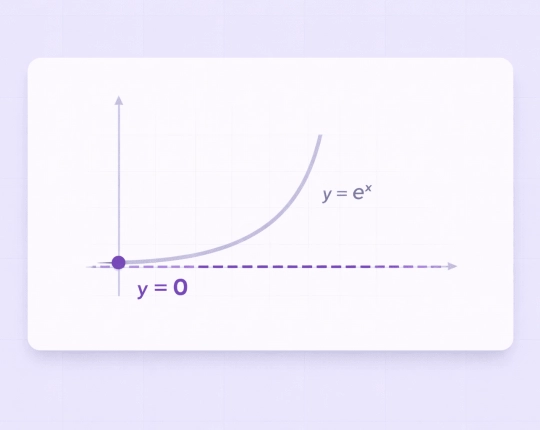
Exponential graphs share consistent properties:
- Always positive (for real positive bases), even when the exponent is negative, such as \( 2^{-3} \).
- Pass through \( (0, 1) \) when \( a = 1 \) in the function \( f(x) = a \cdot b^x \).
- Increase or decrease rapidly depending on whether \( b > 1 \) or \( 0 < b < 1 \).
- Approach but never touch a horizontal asymptote, typically \( y = 0 \).
Understanding graph curvature becomes essential in calculus and modeling applications.
Derivatives of Exponential Functions
In calculus, exponential derivatives reveal growth rates.
Key rules include:
- \( \frac{d}{dx} \left(e^x\right) = e^x \)
- \( \frac{d}{dx} \left(a^x\right) = a^x \ln(a) \)
Some analysis is automated in a complex derivative calculator, which evaluates slope, acceleration, and optimization problems involving exponential functions.
This is necessary in physics, economics, and machine learning models.
Example Problem From Equation to Solution
Solve:
\( 3 \cdot 2^x = 24 \)
In this case, \( 3 \) times the exponential value must equal \( 24 \), so the coefficient is isolated first.
Step 1: Isolate exponent term
\( 2^x = 8 \)
Step 2: Convert to exponential equality using the same base
\( 2^3 = 8 \)
Step 3: Solve
\( x = 3 \)
An exponential function calculator performs these transformations instantly while showing algebraic reasoning.
Real-World Applications
Exponential functions model dynamic processes across industries.
- Finance
Compound interest and investment growth follow exponential curves. - Biology
Population expansion and bacterial growth rely on exponential models. - Medicine
Drug concentration decay uses exponential half-life equations. - Technology
Moore’s Law models transistor growth exponentially. - Environmental science
Carbon emissions and climate projections use exponential forecasting.
Automation through an exponential function calculator ensures precise modeling.
Common Mistakes in Exponential Calculations
Manual solving often leads to errors such as:
- Misapplying exponent rules
Incorrect multiplication or division of powers. - Ignoring logarithmic conversion
Forgetting logarithms are needed to isolate variables in forms like \( a^x = b \). - Rounding too early
Premature approximations distort final results. - Confusing linear vs exponential growth
Misreading rate acceleration leads to wrong interpretations.
Structured calculators eliminate these mistakes through rule-based computation.
Working of Exponential Function Calculator.
The calculator analyzes exponential expressions using symbolic algebra and numerical computation.
- First, it identifies constants, bases, and exponent variables.
- Next, it applies exponent laws to simplify expressions.
- If equation solving is required, it converts exponential forms into logarithmic equivalents.
- Growth modeling and graph behavior are computed using exponential curve analysis.
- When advanced explanation is enabled, the integrated math AI free assistant interprets each step, explains transformations, and supports conceptual understanding.
Advanced Math Tools


Choose your plan
Free plan
- Unlimited use with ads included
- Free access to all AI tools
- Download all responses (answers, presentations, flashcards, etc.)
- Share responses with others
AI-Plus
- Expert reviews on discounted prices
- Ad-free experience to:
- AI detector
- Diagram generator
- PowerPoint generator
- Answer generator
- Flashcard maker
- Notes generator
- Research assistant
- Download all responses (answers, presentations, flashcards, etc.)
- Share responses with others
- Advanced reasoning
Expert help
- Presentations (human-made)
- Homework help
- STEM support
- Writing assistance
- Editing & proofreading

 Unlimited AI homework help

 Diagram Generator, Flashcard Maker, Notes Generator, Research Assistant, Answer Generator, AI Homework Helper & AI Detector