

Limit Calculator
Why Use a Limit Calculator?

Rapid Limit Solution for Maths
Paper methods take time and focus. One missed step may change the answer. A limit calculator determines a result once after input. No repeated trials follow. Because of that, work moves forward faster. The answer stays stable even when the expression looks hard.
Support for Different Limit Types
Some limits approach a specific value from one side only, known as one-sided limits, such as a left-hand limit or right-hand limit. Others move toward infinity (infinite limits) or reach a fixed number (finite limits). Each case needs its own rule set. Here, one tool handles and computes all of them in one place. So, you avoid switches between methods and keep the workflow steady.
Clear Output and Function Behaviour
Results appear in a clean and readable form. Each part follows standard math notation, which helps quick reading. Instead of cluttered lines, the structure stays clear. Therefore, you spot the final value fast and understand how the function behaves near the chosen point.
Clear Answers for Tricky Limits
Indeterminate limit cases receive immediate identification. The system selects the correct rule for evaluation without manual trial. All steps remain ordered and transparent. An AI homework helper provides brief logic clarification where needed.
Useful for Learning and Checking Work
During the study, the tool confirms answers from notes. Before a quiz or test, it helps spot errors in mathematics problems. You compare your steps with the output and correct mistakes before they become habits.
Accessible Without Restrictions
Access stays open across devices and sessions. No hard limits block repeated use. You return as often as needed, test new inputs, and review results again. Such freedom fits daily study and quick checks alike.
How to Use the Limit Calculator



Featured in




What Is a Limit Calculator?
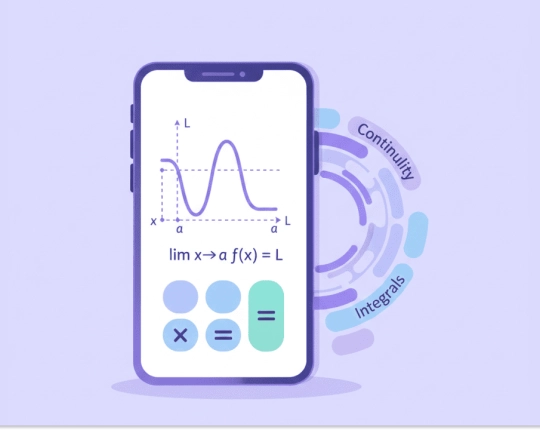
A limit in calculus shows where a function heads when x comes close to a certain value. The function may reach that value, or it may not, yet the direction still matters. For this reason, limits support ideas such as continuity, derivatives, and integrals.
Without limits, those topics lose their base. Still, paper work often leads through long paths and small errors. At that point, a limit calculator gives clarity. It replaces trial checks with a clear outcome. As a result, attention stays on understanding the result, not the process.
Functions Supported by This Limit Calculator
This limit calculator covers the function types that appear most often in calculus tasks. Polynomial limits work as expected and help with basic practice. Rational functions also fit here, even when values cancel or break. It also covers exponential and logarithmic expressions, which behave differently near certain values. Finally, trigonometric limits fit here as well, including cases that usually confuse students.
Limits and Calculus Basics
Limits stand at the core of calculus. A derivative depends on how a function behaves near a point, not only at the given point itself. Continuity follows the same idea. When a limit exists and matches the function value, the graph stays unbroken. Through limits, calculus links change, motion, and growth into one system.
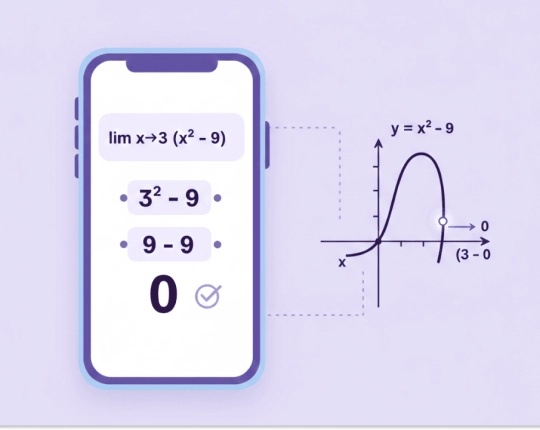
Step-by-Step Limit Example
The example below shows how the calculator handles a limit from start to finish:
Take the limit of the function below:
\( \lim_{x \to 3} (x^2 – 9) \)
Enter the equation:
\( x^2 – 9 \)
Set the approach value:
x → 3
Replace x with 3:
\( 3^2 – 9 \)
Calculate the limit value:
9 − 9 = 0
Read the result: The limit equals 0, since the function approaches the same value as x gets close to 3.
When Manual Solving Becomes Difficult
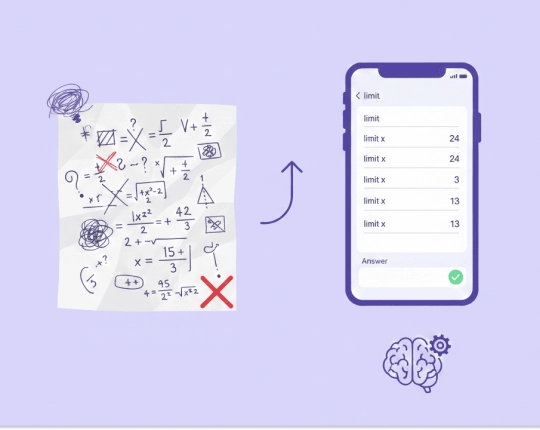
Some limits refuse a straightforward solution. Cases like zero over zero stop direct calculation. Long expressions with fractions, roots, or trigonometric parts only make it harder. At that stage, paper work grows messy. A tiny slip can change the entire outcome, and that causes confusion and waste of time.
Calculators Usage as a Study Aid
A limit calculator supports study when used carefully. It reveals the answer once the student has finished figuring out the problem themselves. That comparison points out mistakes and confirms correct steps. Over time, patterns become clear. Instead of blind trust, the tool serves as a form of feedback. Learning remains active, as comprehension is gained through going over and fixing.
Advanced Math Tools


Choose your plan
Free plan
- Unlimited use with ads included
- Free access to all AI tools
- Download all responses (answers, presentations, flashcards, etc.)
- Share responses with others
AI-Plus
- Expert reviews on discounted prices
- Ad-free experience to:
- AI detector
- Diagram generator
- PowerPoint generator
- Answer generator
- Flashcard maker
- Notes generator
- Research assistant
- Download all responses (answers, presentations, flashcards, etc.)
- Share responses with others
- Advanced reasoning
Expert help
- Presentations (human-made)
- Homework help
- STEM support
- Writing assistance
- Editing & proofreading

 Unlimited AI homework help

 Diagram Generator, Flashcard Maker, Notes Generator, Research Assistant, Answer Generator, AI Homework Helper & AI Detector