
In the past couple of years, AI tools like Edubrain have become essential for students, researchers, content creators, and professionals...
Best AI Tools for Fact-Checking and Verifying Artificial Intelligence Content
The world is full of misinformation that is spreading at a rapid speed. There is far too much content being generated by AI, and it is becoming difficult to know what is true and what is not. It may seem that articles, posts, and even videos are persuasive, yet a large number of them include fake information. AI fact-checking tools are here to help with assessing AI output in content creation.
These tools quickly check the accuracy of content by comparing it to trusted sources. They are fast, accurate, and allow for real-time verification. This article covers the best AI fact-checking tools, making it easier for writers and journalists to spot false information and maintain trustworthy content.
Table of Content
ToggleWhy AI Fact-Checking Tools Matter
Newspapers, blogs, and even social networks have become very dominant in content that may seem real but has been fabricated. This is especially necessary due to the fact that, unlike in the past, when real facts could never have been published so fast, fake information is published so fast, necessitating the use of AI to automatically verify claims. Studies have shown that AI systems misrepresent real news content in the real world 45% of the time, regardless of the language or region.
AI fact-checking tools are essential because they help verify information quickly and accurately. Humans can’t keep up with the vast amount of content produced every day. AI tools make it possible to scan and check huge volumes of material, including text and images, in seconds rather than hours, enhancing the efficiency of the fact-checking dataset. This capability is especially important as 24% of misinformation posts on TikTok and 19% on YouTube are AI-generated, with most lacking any label, making fact check AI generated content crucial.
Here’s why AI fact-checkers are so important now:
- Speed: AI checks large amounts of content fast, making it an essential component of any efficient workflow.
- Accuracy: These tools compare claims with trusted sources.
- Scalability: AI-based tools may be used to achieve scalability in a variety of applications. They process large amounts of data that human beings are unable to, and the dataset can be analyzed more comprehensively.
- Openness: They can be used by creators, journalists, educators, and anyone involved in content creation.
AI fact-checking has become a necessity as misinformation keeps on increasing. They assist in making sure that content remains valid and reliable, and will be important in keeping the information honest.
While using the best AI tools for fact-checking to ensure your sources are reliable, you can also utilize an inequality calculator to verify the accuracy of complex mathematical comparisons and logical statements in your research.
Top AI Fact-Checking Tools to Watch This Year
There are numerous fact-checking tools that are currently available, and which ones are worth using is sometimes difficult to determine. The following tools are reliable to be used in testing, and they provide features that assist in checking the contents, that detects the contents more accurately and quickly. They encompass an assortment of requirements, including fast searches and thorough research, as well as free and paid solutions.
| Tool | Key Strengths |
| EduBrain | AI-driven support for learning and fact-checking |
| Google Fact Check | Quick access to verified claims |
| ClaimBuster | Focus on breaking down long content for verification |
| ChatGPT | Helpful for content analysis, but not a fact-checker |
| Elicit | Summarizes and verifies scientific research |
| Consensus | Focus on academic research and evidence |
| Snopes | Trusted source for verifying viral misinformation |
Google Fact Check Explorer

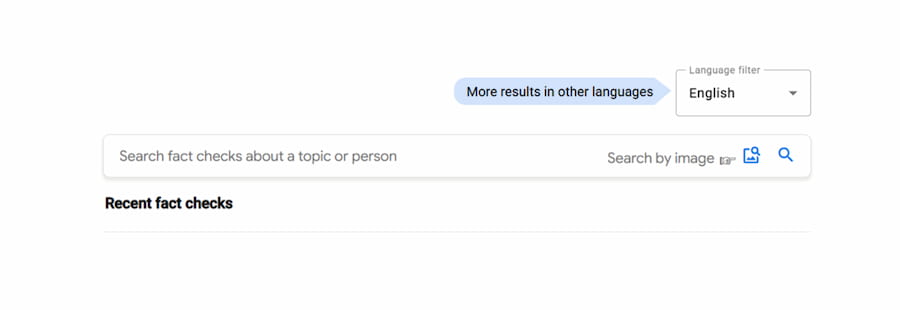
Google Fact Check Explorer is a reliable tool for checking whether a claim has been verified by a trusted organization. Users can easily browse and search through a vast database of fact-checks on various topics. This tool is especially useful when trying to verify the credibility of information found online, offering quick access to established sources that have already investigated claims.
In addition to text-based fact-checking, Google Fact Check Explorer can search by image. This feature is particularly helpful when AI-generated visuals or recycled photos are shared out of context. As a student and a researcher, the tool provides a straightforward method of switching the responses produced by AI to verifiable information, which makes it a key tool to check the accuracy of information.
EduBrain

EduBrain is an AI software that facilitates how educators and students can authenticate information in learning content. It brings out clear explanations, and therefore researchers, writers and journalists can easily understand other issues that were complex. Even though it is not a general fact-checker, it is the best one to use when verification of homework, math AI, research papers, and study material is required because it ensures that the information is accurate and well-explained.
- Homework Help: Type in a question and receive a clear step-by-step explanation.
- Research Assistance: Check arguments or arguments in papers and assignments.
- Subject Coverage: Covers a wide subject such as math, science, history, and so on.
- Flashcards and Notes: This creates AI-based study aids to assist with locking down the major ideas.
- Step-by-Step Solutions: Helps to deconstruct answers to demonstrate the use of conclusions.
EduBrain can be used particularly with those students who require assistance in studying homework or research projects, providing them with tailored research guides. It provides an excellent opportunity to learn material faster and check facts as soon as possible. EduBrain can guide you on the right path, whether you are not sure about an answer or you are studying a new subject.
ClaimBuster Fact-Checking AI

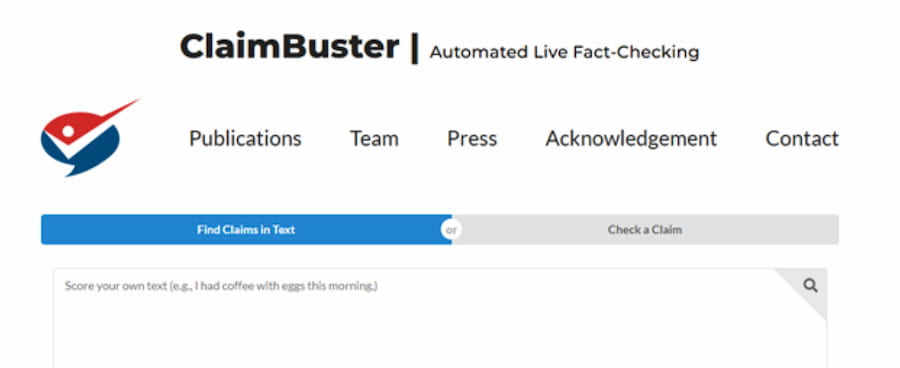
ClaimBuster is a dedicated AI application designed to locate and identify factual claims that were not checked in long text, speech, or transcripts. It is an online live fact-checking device defined by RAND. ClaimBuster is based on the principles of natural language processing and supervised learning to identify significant factual claims. This is a useful tool when addressing long content, interviews, or political speeches; it is easier to know what claims have to be verified first in your workflow.
- Fact-Detection: Finds key factual claims in long texts and speeches.
- Natural Language Processing: Analyzes language to detect verifiable claims.
- Automated Verification: AI detection tools can automate the verification process. Flags claims automatically for easy checking.
- Live Fact-Checking: Works in real-time during events or broadcasts, allowing for immediate fact-checking by content creators.
ClaimBuster is ideal when sifting through long or complex content, helping users decide which claims are most important to verify first. It’s a great tool for journalists, researchers, and anyone working with lengthy or speech-based material.
ChatGPT

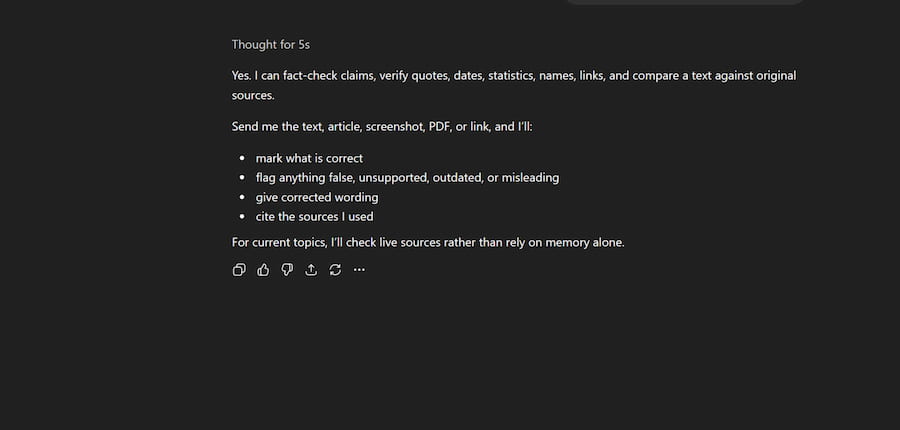
ChatGPT could be an effective fact-checking tool, although it has limitations. It is able to search through the web and give responses with links to information, and this is useful in making a content breakdown. You can also paste a paragraph, inquire what is in question, and receive a list of possible sources or context loss. This renders it an appropriate place to start with fact-checking, particularly in the case of AI-generated materials.
However, just asking “Is this true?” and accepting the answer isn’t enough. ChatGPT can’t fully verify the accuracy of content on its own. It’s important to use AI fact-checking tools or check reliable fact-checking websites, like Snopes, to confirm the facts. ChatGPT is useful for identifying what needs checking, but combining it with other fact-checking methods and tools will give you a more complete verification process.
Elicit
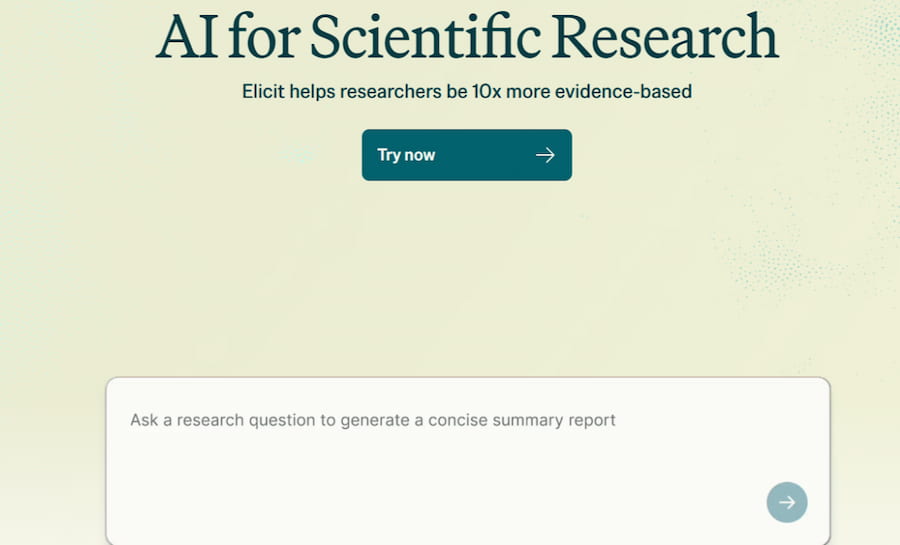
Elicit is a good tool to use when you are checking the content or claims that are created by AI and supported by academic studies. In contrast to general AI chatbots, Elicit is devoted to fact-checking research, which allows users to access and analyze more than 125 million academic papers and utilize specialized tools for accurate content verification. It is ideal for checking the assertions made as facts and ensuring that the information is backed by credible and reliable sources.

What is really helpful about Elicit is that it does not simply verify facts, but gives you a chance to communicate with the output of the AI. You are able to compare studies, source checking, and even extract important information in real-time. This is particularly critical in case you are working with AI-generated content or complicated data. Journalists, writers, and students who must find out the truth quickly and precisely should consider it, as it is a worthy addition to any fact-checking process.
While using the best AI tools for fact-checking to ensure your sources are reliable, you can also utilize a triple integral calculator to verify the accuracy of complex multivariate calculus problems in your scientific research.
Consensus
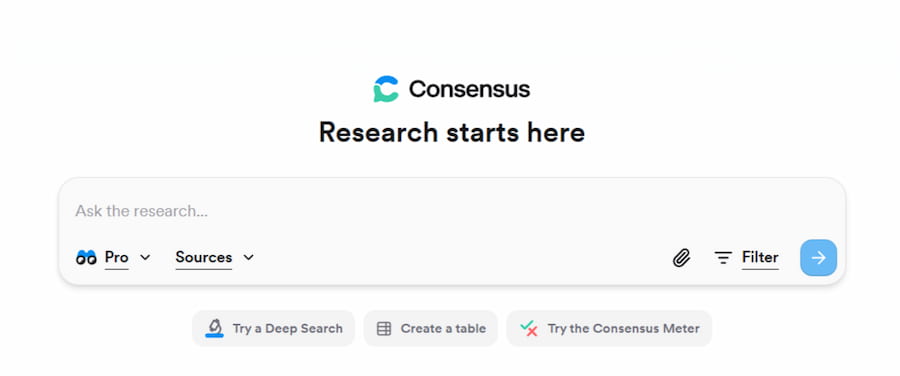
Consensus is a powerful tool for verifying research-based claims. It’s an AI search engine focused on peer-reviewed literature, providing responses that include citations to the original research papers. This makes it ideal for questions like “Does sleep affect memory?” or “Do study guides improve recall?” It’s a great choice when you need to back up claims with scientific evidence but don’t have direct access to the studies.

While Consensus isn’t designed to tackle viral misinformation, it excels at verifying content that makes broad claims like “science says…” without actually providing the supporting evidence. For anyone looking to check the scientific accuracy of content, Consensus is a reliable tool for gathering credible sources and ensuring that the information aligns with peer-reviewed research.
Snopes
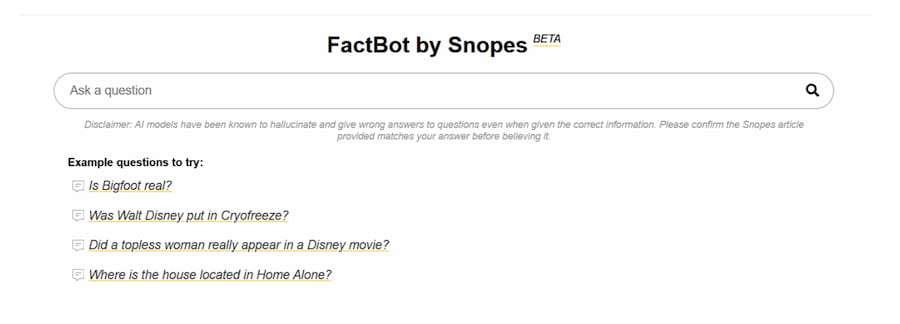
As one of the best fact-checking websites, Snopes specializes in debunking rumors, manipulated images, folklore, and misleading social media posts. It’s particularly effective for verifying AI-generated content and tackling misleading claims that have gone viral. With its solid reputation built over years of thorough research, Snopes stands out as a top tool for identifying false information.

Snopes has applied an elaborate fact-checking format that extends beyond fact verification. It is able to examine the fact that an image has been altered digitally or verify the truth of the viral statements. In cases when it is required to check the content, and in particular, the AI-generated content, Snopes is not always slower and more accurate than running it through another AI prompt or chatbot. Snopes is a very important tool to content creators, and it is something that any person engaged in content verification will find very useful.
How to Choose the Best AI Fact-Checker for Content Verification
Selecting an appropriate AI fact-checking tool is significant in order to check the content fast and correctly while utilizing research guides for better outcomes. It depends on whether you are checking AI-created content, factual statements, or social media posts; you need a tool that suits you. Consider the nature of the content you operate, the capabilities the tool has, and the cost to locate the most suitable one.
These are the considerations to make when choosing the best AI fact-checker:
- Determine Your Requirements: What kind of content do you confirm? There are some tools more useful in checking the text, while others concentrate on the image or video.
- Select the Tool for Your Process: Do you require a quick and basic tool, or an advanced tool to do a more in-depth analysis?
- Important Characteristics to Note: Pay attention to speed, accuracy, real-time confirmation, and integration with the tools you are already using.
- Consider Pricing: Check out free tools against paid ones to make sure that you are getting good value for money.
When you are aware of what is required, then look at how fast and accurately the tool is. When handling a lot of content, you should select a tool that is quick to use without compromising its quality, ensuring the accuracy of the AI output. Live verification is particularly applicable in busy settings such as newsrooms. The tools with access to your existing systems can save time, and even though some of the tools are free, they are effective and efficient; some of the paid ones have additional features that will be worth the expense.
Challenges and Limitations of AI Fact-Check
The AI fact-checkers are unified tools, yet they also possess certain challenges that can hinder their effectiveness beyond fact-checking tasks. False positives and negatives are one of the key problems. AI may occasionally indicate certain claims as false, or overlook little details and make a claim accurate. It also has problems with the interpretation of concepts such as sarcasm or culture, which may be misconstrued.
The other weakness is training data bias. AIs are trained with massive amounts of data, yet such data can be biased, particularly in the case of non-English information. AI fact-checkers cannot be effective at verifying the content of videos or detecting plagiarism. Although AI tools can check the content faster, they cannot substitute the reliance on trusted sources and fact-checking organizations to check the accuracy and reliability of data.
Advice for Using AI Tools for Fact-Checking Effectively
The use of AI fact-checking tools is effective in ensuring that information is quickly verified, although it is not infallible. Although they are capable of assisting in identifying inaccurate claims or verifying facts on a large scale, they should be used with other tactics in order to prevent errors. The following are just some of the tips to ensure that AI fact-checking tools are the most useful to use:
- Don’t Rely on AI Alone: AI tools are fast, but they can miss important context or misunderstand claims. Always double-check results using reliable sources. trusted sources or fact-checking websites like Politifact and Snopes.
- Use More Than One Tool: Each fact-checking AI has strengths that can be leveraged by content creators. Combine tools to get a fuller picture of whether a claim is true.
- Add Human Judgment: AI-generated content is helpful, and it is necessary to use your own critical thinking. See the references and the background of the facts.
- Verify Your Sources: Make sure that the content you’re checking is backed by reliable and authoritative sources. This ensures that the information is credible and helps in producing accurate content.
- Check Multiple Sources: Lateral reading is a practice that can be adopted by content creators to validate information. assists in fact-checking things on various platforms and helps to check the sources.
These tips will help you make certain that your process of fact-checking is complete, accurate, and reliable. Artificial intelligence can be useful, yet the best results will be achieved when you combine the tools with other techniques.
Conclusion: How AI Fact-Checkers Improve AI Content
The significance of AI fact-checkers lies in verifying information created by AI and the quality of information, particularly in the process of verifying particular statements. Because the misinformation has increased, we are able to utilize the tools to speedily and reliably check the facts, thus saving time and energy in the verification process. The AI fact-checkers are used to ensure the material is valid and accurate by automatically screening it to detect falsehoods or falsehoods.
These are ideal tools to use in various fact-checking purposes, be it checking an article, a social post, or a work of research. By incorporating AI into your content checking process, you can more easily identify mistakes and are able to make sure your working content is credible. Although AI-generated content may be verified with AI fact-checkers, human judgment is significant to consider the context and finally check the work. Using both of them allows you to increase the accuracy and reduce the time spent in the fact-checking process.
Explore Similar Topics
The rise of AI tools like ours in content creation has raised important questions about the future of technical writing....
Students don’t need one perfect app. They need a setup that can record what they learn in class, clean it...