

Q. How to reflect a point over \(y = x\).
Answer
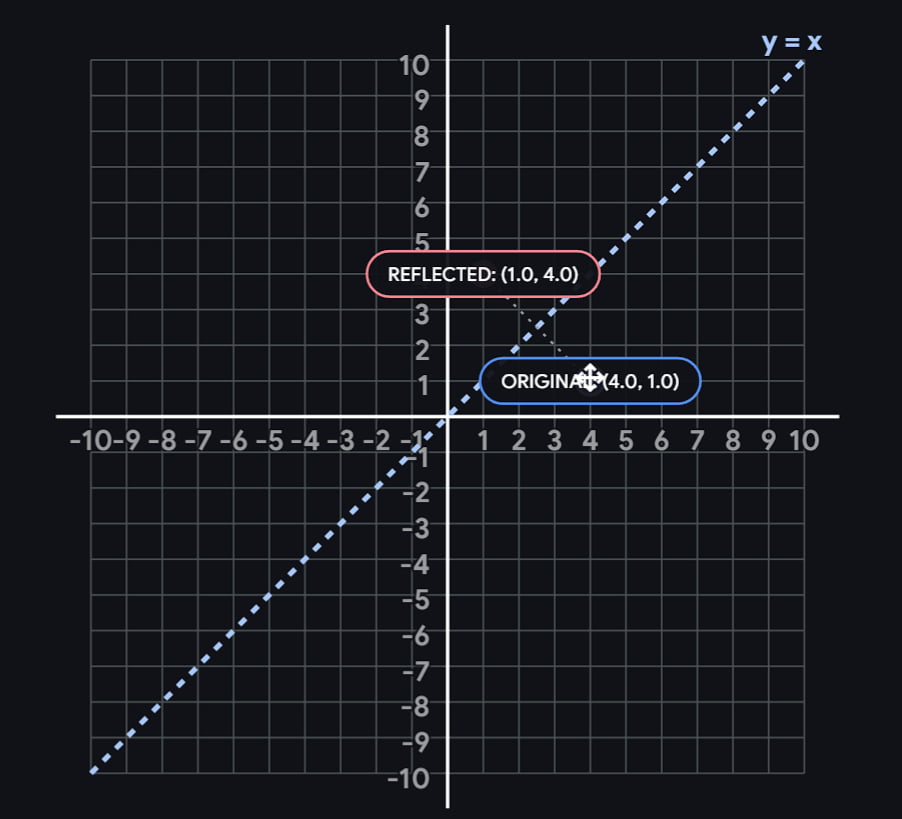
For a point \((x,y)\), the reflection across the line \(y=x\) is \((y,x)\).
Quick explanation: the midpoint of \((x,y)\) and \((y,x)\) is \(\bigl(\frac{x+y}{2}, \frac{x+y}{2}\bigr)\), which lies on \(y=x\); and the slope of the segment joining them is -1, perpendicular to the slope 1 of \(y=x\), so they are symmetric.
Detailed Explanation
-
State the given point and the mirror line.
Let the point to be reflected be \(P=(a,b)\). The mirror line is \(y=x\).
-
Find the equation of the line through \(P\) that is perpendicular to \(y=x\).
The line \(y=x\) has slope 1. A line perpendicular to it has slope -1. The perpendicular line through \(P=(a,b)\) therefore has equation
\[y-b = -1(x-a)\]
or equivalently
\[y = -x + (a+b)\]
-
Find the intersection point \(Q\) of the perpendicular line with \(y=x\) (the foot of the perpendicular).
At the intersection, \(y=x\) and \(y=-x+(a+b)\). Solve the system:
\[x = -x + (a+b)\]
\[2x = a+b\]
\[x_Q = \frac{a+b}{2}\]
Since \(y_Q=x_Q\),
\[y_Q = \frac{a+b}{2}\]
Thus the foot is \(Q=\bigl(\frac{a+b}{2}, \frac{a+b}{2}\bigr)\).
-
Use the midpoint property to determine the reflected point \(P’\).
Reflection across a line makes the intersection point \(Q\) the midpoint of the segment joining \(P\) and its reflection \(P’=(x’,y’)\). Therefore
\[\frac{a+x’}{2} = x_Q = \frac{a+b}{2}\]
\[\frac{b+y’}{2} = y_Q = \frac{a+b}{2}\]
Solving these gives
\[x’ = a+b – a = b\]
\[y’ = a+b – b = a\]
Hence the reflection is \(P’=(b,a)\).
-
Summary and alternative matrix viewpoint.
Reflecting a point across the line \(y=x\) swaps the coordinates. For any point \(P=(a,b)\), the reflection across \(y=x\) is
\[P’=(b,a)\]
Equivalently, as a linear transformation on column vectors, the reflection is given by the matrix
\[\begin{pmatrix}0 & 1\\[4pt]1 & 0\end{pmatrix}\]
so
\[\begin{pmatrix}0 & 1\\[4pt]1 & 0\end{pmatrix}\begin{pmatrix}a\\[4pt]b\end{pmatrix}= \begin{pmatrix}b\\[4pt]a\end{pmatrix}\]
-
Quick numeric example.
Reflect \(P=(2,5)\) across \(y=x\). Swap coordinates to get \(P’=(5,2)\).

FAQs
What is the rule to reflect a point over the line y = x?
How do I write the reflection as a matrix?
How do I reflect the graph of an equation across y = x?
How do I reflect a point across the line y = x + c (parallel shifted)?
How do I reflect a point across a general line ax + by + c = 0?
How do I reflect a polygon or shape over y = x?
Does reflection across y = x preserve distances and orientation?
How is this reflection expressed in the complex plane?
Try our tools below.

Math, Calculus, Geometry, etc.

 Unlimited AI homework help

 Diagram Generator, Flashcard Maker, Notes Generator, Research Assistant, Answer Generator, AI Homework Helper & AI Detector