

Q. What does \(y = -x\) mean in reflections?
Answer
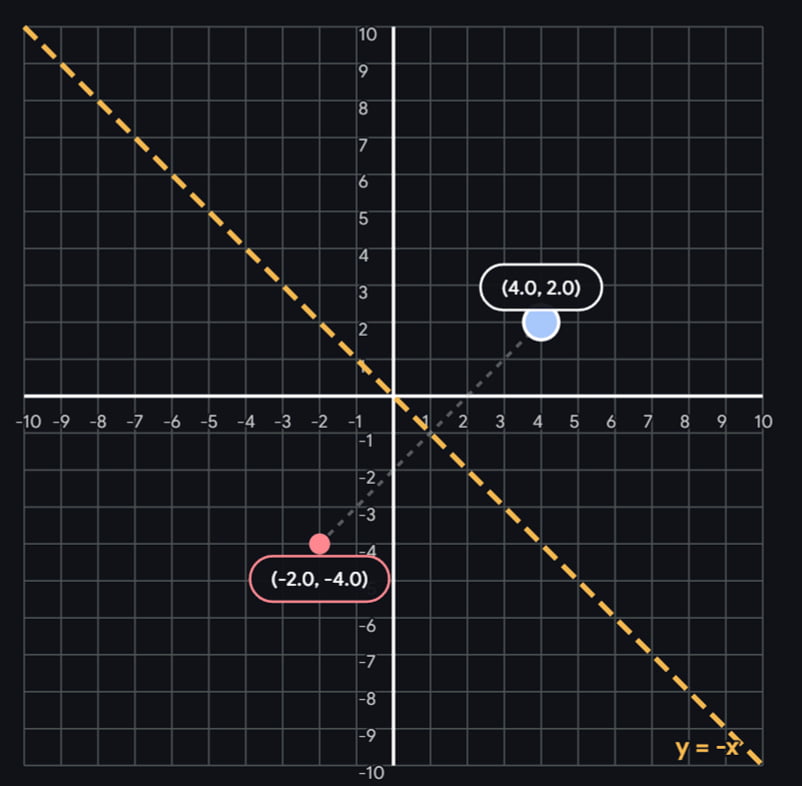
Reflection across the line \(y=-x\) sends the point \((x,y)\) to \((-y,-x)\).
In matrix form:
\[
\begin{pmatrix} 0 & -1 \\[4pt] -1 & 0 \end{pmatrix}
\begin{pmatrix} x \\[4pt] y \end{pmatrix}
=
\begin{pmatrix} -y \\[4pt] -x \end{pmatrix}.
\]
Points on the line \(y=-x\) are fixed (they satisfy \(y=-x\)); for example \((1,2)\) is reflected to \((-2,-1)\).
Detailed Explanation
Understanding what the line \(y = -x\) means for reflections
We explain step by step what it means to reflect a point across the line \(y = -x\), how to compute the reflected point, why the formula is correct, and give the matrix form. Each step is explained separately and in detail.
-
Describe the mirror line:
The line \(y = -x\) passes through the origin and has slope \(-1\). Its direction vector is \((1, -1)\). Geometrically it is a \(45^\circ\) line slanting down from left to right. When we reflect a point across this line, the line acts like a mirror: the original point and its reflected image are symmetric with respect to this line.
-
Set up the unknown reflected point:
Let the original point be \(P = (x, y)\). Let its reflection across the line \(y = -x\) be \(P’ = (x’, y’)\). Reflection means two things:
- The midpoint of the segment joining \(P\) and \(P’\) lies on the mirror line.
- The segment joining \(P\) and \(P’\) is perpendicular to the mirror line.
-
Write the midpoint condition:
The midpoint \(M\) of \(P\) and \(P’\) is
\[ M = \left(\dfrac{x + x’}{2}, \dfrac{y + y’}{2}\right). \]
Because \(M\) lies on the line \(y = -x\), its coordinates satisfy
\[ \dfrac{y + y’}{2} = -\dfrac{x + x’}{2}. \]
Multiply by 2 to obtain the linear relation
\[ y + y’ = -x – x’. \]
Rearrange to a convenient form:
\[ x’ + y’ = -x – y. \]
-
Write the perpendicularity condition:
The vector from \(P\) to \(P’\) is
\[ \overrightarrow{PP’} = (x’ – x, \, y’ – y). \]
The mirror line has direction vector \((1, -1)\). For \(\overrightarrow{PP’}\) to be perpendicular to the mirror line, their dot product must be zero:
\[ (x’ – x)\cdot 1 + (y’ – y)\cdot(-1) = 0. \]
Simplify this to:
\[ x’ – x – y’ + y = 0. \]
Rearrange to get
\[ x’ – y’ = x – y. \]
-
Solve the linear system for \(x’\) and \(y’\):
We now have the two linear equations:
\[ x’ + y’ = -x – y \]
\[ x’ – y’ = x – y \]Add the two equations to eliminate \(y’\):
\[ 2x’ = (-x – y) + (x – y) = -2y. \]
Therefore
\[ x’ = -y. \]
Subtract the second equation from the first to eliminate \(x’\):
\[ 2y’ = (-x – y) – (x – y) = -2x. \]
Therefore
\[ y’ = -x. \]
-
State the reflection formula and interpret it:
The reflection across the line \(y = -x\) sends a point \((x, y)\) to the point
\[ (x, y) \text{ reflected across } y=-x \text{ equals } (-y,-x). \]
In words: swap the coordinates and negate each one. Geometrically, the reflected point lies on the line perpendicular to \(y = -x\) through the original point, and the mirror line is the midpoint location between the point and its image.
-
Matrix form of the reflection:
The linear transformation that performs reflection across the line \(y = -x\) is given by the matrix
\[
\begin{pmatrix}
0 & -1 \\
-1 & 0
\end{pmatrix}.
\]Applying this matrix to the column vector \(\begin{pmatrix} x \\ y \end{pmatrix}\) yields \(\begin{pmatrix} -y \\ -x \end{pmatrix}\), consistent with the formula above.
-
Examples:
Reflect \((3, 1)\) across \(y = -x\): the image is \((-1, -3)\).
Reflect \((0, 2)\) across \(y = -x\): the image is \((-2, 0)\).
Summary: Reflecting across the line \(y = -x\) takes any point \((x, y)\) to \((-y, -x)\). This can be derived by enforcing that the midpoint of the point and its image lies on \(y = -x\) and that the segment joining them is perpendicular to \(y = -x\). The matrix of reflection is \(\begin{pmatrix} 0 & -1 \\ -1 & 0 \end{pmatrix}\).

FAQs
What geometric object is \(y=-x\)?
How do you reflect a point across the line \(y=-x\)?
Which points stay fixed under reflection in \(y=-x\)?
What is the matrix for reflection across \(y=-x\)?
How does reflecting a line \(y=mx+b\) across \(y=-x\) change it?
How do you reflect the graph of a function \(y=f(x)\) across \(y=-x\)?
What happens to slopes under reflection across \(y=-x\)?
Is reflection across \(y=-x\) the same as a rotation?
Try the interactive tools below.

Math, Calculus, Geometry, etc.

 Unlimited AI homework help

 Diagram Generator, Flashcard Maker, Notes Generator, Research Assistant, Answer Generator, AI Homework Helper & AI Detector