

Q. Identify the graph of \(y = \ln(x) + 1\).
Answer
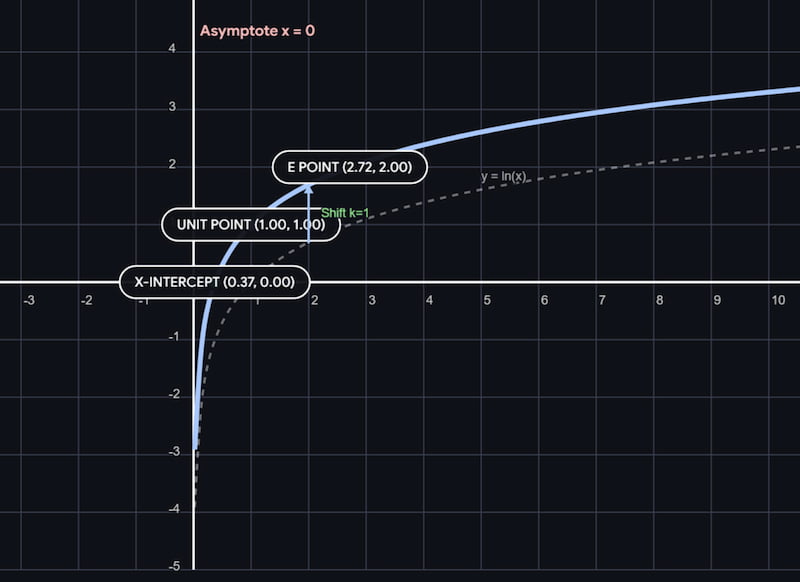
The graph is the natural logarithm shifted up 1 unit: \(y=\ln x+1\).
Quick properties and explanation:
– Domain: \(x>0\).
– Range: \((-\infty,\infty)\).
– Vertical asymptote: \(x=0\).
– x-intercept: solve \(\ln x+1=0\) gives \(x=e^{-1}\) (point \(\bigl(\tfrac{1}{e},0\bigr)\)).
– Point on the curve: \((1,1)\).
– Increasing for \(x>0\) since \(y’=\dfrac{1}{x}>0\); concave down since \(y”=-\dfrac{1}{x^2}<0\).
– Behavior: as \(x\) approaches \(0\) from the right, \(y\to -\infty\); as \(x\to\infty\), \(y\to\infty\).
Final description: the curve of \(y=\ln x\) shifted upward by 1 unit, with domain \((0,\infty)\), range \((-\infty,\infty)\), vertical asymptote \(x=0\), and x-intercept at \(\bigl(\tfrac{1}{e},0\bigr)\).
Detailed Explanation
Graph of y = ln x + 1 — Step-by-step explanation
- Recognize the parent function and transformation.The given function is a vertical translation of the natural logarithm. The parent function is \(y = \ln x\). The equation \(y = \ln x + 1\) is obtained by shifting the graph of \(y = \ln x\) upward by 1 unit.
- Domain and range.For the natural logarithm, the domain is positive real numbers. Therefore the domain of \(y = \ln x + 1\) is
\(x > 0\).
The range of the natural logarithm is all real numbers, and a vertical shift does not change that, so the range is
\(\displaystyle (-\infty, \infty)\).
- Vertical asymptote.The parent graph \(y = \ln x\) has a vertical asymptote at \(x = 0\). A vertical shift does not move vertical asymptotes, so \(y = \ln x + 1\) also has a vertical asymptote at
\(x = 0\).
- Intercepts and key points.There is no y-intercept because the graph is not defined at \(x = 0\).
Find the x-intercept by solving \(\ln x + 1 = 0\).
\(\ln x = -1\)
Exponentiate both sides with base \(e\):
\(x = e^{-1} = \dfrac{1}{e} \approx 0.3679\).
So the x-intercept is the point \(\left(\dfrac{1}{e},\,0\right)\).
Find a couple of additional convenient points:
- At \(x = 1\): \(y = \ln 1 + 1 = 0 + 1 = 1\). Point \((1,1)\).
- At \(x = e\): \(y = \ln e + 1 = 1 + 1 = 2\). Point \((e,2)\).
- Slope and concavity (shape).Compute the first derivative to check monotonicity:
\(\dfrac{dy}{dx} = \dfrac{d}{dx}(\ln x + 1) = \dfrac{1}{x}\).
For \(x>0\), \(\dfrac{1}{x} > 0\), so the function is increasing on its entire domain.
Compute the second derivative to check concavity:
\(\dfrac{d^2y}{dx^2} = \dfrac{d}{dx}\!\left(\dfrac{1}{x}\right) = -\dfrac{1}{x^2}\).
For \(x>0\), \(-\dfrac{1}{x^2} < 0\), so the graph is concave down for all \(x>0\).
- End behavior.As \(x\) approaches 0 from the right, \(\ln x\) goes to negative infinity, so \(y = \ln x + 1\) goes to negative infinity. In words: as \(x\) gets very small and positive, the graph falls without bound.
As \(x\) becomes large, \(\ln x\) increases without bound (but slowly), so \(y = \ln x + 1\) increases without bound as well.
- How to sketch the graph (step-by-step instructions).
- Draw the vertical asymptote line at \(x = 0\).
- Plot the key points found: \(\left(\dfrac{1}{e},0\right)\), \((1,1)\), and \((e,2)\).
- Remember the graph is increasing and concave down for all \(x>0\).
- Starting just to the right of \(x = 0\), draw the curve descending steeply toward negative infinity, passing through \(\left(\dfrac{1}{e},0\right)\), then rising through \((1,1)\) and \((e,2)\), and continuing to increase slowly as \(x\) increases.
- Summary description.The graph of \(y = \ln x + 1\) is the standard natural logarithm curve shifted upward by 1 unit. It has domain \(x>0\), range all real numbers, a vertical asymptote at \(x=0\), x-intercept at \(\left(\dfrac{1}{e},0\right)\), is increasing and concave down on its domain, and passes through \((1,1)\) and \((e,2)\).

FAQs
What is the function written explicitly?
What is the domain of \(y=\ln x+1\)?
What is the range of \(y=\ln x+1\)?
Does the graph have any asymptotes?
Where are the x- and y-intercepts?
How is this graph related to \(y=\ln x\)?
Is the function increasing or decreasing; what are its derivatives?
What is the inverse function of \(y=\ln x+1\)?
Choose a tool below.

Math, Calculus, Geometry, etc.

 Unlimited AI homework help

 Diagram Generator, Flashcard Maker, Notes Generator, Research Assistant, Answer Generator, AI Homework Helper & AI Detector