
Geometry shapes our world, influencing everything from architecture to technology. To navigate this world, a solid grasp of geometry terms...

Math Guide. Writing Proofs and the Geometric Proof in Geometry
Geometry is all about shapes, lines, points, and every angle or segment in between. A proof in geometry allows us to be certain that a given statement is definitively true. Writing proofs gives us explicit procedures that tell us why a conclusion is accurate. Whether you are solving an equation in algebra or finding the missing side of a triangle, a proof in math helps check facts. It follows a logical path, starting with facts we already know and concluding in a final, proven statement.
There is more than one different way to construct a proof. Some use a step-by-step format, while others explain ideas in a paragraph. Some rely on a visual diagram or a flowchart, and others use algebra. Each type of proof helps to verify a mathematical claim. This article will explore what geometry proofs are, how to organize them, and why they matter. By the end, you will see how proof writing transforms a challenging puzzle into clear, reliable logic.
Table of Content
ToggleFoundations of a Geometric Proof
A geometric proof is a logical method of demonstrating that a geometric statement is true. It is founded on facts, rules, and a solid reason to conclude a point. A proof is required because, without it, we would not know if a geometric rule always holds true. Every first step begins with simple concepts and progresses to more complex ones. The basics of any geometric proof depend on main components:
- Axiom: A foundational statement accepted as true without a proof.
- Postulate: Basic properties of geometric objects we assume to be true (such as the angle addition postulate).
- Definition: The exact meaning of a term. A clear definition is vital for any proof.
- Theorem: A new statement that can be proven using any axiom, postulate, definition, or property we have already proved.
One of the most significant influences on geometric reasoning is Euclid. Written over 2,000 years ago, his famous textbook, Elements, established the structure for the modern proof. Euclid used definitions, postulates, and logical steps to construct a proof. His work remains a cornerstone of how we teach and approach geometry today.
Types of Geometry Proofs to Teach
Direct Proofs
A direct proof uses step-by-step reasoning to show that a statement is true. Each step builds on the last. It starts with known facts and ends with the conclusion. This method relies on definitions, axioms, and any theorem previous mathematicians have established.
- Example: Proving the Triangle Sum Theorem, which states that the sum of the angles in any triangle is $$\angle A + \angle B + \angle C = 180^\circ$$.
By drawing a parallel line and using corresponding angles, we logically show the angles add up to $180^\circ$. This proof relies entirely on basic geometric facts.
Indirect Proofs (Proof by Contradiction)
In an indirect proof, we start with an assumption that is the exact opposite of what we want to prove. Through a series of logical steps, we show that this assumption leads to a contradiction.
- Example: Proving the irrationality of $$\sqrt{2}$$.
We assume that $$\sqrt{2}$$ is a rational number, meaning it can be expressed as a fraction $$\frac{a}{b}$$ (where $$a$$ and $$b$$ are integers with no common factors). By squaring both sides, we get $$2 = \frac{a^2}{b^2}$$, which leads to the conclusion that $$a^2$$ is an even number and must also be even. This leads to further steps showing that $$b$$ must be even as well, contradicting the assumption that $$a$$ and $$b$$ have no common factors. Thus, $$\sqrt{2}$$ is irrational.
Construction Proofs
Construction proofs use tools to create geometric objects to support a statement. These help create geometric objects or diagrams to prove a statement. These proofs are helpful for understanding geometric properties that we can see and build.
- Example: Constructing a perpendicular bisector. We use a compass to bisect a segment, creating two equal parts.
We first use a compass to draw two circles with the same radius centered at each endpoint of the segment. The intersection of these circles gives us two points. Connecting these intersection points with a straightedge produces the perpendicular bisector, which divides the original segment into two equal parts.
Algebraic Proofs
An algebraic proof using coordinate geometry combines visual shapes with algebra. This method is common when a geometric figure is on a coordinate plane. Algebraic equations help show geometric relationships.
- Example: Proving the midpoint formula. You can demonstrate that a midpoint is correct by establishing that the distances from each endpoint are equal.
Let’s say we have two points, $$A(x_1, y_1)$$ and $$B(x_2, y_2)$$. The midpoint $$M$$ of the line segment connecting these points is found by averaging the x‐ and y‐coordinates of the two points: $$M = \left(\frac{x_1 + x_2}{2}, \frac{y_1 + y_2}{2}\right)$$. One can demonstrate that $$M$$ is the midpoint by establishing that the distances from each endpoint to $$M$$ are equal using the distance formula.
The Two-Column Proof and Other Formats
A proof enables us to demonstrate the truthfulness of a claim. Various approaches exist to organize this evidence. Let us introduce the most commonly used structures in high school geometry.
Two-Column Proofs
A two-column proof is a simple and organized way to try writing a proof. It has one column for a list of statements and a second column for a list of reasons. This layout makes it easy to follow each step. Two column proofs are famous for clear justification.
- Example: Proving congruence using the ASA (Angle‐Side‐Angle) Theorem.
Here’s how you might set it up:
| Statement | Reason |
|---|---|
| Triangle ABC and Triangle DEF are given. | Given |
| $$\angle A = \angle D,\quad \angle B = \angle E,\quad AB = DE$$ | Given |
| $$\angle C = \angle F$$ | Angle Sum Theorem |
| Therefore, $$\triangle ABC \cong \triangle DEF$$ | ASA Theorem |
Paragraph Proofs
A paragraph proof is written as a story. It connects all the logical steps in one paragraph without visually separating the statement and reason. It explains the reasoning in a natural, flowing way.
- Example: Proving vertical angles are equal. When two lines intersect, they form pairs of opposite angles. The vertical angles are congruent since they share a common vertex. Thus, by definition, $\angle 1 = \angle 2$.
When two lines intersect, they form pairs of opposite angles. The two vertical angles are congruent to each other since they share a common vertex and are formed by the same lines. Thus, by definition, vertical angles always satisfy $$\angle 1 = \angle 2$$.
Flowchart Proofs
A flowchart proof shows the steps visually. Using arrows to connect each statement, it makes the logic easy to follow. A flowchart is an excellent alternative if you are not yet comfortable with using a traditional two-column proof.
- Example: Proving the properties of parallelograms.
In a parallelogram, the opposite sides are equal and parallel. A flowchart can show how we use the definition of a parallelogram and the properties of parallel lines to prove these facts step by step.
Coordinate Geometry Proofs
Coordinate geometry proofs use algebra on a coordinate plane to prove that angle or side relationships exist using slope or distance formulas.
- Example: Proving the distance formula. If you have two points, $$(x_1, y_1)$$ and $$(x_2, y_2)$$, the distance between them is given by $$d = \sqrt{(x_2 – x_1)^2 + (y_2 – y_1)^2}$$.
High School Geometry: Fundamental Theorems
Several key theorems in geometry provide foundational rules for proving various properties. A few key theorems provide foundational rules for proving a property:
Triangle Congruence Theorems
Triangle congruence theorems affirm that two triangles are congruent in size and shape. When two triangles are exactly the same size and shape, the triangles are congruent.
- SSS (Side‐Side‐Side): Two triangles are congruent if three sides of one triangle match three sides of another triangle.
- SAS (Side‐Angle‐Side): Two triangles are congruent if two sides and the included angle of one triangle match two sides and the included angle of another triangle.
- ASA (Angle‐Side‐Angle): Two triangles are congruent if two angles and the included side of one triangle match two angles and the included side of another triangle.
- CPCTC (Corresponding parts of congruent triangles are congruent): This means if you prove congruence, every matching pair of sides or angles will correspond perfectly.
Example Proof: Proving congruence using the ASA theorem. If we know that $$\angle A = \angle D$$, $$\angle B = \angle E$$, and $$AB = DE$$, we can prove that $$\triangle ABC \cong \triangle DEF$$ by ASA.
Parallel Lines and Angles
When a transversal cuts two parallel lines, the angles formed have specific relationships. Key angle pairs include:
- Alternate Interior Angles: These are equal when a transversal cuts two parallel lines.
Example Proof: Proving that alternate interior angles are equal. If lines $$\ell$$ and $$m$$ are parallel and are cut by transversal $$t$$, then $$\angle 1 = \angle 2$$.
Pythagorean Theorem
The Pythagorean Theorem states that in a right triangle, the square of the hypotenuse is equal to the sum of the squares of the other two sides: $$a^2 + b^2 = c^2$$. You can prove this theorem using different methods, like algebraic or geometric reasoning. It is key for many geometric calculations, especially with right triangles.
How to Approach a Geometric Proof
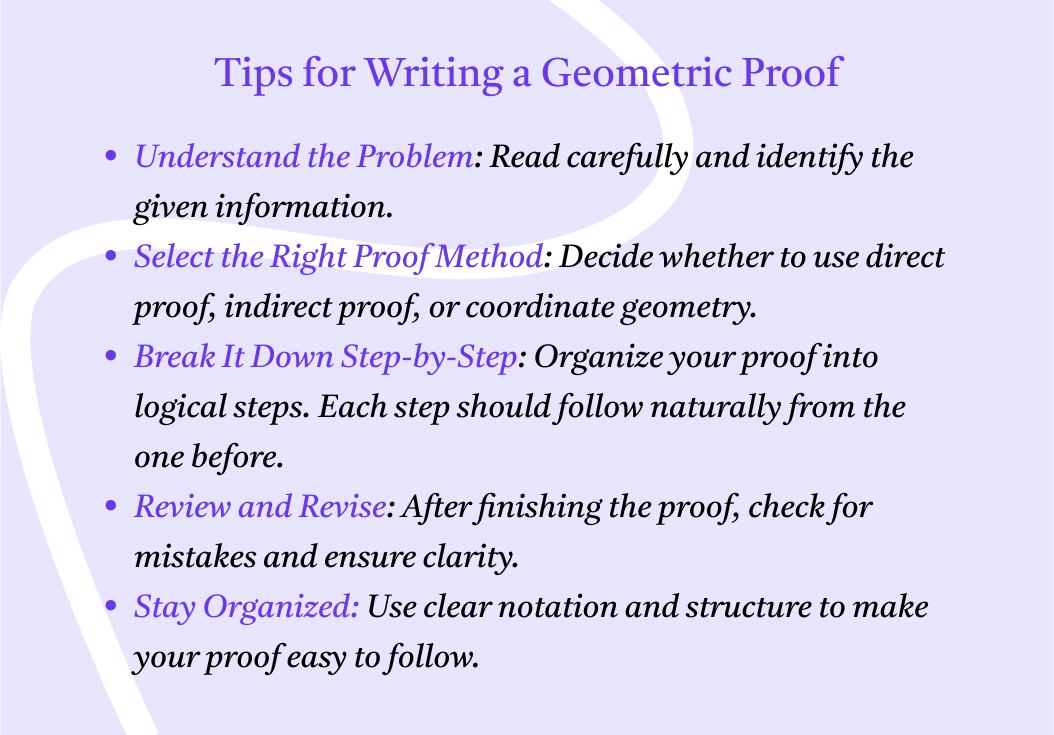
Writing a geometric proof can seem hard, but it gets easier. Start by reading the problem carefully. You can also use resources like the geometry AI solver to help organize and understand geometric proofs. Next, think about how to prove the statement. You can use direct proof to show each step in order. Or you can try an indirect proof (proof by contradiction) if needed. If the problem involves coordinates, use coordinate geometry. Choose the best method for the problem.
Then, break the proof into clear steps. Each step should follow from the one before it. Make sure each step is explained with a reason. This will help make the proof easy to follow. Once the proof is done, review it carefully. Check for mistakes or unclear steps. Ensure the logic is correct, and each step is backed up with a reason. Revising will make your proof clearer and more accurate.

- Read the problem carefully.
- Sketch a diagram to visualize the shapes.
- Think about how to logically approach the goal. Sometimes working backwards from the conclusion helps you find the right postulate or property.
- Write down a statement for every reason. You might use a two-column proof or a paragraph. You might simplify by using substitution.
- Verify every justification.
Whether you are working from a textbook or a free pdf worksheet, revising will make your proof clearer.
Learning these methods is crucial. If you learn a completely different type of proof, you still strengthen your overall logic. The more you practice writing proofs, the better problem solver you become. Over time, proof writing will become a natural and essential part of your mathematical toolkit.
Final Words
We looked at different ways to write geometric proofs. Some of these ways include two-column proofs, paragraph proofs, and diagram or algebra methods. All of these ways help to make geometric concepts more understandable and organized. Learning these methods is crucial. They also help you become a better problem solver in geometry and beyond. The better you become at making proofs, the more easily you can handle tough challenges. The more you practice making proofs, the better you get. Over time, proof-writing will become a natural part of your mathematical toolkit.
Explore Similar Topics
Although Geometry is not extremely difficult, like organic chemistry or quantum physics, it takes time and effort to learn it...
According to my experience, preparing for the NYS Geometry Regents exam requires not only a sharp mind but also diligence...