
Are you a high school student curious about chemistry? Many summer programs are available to help you explore this exciting...

Why is Critical Thinking Important for Study, Work, and Everyday Decisions
In an AI-first market, employers set higher standards. The top skill is the ability to conduct clear analysis, ask tough questions, and exercise sound judgment. So, why is critical thinking important? In plain terms, it means careful use of facts, fair tests of claims, and a decision that stands up to scrutiny. You see the payoff at work, in school, and in everyday life.
It lifts teamwork, sharpens communication, and keeps bias out. It also improves problem-solving while enhancing decision-making. Expect a rapid, visual tour that shows what improves in classrooms, what changes on the job, and what gets easier at home as critical thinking skills rise.
Table of Content
ToggleWhat Experts Mean by “Critical Thinking Skills”
Experts often refer to critical thinking as a rational, self-controlled evaluation. It mainly involves core skills, reasoning, drawing conclusions, evaluating, and clarifying, as well as characteristics such as being open-minded, seeking the truth, and being fair. The APA Delphi consensus is the source of this statement and the basis for the language used in instruction and assessment. Clear terms matter.
When one researcher checks reasoning with puzzles and another checks argument quality, their results cannot line up. A shared framework allows schools and employers to measure the same thing and see the real progress when learners develop critical thinking skills. Key parts include the following:
- Weigh evidence
- Consider multiple viewpoints
- Refer to your own ideas and past actions
- Form a reasoned conclusion
In practice, this means learners do more than answer correctly. They understand why their choice makes sense and what shaped it. Self-reflection, therefore, is the process that finally connects and eventually leads to the improvement of the next decision. There are students who, during their studies, want quick help, and in this case, tools that help structure questions and evidence can be of tremendous assistance. Some students use AI help with homework to plan the steps, check the claims, and note the sources. The goal is still to make better decisions in class, at work, and in daily life, especially when solving complex problems.
The Labor-Market Case: Where Critical Thinking Moves Careers
Across fields, employers keep naming the same core skill: the ability to think clearly. Data from the World Economic Forum shows that analytical thinking is at the top of the skills needed over the next few years, with creative thinking close behind. These skills determine who manages unclear tasks, who receives decision-making trust, and who transitions into roles with increased responsibility. An AAC&U survey shows a similar trend for the three skill areas of critical thinking, communication, and teamwork. However, numerous employers report that fresh graduates rarely demonstrate these skills, so their on-the-job progress is somewhat slow.
LinkedIn skill reports line up with this view. Communication, project work, teamwork, analytics, and problem-solving consistently appear. Workers must verify outputs, test claims, and confirm steps before using AI tools in daily tasks. In interviews, a candidate can demonstrate their abilities by clearly stating the problem, noting the options considered, explaining why one option was chosen, and highlighting the resulting outcome. This procedure illustrates how a person transitions from a messy task to a clear outcome, a method effective across teams and sectors that highlights the role of effective communication.
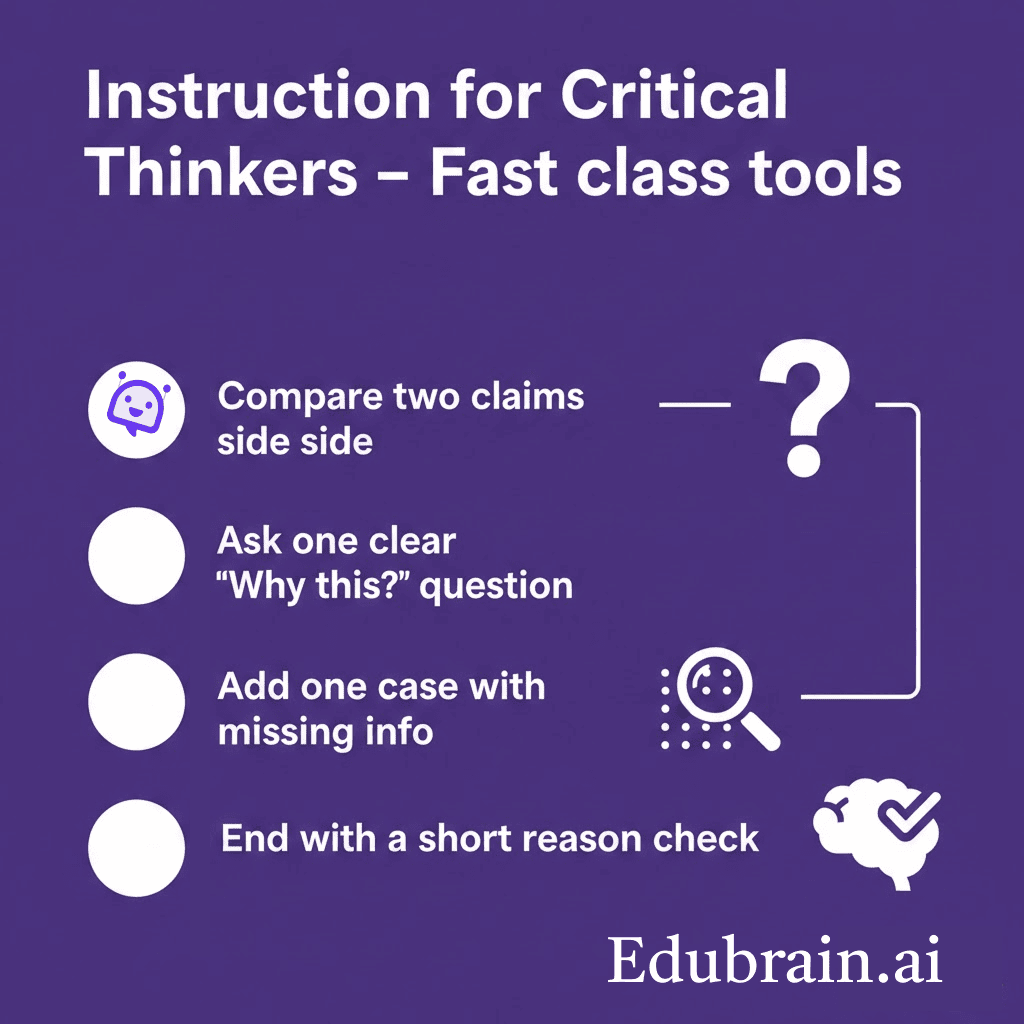
Instruction for Critical Thinkers
More than thirty studies demonstrate the possibility of teaching critical thinking. Large research reviews find steady gains when teachers show each step in the thought process. Results are stronger when critical thinking is part of the subject, not treated as an extra task. Classes that include short pupil explanations, comparison of two possible answers, and work on real cases show clearer improvements than classes built only on short drills.

- In each unit, the thinking objectives should be made clear: outline how students will challenge assumptions, recognize biases (even their biases), compare arguments, and verify claims through data analysis.
- Design a structured talk. Socratic questioning, debate protocols, and argument mapping build habits like active listening and fair evidence use.
- Integrate critical thinking into real-world scenarios, such as science labs that solicit competing hypotheses, history assignments that evaluate contradictory sources, and business cases that necessitate risk assessments, as transferability enhances when students utilize tools in genuine contexts.
- Close each cycle with a short written self-reflection to consolidate strategies and reduce overconfidence.
Together, these steps enhance critical thinking without turning it into a stand-alone add-on. One more practical angle matters in STEM: thoughtful use of digital scaffolds. Students can explore stepwise reasoning with a calculus AI helper while the assignment still requires full justification, checks for faulty leaps, and a clean chain of logic.
Still, the student’s answer will be graded on the level of their explanation of the choices, identification of weak assumptions, and correction of mistakes. When technology is employed in such a manner, it aids the development of a growth mindset and does not allow the focus to drift from the quality of reasoning to that of answer hunting.
The Importance of Critical Thinking in the AI Era
AI is capable of handling tasks very quickly. Critical thinking sets the task, checks the result, and makes the final decision. The World Economic Forum expects analytical and creative thinking to stay at the top of needed skills through 2030. This shows that critical thinking remains central in many jobs, affecting personal decision-making. People define the problem, set limits, and verify claims. Models produce options. People then review the risks and choose the path. Core actions in this process:
- State the problem in clear terms
- Check the source of the information
- Compare more than one option
- Confirm the reason for the final choice
The approach lowers mistakes and enables the teams to make a change in their way of working very quickly if it is necessary. The method can also be used in areas independent of work, such as health, money decisions, or taking advice from AI tools. Outcomes are better when you have the goal set, check the source, and compare the options before taking a step. Hiring reports this year agree on one thing: companies want to employ people who can exhibit both adaptability and critical thinking skills, as this combination is capable of handling tasks of an undefined nature without losing their sense of direction.
Information Quality and Citizenship
The Stanford History Education Group’s national investigations reveal a distinct pattern: many students find it difficult to assess online legitimacy, misinterpret sponsored content, and rely on flimsy cues like follower counts. Since professional fact-checkers routinely beat students and even subject-matter experts on these activities, instruction that teaches lateral reading, leaving the page to examine who’s behind it, improves accuracy and speed. A simple routine helps to solve problems:
| Step | Quick check | Critical-thinking move |
| Stop (SIFT) | Define your purpose | Set scope; avoid knee-jerk shares |
| Investigate | Who runs this site? | Source credibility; funding, expertise |
| Find coverage | Compare multiple reports | Corroboration; question assumptions |
| Trace | Follow data to origin | Verify context; spot edits or misquotes |
Practice makes perfect. If you want to get better at verification, then you need to treat it as an ongoing process: write down what would change your mind, keep track of sources, and check claims when you get new evidence. Such an approach not only helps to achieve academic success but also leads to making wiser decisions at home.
For instance, learners aiming to be better at physics can perform similar verification checks on explanations, problem “shortcuts,” and physics-related videos. Consistently using these same habits also helps in developing strong judgment that lasts a lifetime.
Who Develops Critical Thinking
PISA 2022 shows a clear pattern: students from higher-income homes score higher in creative and critical thinking than those from lower-income homes in most countries. This matters because these skills support daily decisions, work tasks, and public life. The lesson is that schools cannot assume these skills will appear on their own. Progress happens when pupils practice reflective thinking by checking sources, asking clear questions, and working through real problems with evidence.
Research across OECD systems shows that structured tasks, steady support, and regular feedback help close these gaps. In class, this can mean comparing claims from more than one source, stating the reasons for a conclusion, and applying a critical eye to easy explanations across mathematics, science, and humanities. When these habits are taught directly, more pupils gain the ability to use evidence across subjects and later in work.
Benefits of Critical Thinking
One can observe critical thinking on the first page of a study paper. You scrutinize the research question, introduce the research method, and determine whether the data support the statement. You are questioning the assumptions of the literature review, considering arguments of reason, and indicating the gaps that a more resolute design would address.
Such experiments are also made more productive: you identify variables, predict outcomes, and conduct objective analysis to explain the findings. Not only can one develop their level of analytical skills because of their logical thinking, but they can also communicate. Quick examples you can copy into practice:
- Study: Verify the author’s credentials, restate the claim in one sentence, and then list the strongest counterclaim.
- Work: Ask “What would change our choice?” before a meeting; write two options with costs, risks, and success metrics.
- Life: Use SIFT on a viral post; check who runs the site, compare coverage, and trace quotes to the source.
Strong critical thinking skills turn confusion into clear choices. You trace cause and effect, compare options, and look at the trade-offs. An AI research assistant can help collect sources, but you decide what is solid and what is not. The same approach applies in daily life. You check if a “free” offer has a catch, you confirm health claims, and you use SIFT when news spreads fast. You pause after each decision to see what worked and what did not. Over time, this leads to better choices at school and at home.
Conclusion
Critical thinking is developed through habit rather than luck. Suppose a lesson uncovers the reasoning steps and provides time to verify sources and compare alternatives. In that case, students learn how to go from a problem to a conclusion with less confusion. Questioning what piece of evidence would change the decision helps the process to remain truthful and diminishes bias.
These behaviors are transferable to math, science, and humanities subjects, as well as making decisions in daily life outside school. By consistent practice, students acquire a method they can trust with different tasks and their future studies or work.
Explore Similar Topics
Homework has been a cornerstone of education for generations. It has sparked endless debates among educators, parents, and students. Some...
Some may find geography uninteresting. Yet, it holds lessons for daily life. It’s not just a subject that you either...