
Many students say math is the subject they fear the most. Not because they never understood numbers, but because at...

Best AI for Chemistry Problems for Students & Researchers I Tested
AI has quietly become one of the most powerful allies for students, educators, and even professional chemists. Whether you need retrosynthesis planning, or step-by-step solutions for stoichiometry at an odd hour, you’ll find these tools helpful.
I spent several weeks testing some of the most talked-about AI chemistry solvers available right now. Here’s what I found, including which ones genuinely helped me learn, which ones just handed me answers, and one that surprised me enough to become my regular go-to.
Table of Content
ToggleChemistry AI Solver by EduBrain: My Top AI-powered Chemistry Tutor

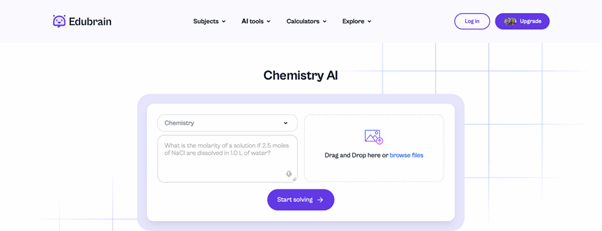
If I had to recommend just one tool from this entire list, it would be the chemistry AI solver by EduBrain. The reason is simple: it doesn’t just give you answers. It teaches you how to get there. I uploaded a photo of a handwritten problem involving limiting reagents, the kind of messy, real-world input that trips up a lot of AI tools. EduBrain handled it without flinching. The solution came back broken into clear, logical steps that actually helped me understand where I’d gone wrong in my own approach. That’s rarer than it sounds.
Pros:
- Focuses on teaching the user how to reach the answer.
- Supports multi-modal input, including text, photos, and PDFs.
- Covers a wide range of topics from basic periodic concepts to advanced organic mechanisms.
Cons:
- The free plan limits users to uploading only one file at a time.
- Can feel restrictive when working through large problem sets.
Price: Free tier available. $3.99/week for AI-Plus ad-free & advanced features.
ChemGenius.ai: Best AI Tool for Collaborative Chemistry Solutions

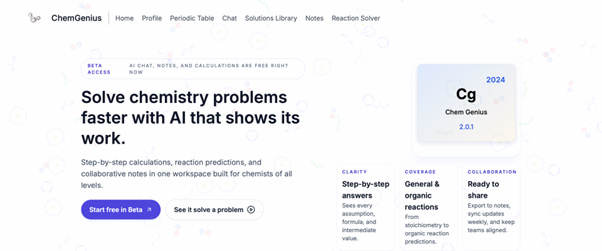
ChemGenius.ai caught my attention because it’s built with shared learning in mind. When I was working through a set of cheion prediction problems with a study partner, the ability to share notes and annotate solutions together genuinely streamlined our session in a way that a basic chatbot simply couldn’t.
Pros:
- Allows users to share notes and annotate solutions together in real-time.
- Generates reaction predictions alongside worksheets and study notes.
- Excellent performance for foundational chemistry concepts.
- It produces reaction predictions to create a more complete study environment.
Cons:
- Currently in beta, leading to some unpolished features.
- Occasional inconsistencies when handling advanced organic chemistry reactions.
Price: Free beta version. They may introduce subscription later.
ChemAI: The All-in-One Lab Companion

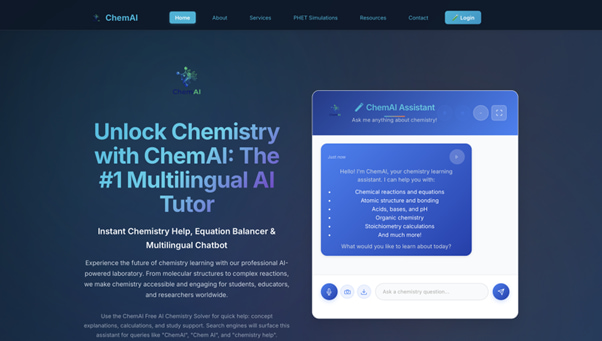
ChemAI.in is the closest thing to a full chemistry research environment in this list. When I first opened it, I genuinely wasn’t sure where to start. There are interactive virtual labs, 3D molecular visualisation tools, retrosynthesis planning, spectroscopy analysis, mind maps, and more. For a student who has been relying on textbooks and a basic calculator, the jump is significant.
I spent the most time with the 3D molecular models, which helped me finally visualise why certain stereoisomers behave differently. Seeing the spatial relationships rather than just reading about them shifted something in my understanding. The retrosynthesis planner is similarly impressive: you input a target molecule and it works backwards through plausible synthetic routes.
Pros:
- Offers interactive virtual labs and 3D molecular visualization.
- Helps users visualize spatial relationships in stereoisomers.
- Includes a retrosynthesis planner that works backward from a target molecule.
- Provides spectroscopy analysis and mind mapping tools.
Cons:
- The sheer volume of features can be overwhelming for casual users.
- Advanced capabilities like SpectraFuse and enhanced simulations are behind a paywall.
Price: Many core chemistry features come for free. Advanced analysis, lab simulations, and retrosynthesis require the paid plan, but pricing isn’t published and usually involves contacting the platform.
In addition to solving complex equations, the best AI for chemistry problems can be paired with an AI diagram generator to visualize molecular structures and reaction pathways. This combination helps students and researchers transform abstract data into clear, academic-ready visuals for better understanding.
Flowith AI Chemistry Solver: Best for Visual Thinkers

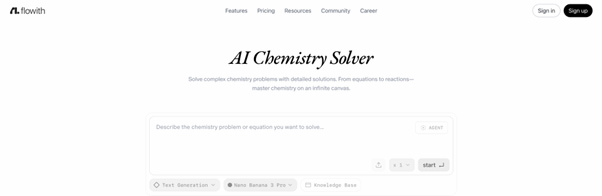
Flowith has a genuinely different interface from everything else I tested. Rather than a standard chat window, it gives you an infinite canvas where you can lay out problems, solutions, and notes spatially. It in fact, makes connections across problems and compares approaches side by side.
I used it to work through a set of stoichiometry problems where I kept getting confused about molar ratios. Being able to place each problem next to its solution, draw arrows between related concepts, and zoom out to see the big picture helped me spot the pattern I had been missing.
Pros:
- Uses an infinite canvas to lay out problems and notes spatially.
- Allows users to draw connections and zoom out to see the big picture of concepts.
- Quickly balances complex equations and handles organic, physical, and general chemistry.
- Includes collaboration features for sharing canvases with classmates.
Cons:
- The interface takes time to get used to compared to traditional chat tools.
- Some advanced features require a premium plan.
Price: Free tier available. The annual premium subscription starts at $15.39/mo.
Chymia: The Step-by-step Snap a Photo Study App

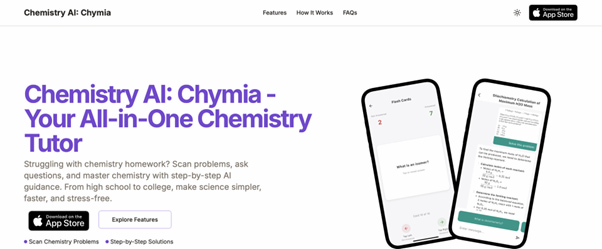
Chymia is where I went when I was studying away from my desk and needed answers fast. The photo-scanning feature is its standout capability. I’d snap a picture of a problem in my textbook or on a past exam paper, and within seconds, Chymia would parse it and walk me through the solution. For learning on the go, this approach is hard to beat.
For exam prep and building a solid conceptual foundation, the adaptive learning features make it genuinely valuable. After a week of using Chymia, the quiz recommendations had shifted noticeably toward anything involving electrochemistry in my case.
Pros:
- Features a fast photo-scanning capability.
- Includes integrated flashcards, cheat sheets, and adaptive quizzes.
- Adjusts quiz recommendations based on the user’s specific weaknesses.
- Designed as an all-in-one student AI tutor (from basics to college homework).
Cons:
- Not well-suited for deep research or complex synthesis planning.
- The free tier has limits, with advanced tools requiring a subscription.
Price: Free download with premium features available. Typically uses in-app subscriptions. The tool is designed for iPad.
UPDF AI Chemistry Solver: Best Speed-to-Answer Chemistry ChatGPT

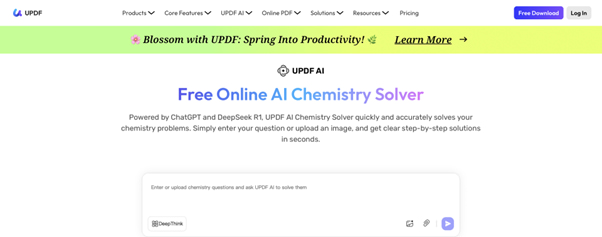
UPDF positions itself as a fast, powerful solver, and that’s an accurate description. Backed by AI models including ChatGPT 5 and DeepSeek R1, it handles a wide range of chemistry problems quickly and with detailed step-by-step breakdowns. When I was working against a deadline and needed to check a series of pH calculations, UPDF was the tool I reached for.
UPDF AI is great for getting an answer fast, less great if you’re trying to understand the underlying mechanism.
Pros:
- Extremely fast solver backed by ChatGPT 5 and DeepSeek R1.
- Provides detailed step-by-step breakdowns for problems like pH calculations.
- Offers cross-platform support for desktop, mobile, and web.
- Free tier allowing for approximately 100 queries.
Cons:
- Query limits can run out quickly during intensive study sessions.
- Sometimes oversimplifies explanations for advanced theoretical questions.
Price: Free up to 100 questions/month. Paid plan for unlimited usage at $49.99.
Struggling with complex equations or reaction logic? You can ask AI free question to get instant, step-by-step guidance and clear solutions for any chemistry problem.
EaseMate AI Chemistry Solver: Best Zero Friction Entry AI Tool for Chemistry

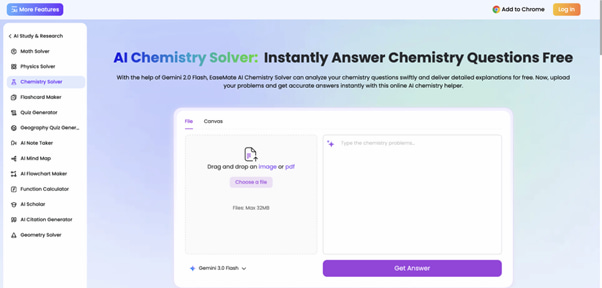
What surprised me was the quality of the explanations. EaseMate doesn’t just solve the problem; it highlights common mistakes associated with that type of question and generates a short quiz to test whether you’ve actually absorbed the concept. For a free, no-signup tool that is available also as a Chrome extension, that’s a thoughtful approach.
Pros:
- Requires no account creation, subscription, or email signup.
- Highlights common mistakes associated with specific types of questions.
- Generates short quizzes to ensure the user has absorbed the concept.
- Completely free to use.
Cons:
- Lacks advanced research features.
- Does not integrate with lab tools or synthesis planners.
Price: Free to use. The annual subscription starts at $7.49/month.
GolloAI Chemistry Solver: Best for Exam Prep on Chemistry Concepts

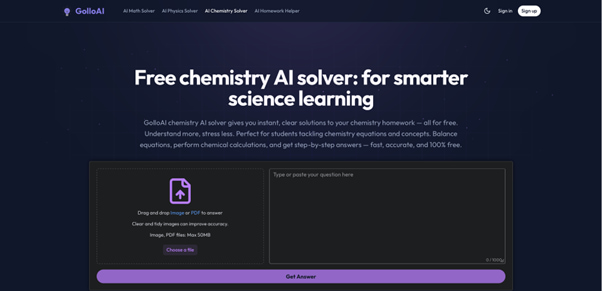
GolloAI is built with students in mind, specifically those preparing for standardised exams. It balances equations, handles stoichiometry calculations, and produces clear step-by-step explanations that prioritise understanding over speed. When I worked through a set of AP Chemistry practice problems with it, the explanations mapped closely to the kind of structured reasoning that exam markers reward.
Pros:
- Produces explanations that map closely to the reasoning exam markers that reward.
- Prioritizes understanding and clear steps over quick answers.
- Supports photo uploads for handwritten practice problems.
- Entirely free with no barriers for heavy use during exam season.
Cons:
- Less powerful for graduate-level problems or complex chemical reaction mechanisms.
- May be slower at delivering answers compared to tools built for rapid output.
Price: Completely free tool. No subscription required.
How to Choose the Best AI Chemistry Solver for You
After testing all 8 of these tools, the pattern that emerged is that the best one depends almost entirely on how and where you’re using it. If you’re a student who needs to genuinely understand concepts rather than just copy answers, EduBrain’s step-by-step approach is the right foundation. If you’re preparing for exams, GolloAI’s structured explanations closely match the format you’ll be expected to produce on the exam day. If you’re doing research-level work, ChemAI’s suite of advanced features (especially the retrosynthesis planner and spectroscopy analysis) justifies the learning curve.
One thing all of these tools share is that they work best when you engage with them actively. Typing in a problem to analyze and accepting the output without reading the solution is a missed opportunity. The best AI chemistry tools treat every problem as a teaching moment, not just a calculation to complete. Thus, pay attention not just to whether the tools you use get the answer right but to whether they help you understand why.
Explore Similar Topics
Artificial intelligence (AI) is transforming educational technology. This change is particularly notable in mathematics. Traditional teaching methods now integrate with...
In 2025, automated assistants can produce emails, blog posts, study notes and technical summaries within seconds. This efficiency is useful,...