Almost every teen brings a cell phone to school, yet schools statewide and abroad now move from loose rules to...

Digital Distractions. Cell Phone Use Linked to Lower Academic Performance
Classrooms feel full of electronic devices. The loud claim, that a phone is a major distraction in school, raises a fair question: how many students drift off-task during class time. This research seeks a clear count based on data from the National Center for Education Statistics and the Pew Research Center, rather than hunches.
Table of Content
ToggleHow Cellphone Use in Class Impacts the Student
Numbers show how cell phone use breaks focus, sparks side chats, and forces distractions on students’ learning. By the end, you will get an answer on scale and impact – and what the evidence says about student learning.
Defining Classroom Distraction, Smartphone Use and Digital Devices
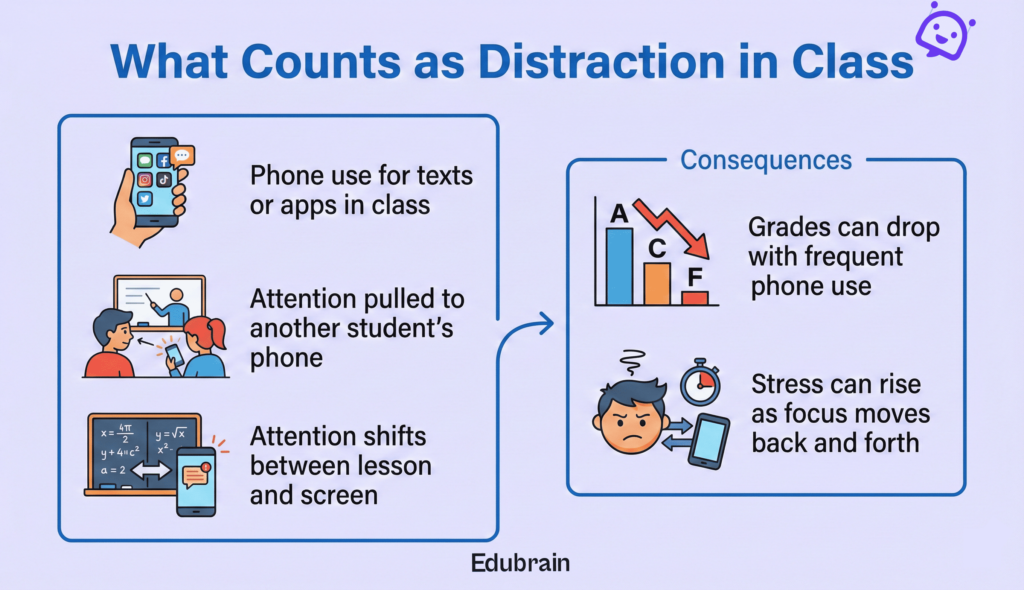
Distraction covers off-task cellphone use (texts, social apps, quick games) and “peer distraction,” where nearby smartphones or other digital devices steal attention in the classroom. A student using mobile phones can disrupt a room even if the phone sits face-down. Researchers compare student self-reports, teacher logs, and app records; results vary across K-12 and college students, and they change under a ban with weak enforcement.
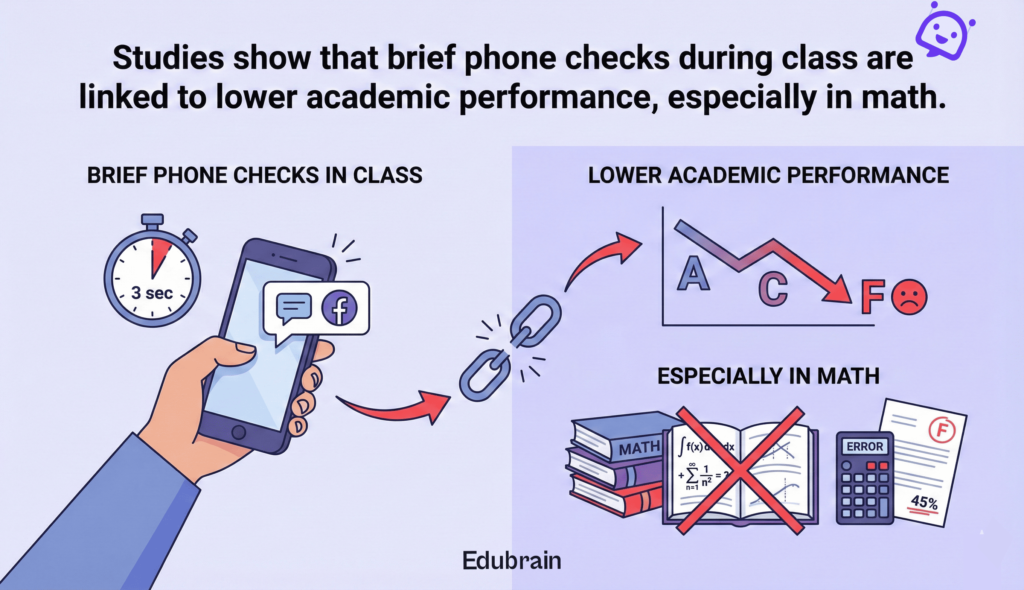
Studies link off-task use in the classroom to lower academic performance and added strain on students’ mental health. Good rules also enable students to use technology with purpose: coding tools and homework resources sit beside calculators, so phones during class support the class task rather than distract from it.
Good rules also enable students to use tech with purpose: tools in communication education and coding homework help resources sit beside calculators and note apps, so phones support the task rather than derail it.

What Teachers Say? A Major Problem in the Classroom
Concern sits high among educators. High school teachers say cellphone distraction is a severe issue. According to the National Center for Education Statistics, half of public school leaders view this as a primary hurdle. In fact, public school leaders say cell phones hurt academic performance across all grades, calling it a major problem in the classroom.
- 72% of U.S. teachers say cell phones are a major classroom distraction. Many parents agree.
- In a school or district with cellphone bans, 29% of students still use a smartphone several times a day; 21% report daily use.
- 59% of students say peers’ use of digital devices diverts their attention in at least some math lessons.
- One study found that teens can receive up to 273 notifications a day.
- By the end of 2024, approximately 40% of worldwide education systems had policies limiting use during class.
These figures frame practical questions for digital literacy. Habits persist without clear routines that teach students self-discipline.
The Student Experience. K-12 vs. Higher Education Academic Performance
A cell phone used by a student sitting two seats away causes a spillover, so even the students who use discipline to try to focus are impacted. Teachers often say that students being distracted by device use is a daily challenge. PISA data indicates that checking devices in the classroom during a lesson is considered rule-evasion. This pattern is linked to lower math results.
The picture changes outside the school yard. In higher education, psychology students and other college cohorts talk of self-directed multitasking (like checking emails or taking out a cellphone), and concede that they lose time and weaken recall. For example, even basic laptop use can distract a student if not guided. Many schools are strengthening measures by establishing clear cell phone policies for a better learning environment.
| Setting | What happens | Effect |
| K–12 | Phones pull attention in class | Math scores drop; lower test scores occur. |
| Higher Ed | Electronic devices used for texts in class. | Focus drops and lower grades can follow. |
How Many Students Are Distracted?
Data from PISA 2022 aligns with earlier results. Even under a ban, a high percent of students admit to usage. When students were asked about their habits, about 29% still check their cell phones several times a day. For example, geometry AI helps break down a proof or shape task into clear stages, and many learners rely on it to follow the logic after the lesson ends without extra cost or a private tutor. Typical technology use and phone distractions in class include:
- Replying to a short message on smartphones.
- Looking at new posts on social apps.
- Checking email inbox for new information.
- Tapping an alert on the lock screen.
- Opening a calculator on their cellphone.
Rules differ by school or district. Across sources, a steady range appears: about 20-30% of students use phones during the school day, and about one-half to three-fifths report attention pulls from peer devices in class.

What Teachers Say About Cellphones and Student Learning
Teachers talk bluntly about the use of electronic devices. A majority assert that using cell phones and students’ use of cell phones divert attention and lead to a lower test result. Surveys from the Pew Research Center confirm this view: adults feel the impact of cell phone use on academic achievement is highly negative. They believe phone use on academic performance actively harms retention.
Students answer with a less serious view. They admit to students using phones for a quick check but maintain they return to work quickly. This sets the gap: adults focus on the results, while the student focuses on the intentions. Schools can prioritize lesson plans and have brief open periods for the use of cell phones so phones become tools for work rather than a distraction.
Enforcing a Ban on Smartphone Use in the Classroom
Phone regulations are becoming stricter worldwide. By late-2024, 79 education systems had imposed limits on phone use in classrooms. In England, the movement for banning cell phones (or banning cell access entirely) is strong.
Prohibitions are beneficial only when enforced. 29% of students in schools with rules still check their mobile phones daily. Behavior only changes when there are physical storage places for students’ devices, cutting down cellphone use. In the U.S., about three out of ten public schools block use in school all day, while others allow cell phones during class only at a teacher’s signal.
How Digital Distractions Impact Academic Performance
Most of the time, data points converge. If phones are not silenced, student concentration deteriorates. The use of cell phones and regular smartphone use line up with weaker math results. Students using their cell phones to multitask between screens are less likely to recall information.
- Regular cell phone use checks line up with weaker results.
- Watching other students using phones hurts focus too.
- Limits link to more on-task student behavior.
When a school treats the cell phone as a tool for specific moments rather than a constant companion, a student holds their attention more easily.
The Root of Classroom Distraction and Use in Class
Diaries reveal that a student goes off-task due to boredom or habit. Whenever there is a dull moment, a student quickly takes out their phone to scroll. However, when an educator incorporates technology to build digital literacy, the pattern changes. A class that explores study paths can use phones to check requirements and bring answers back to the room.
Key factors to watch:
- Open Wi-Fi and unmonitored time invite a student to distract themselves.
- Clear norms and “tech-on/tech-off” cues cut noise.
- Active learning keeps heads in the class.
- Short, timed phone windows reduce random checks.
To put it shortly, it is the structure that is the deciding factor. When the strategy provides the tool with a sense of direction and the space with obvious rules, students concentrate. They become scattered if the internet is accessible for everyone without any restriction, the time is not controlled and the phone is the only thing that can be used for an interesting activity.
Managing Cellphone Bans and Use in Class
Typically, a gradual program is more effective than an abrupt ban. Educational institutions achieve better academic performance when they maintain consistent standards. Key moves that make a difference:
- Clear norms: One set of rules across the school regarding cellphone access.
- Phone-free blocks: Short periods with no screens reduce divided attention during the school day.
- Lockable pouches: Cell phones stay out of sight, not just “off”.
- Active lesson design: Keeps eyes up and minds in the room, limiting digital distractions.
- Timed tasks: Goal set, timer on, structure builds student self-discipline.
Timing matters too. With a quarter coming, short retrieval drills help memory stick and boost long-term retention. When routines feel fair and predictable, teenagers receive them well – and attention stays on the work, not the screen.
Conclusion: Balancing Cell Phones and the Learning Environment
Cell phones will not disappear, but the way they are handled matters. When a phone stays in a bag, attention holds longer. A single set of rules across the school provides students with a fair structure. The goal is to ensure the smartphone does not take center stage. With the pull of the screen reduced, the student thinks with more focus, finishes more work in class, and achieves stronger student learning outcomes.
Explore Similar Topics
Homework has been a cornerstone of education for generations, sparking endless debates among educators, parents, and students. Some see it...
People who are learning about education in college or university are typically studying to become teachers. Some people want to...