
In a world where technology increasingly defines our interactions, using AI for flirting is no longer a futuristic concept —...

How to Find a Research Gap: Identifying Gaps Easily
Before you begin a project or dissertation, check what others already wrote. A research gap means something important hasn’t been covered yet. Maybe no one asked a critical question or focused on a certain group. This step helps you choose a fresh topic and develop a relevant research question. This guide explains how to spot that gap clearly.
Table of Content
ToggleWhat is a Research Gap? Common Signs
A research gap means something important hasn’t been covered yet in the existing literature. Maybe no one has studied a certain group, or maybe the results from past papers present a contradiction. In some cases, the last solid study was done years ago, and things have changed since then. Other times, a researcher talks about theories but leaves a disconnect between ideas and real life.
Here are some signs of gaps in the literature:
- A group or place has no real data, like adults over 60 in small towns
- Past results point in opposite directions, creating a disconnection.
- Most papers come from before a key change, like a new law or crisis
- No clear link exists between ideas and how people act or decide
A gap isn’t an indication that no one wrote about the topic. It means the work so far feels incomplete. If you find gaps in the academic research, you have a chance to ask a research question from a fresh angle.
Explore Research Articles and Background Sources
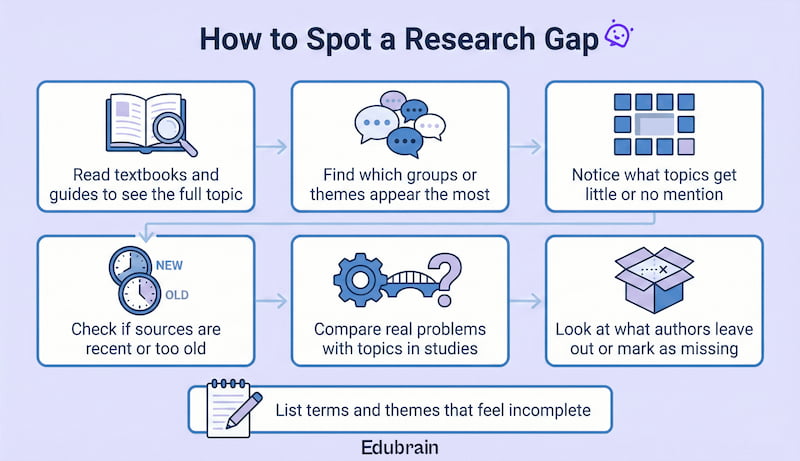
The best way to find a research gap is to step back and explore the full topic first. Try to understand what’s already known. Read textbooks or general articles that explain key terms. These sources show what most experts focus on and what they skip.
Be watchful of general patterns as you read. Some areas are repeatedly discussed, while others are unexplored. You may find that you never see certain parts of the world mentioned. In these silent places, there is sometimes an indication of a possible gap that requires an original research paper. Develop the whole picture before you decide which way to go.

Find Research: Search the Academic Literature Strategically
The second step is to find research studies once you understand the basics. Search reputable academic databases to access articles and a literature review on your topic. Pay attention to what categories the studies address. An obvious disconnect is likely to appear when comparing several sources together.
Use Databases and Tools Efficiently
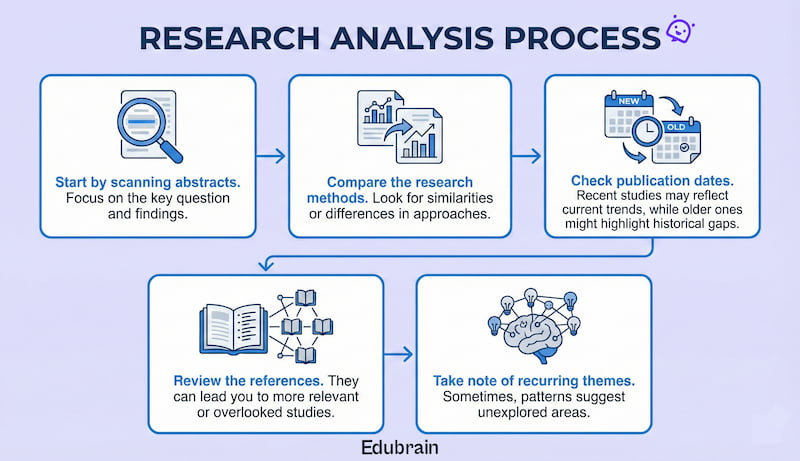
To find research gaps, start with databases like Google Scholar, JSTOR, or Scopus. These sites show a research paper from various journals. Try a simple keyword search at first, then switch terms to see what changes. Look at the titles and abstracts to see if the paper fits your area of interest. Pay attention to which sources the authors cite. This builds a foundation for your citation network.
It also helps to stay organized. PhD students often use EduBrain’s tools to save useful papers and keep track of authors. Instead of trying to remember where you saw something, you can go back and review later.
Understand Keywords vs. Subject Terms
The keyword you type into a database can change what you find. To cover more ground, try both everyday language and official database terms. One article might use “young people,” while another uses “adolescents.” Write down:
- Keywords from titles and abstracts
- Subject terms used in the database
- Synonyms or related words
- Broad or narrow terms linked to your discipline
Update your list often. A mix of types gives you a better chance to uncover underexplored areas.

Combine Terms to Test Boundaries
After you build your list, try different ways to mix them. This step helps you figure out if your research area is too broad or already well covered. Use a simple table like this to track what works:
| Term 1 | Term 2 | Term 3 | Result Count | Notes |
| STEM women | tenure track | – | 150 | Good focus, recent sources |
| climate change | education | curriculum | 1200 | Too broad, needs narrowing |
| mental health | college students | support services | 80 | Clear, might show a gap |
| online learning | rural schools | – | 20 | Very limited data available |
Identify Research: Analyze Limitations and Future Directions
Among the easiest methods of identifying research gaps is by reading what the authors state they were not able to do. Most studies include a limitations section towards the conclusion. Watch out for statements outlining future research directions, such as “further research is required” or “this section has not been fully explored.”
As you go through new papers, you may notice the same limits appear. Some authors leave out a specific population or avoid certain questions. An AI assistant for academic research can help you spot these patterns across multiple papers by highlighting repeated gaps. Over time, you’ll see where the field needs attention. That’s where a new research project can offer something useful.
Keep Track of What Each Study Covers
It might be hard to follow what each paper says when you read several. A reviewing matrix simplifies identifying gaps. It is a table stating the key information of each source to help you pinpoint what’s missing.
| Author | Year | Topic | Limits | Gap Noted |
| Smith | 2021 | Online learning in small towns | Small sample size | No data on adults |
| Lee | 2020 | Women in STEM | Urban focus only | Rural areas left out |
| Patel | 2022 | Climate in schools | One region studied | No national view |
Once the table gets full, you will begin to see similarity in the limitations. Perhaps there are locations not included in all studies. This is where research gaps in the literature may be found.
Steps to Test Possible Research Gaps
Once you find a gap, make sure it can hold up as a thesis or study. Begin broad, then narrow the idea until it feels clear and manageable. To check this, ask yourself what has already been explored in this area:
- Is the topic too wide for the time or resources you have?
- Does enough background exist to support it?
- Is the idea new enough to add value?
- Can you study it with the data and tools available?
If most answers are yes, the gap is strong. If not, refine the topic. Avoid topics that add little to theory or practice. Contributing new knowledge should connect to real issues, especially in fields like the social sciences.
Practical Ways to Identify Research Gaps
There are a few habits that make it easier to identify research gaps. One is to talk with faculty who have a wide view of the field. Another is to follow citation paths. When you see who cites whom, you build a mental connected papers map. You get a sense of which areas have strong attention and which remain under-cited.
Staying organized is just as important. Students who are struggling to find a gap or who want to know how to use AI to do assignments can use digital tools to sort relevant articles by theme and prepare clean reference lists. This AI approach gives you a clearer view of patterns across studies.
Final Thoughts
Research gaps appear when you look closely at what is known and notice what is still left out. They are not always obvious at first glance, but with steady reading, the contextual missing pieces begin to show.
To find research gaps, students need to keep good notes, revisit past articles, and ask what each paper leaves unsaid. The habit of documenting and questioning previous research makes sure your own novel research stands on solid ground and brings new ideas to the subject. Whether you are a PhD candidate or an undergraduate, mastering how to identify a gap is the first step toward impactful research.
Explore Similar Topics
When you are facing the challenge of not knowing how to write a research assignment for your school or college...
In the past couple of years, AI tools like Edubrain have become essential for students, researchers, content creators, and professionals...

