

Differential Equation Solver
Inferring Differential Equations Without Guessing the Method

Supports multiple equation types
From ordinary differential equations to partial differential equation cases, the tool adapts to different structures.
Handles initial conditions smoothly
You can include initial values and solve an initial value problem directly.
Step-by-step solutions available
Every change is revealed in such a way that you know how it should be, not only what has occurred.
Extends to calculus tools
To calculate derivative-related steps, a differentiation calculator can also be used to check the intermediary results.
Differential Equation Calculator Instructions






Featured in





Differential Equations: What Are They?
Basically, they’re mathematical statements connecting a function and its derivatives. Instead of asking for a number, you’re searching for a function that matches a set condition involving derivatives. That’s where this calculator comes in—it saves you from wrestling with messy steps and helps you find that function fast.
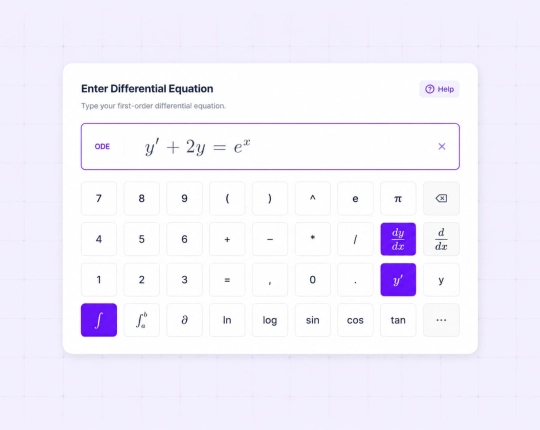
Ordinary Differential Equations and Partial Differential Equations
There are various types of differential equations.
- Ordinary differential equations (ODE)
These involve a single independent variable. For example, time-based models in physics.
- Partial differential equation (PDE)
These include several independent variables and partial derivatives, including mathematical equations of heat conduction.
An ordinary differential equation (ODE) is usually easier to solve, while partial differential equations often require more advanced techniques.
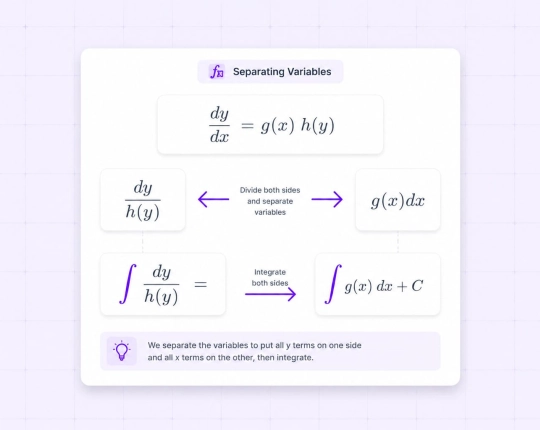
First Order Linear and Second Order Equations
Differential equations are also classified by order.
- First order: The highest derivative is the first derivative.
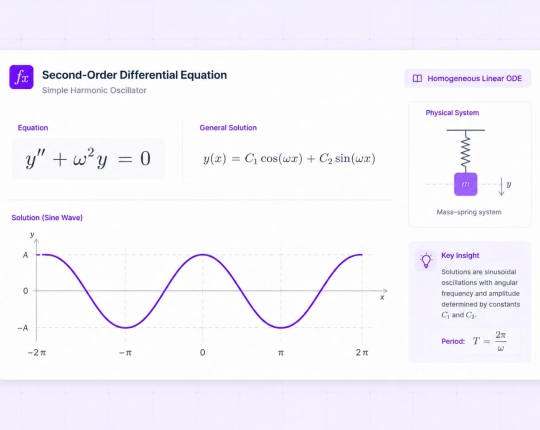
- Second order: There is a second-order derivative in the equation, commonly found in oscillation or motion problems.
For example: \( \frac{d^2y}{dx^2} + y = 0 \)
This is a second-order ODE. The order can be identified by an automatic different equation solver, and the appropriate method can be applied.
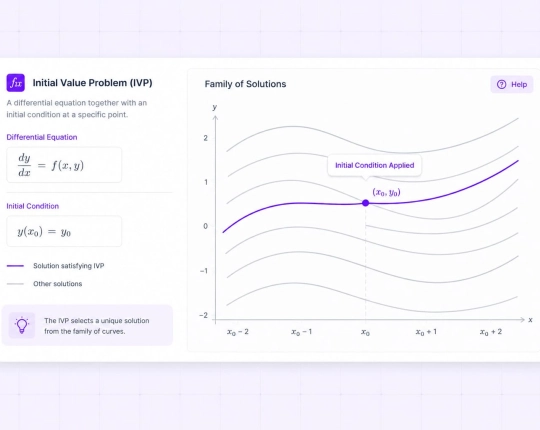
Differential Equation Calculator Example Walkthrough
Consider the equation: \( \frac{dy}{dx} = 2x \)
- Step 1: Integrate both sides
\( \int dy = \int 2x \, dx \)
- Step 2: Compute integral
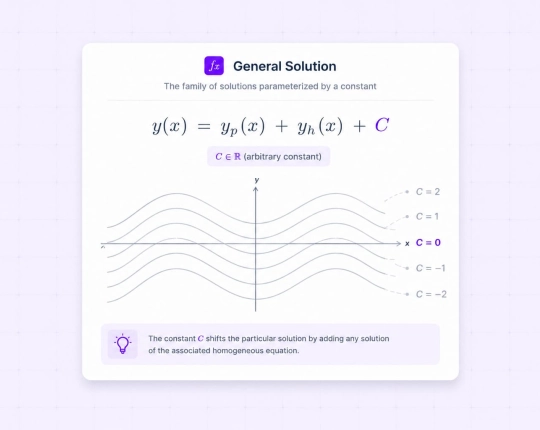
\( y = x^2 + C \)
This is the partial treatment of the problem, C being an arbitrary constant. When initial conditions are given, e.g., \( y(1) = 3 \), the constant can be ascertained.
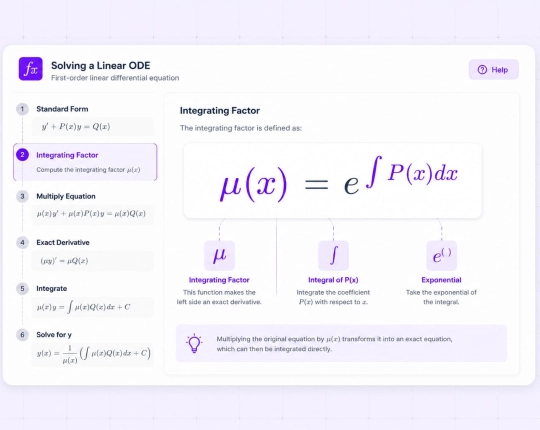
Initial Value Problems Explained
An initial value problem includes extra information. Example:
- \( \frac{dy}{dx} = 3x^2 \)
- \( y(0) = 2 \)
First, solve the equation:
\( y = x^3 + C \)
Next, apply the condition:
\( 2 = 0 + C \to C = 2 \)
Final solution:
\( y = x^3 + 2 \)
Approximations and Numerical Techniques
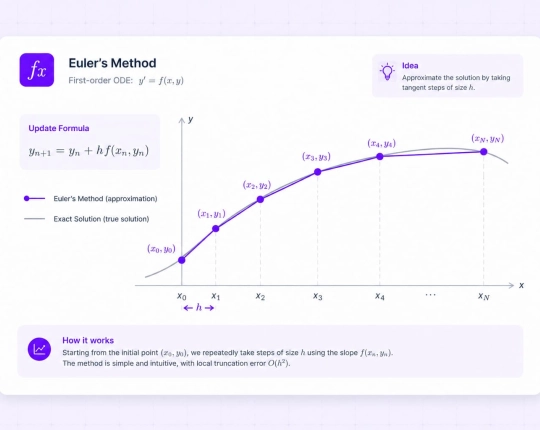
Exact solutions to differential equations are not always available. In such cases, numerical methods are used to approximate the answer. Common approaches include:
- Euler method
- Runge-Kutta methods
- Step-based approximation
Such techniques enable the solver to find numerical solutions to equations that cannot be solved symbolically.
Relation of Derivatives and Integrals
The concept of calculus is important in the field of differential equations. To fix them, you frequently combine statements or evaluate derivatives. If you want to explore integration further, an integral solver can help with antiderivatives. For definite bounds, a definite integral calculator with steps provides a precise evaluation.
Where Differential Equations Are Used
These equations appear in many real-world applications.
- Physics
Motion, force, and energy relationships often depend on differential equations. For a deeper explanation, physics AI tools can help.
- Engineering
Control systems and signal processing rely on differential models.
- Biology and chemistry
Population growth and reaction rates follow differential patterns.
- Economics
Dynamic models use differential equations to describe change over time.
Solver Processing of the Equation
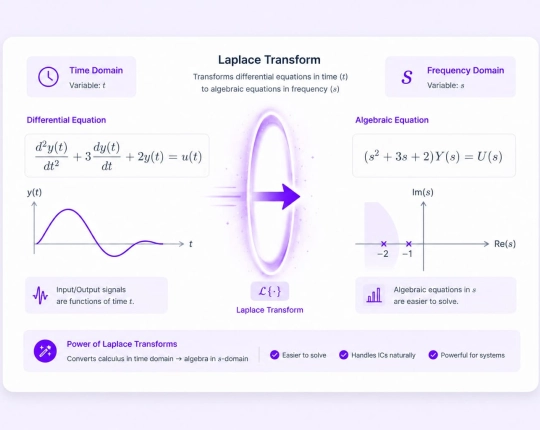
The tool initially makes an analysis of the equation structure. It determines the highest derivative, determines the possibility of variable separation, and determines the approach to be applied. Then, it does the symbolic operations which entail integration, simplification, and substitution. In the event that the equation is too complicated, numerical techniques are used. To get a better insight into it, a calculus homework helper can elaborate on every step.
Free Online Math Calculators with Step-by-Step Solutions


Choose your plan
Free plan
- Unlimited use with ads included
- Free access to all AI tools
- Download all responses (answers, presentations, flashcards, etc.)
- Share responses with others
AI-Plus
- Expert reviews on discounted prices
- Ad-free experience to:
- AI detector
- Diagram generator
- PowerPoint generator
- Answer generator
- Flashcard maker
- Notes generator
- Research assistant
- Download all responses (answers, presentations, flashcards, etc.)
- Share responses with others
- Advanced reasoning
Expert help
- Presentations (human-made)
- Homework help
- STEM support
- Writing assistance
- Editing & proofreading

 Unlimited AI homework help

 Diagram Generator, Flashcard Maker, Notes Generator, Research Assistant, Answer Generator, AI Homework Helper & AI Detector