

Find Domain Calculator
Find the Domain Without Confusion

Detects restrictions automatically
The tool identifies where a function becomes undefined, such as division by zero or the square root of a negative number.
Works across many function types
From rational functions to trigonometric functions and quadratic functions, the calculator adapts to each case. If needed, a fraction solver can help simplify complex expressions before evaluating the domain.
Clear interval notation output
Results are displayed in interval notation and easy-to-read form on the number line.
Extends to deeper analysis
An asymptote calculator can be used in studying vertical or horizontal limits in case your task requires an asymptotic behavior.
The Domain Calculator Usage






Featured in




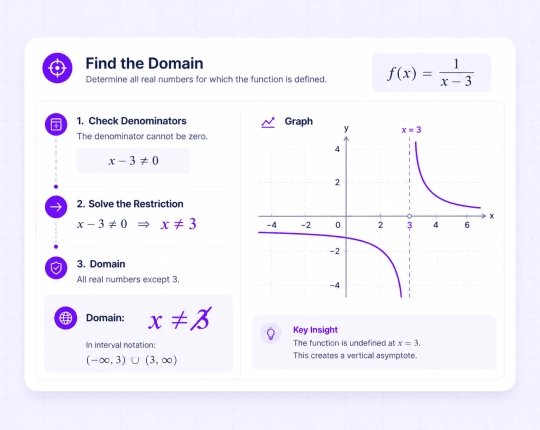
What Does Domain of a Function Mean?
Each function takes in some input values and rules out others. The domain of a function includes all potential values of an input to which the function is mathematically defined.
For example:
- A negative number cannot be entered in a square root.
- A denominator cannot equal zero
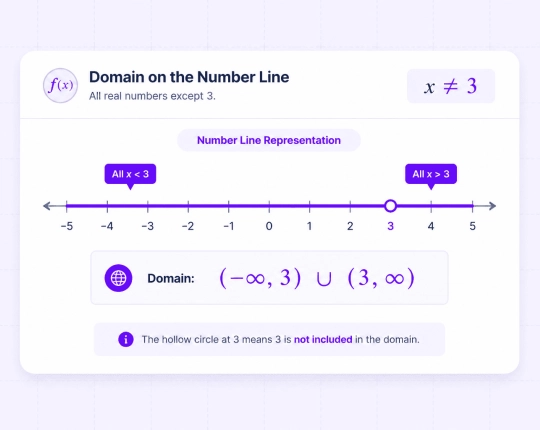
Domain and Range Defined In Relation to Each Other
The domain describes the values of the inputs, whereas the range describes the values of the outputs.
- Domain → what you can put in
- Range → what you can get out
A complete domain and range calculator helps you understand how both sets relate. This distinction is vital in the knowledge of functions and their graphs.
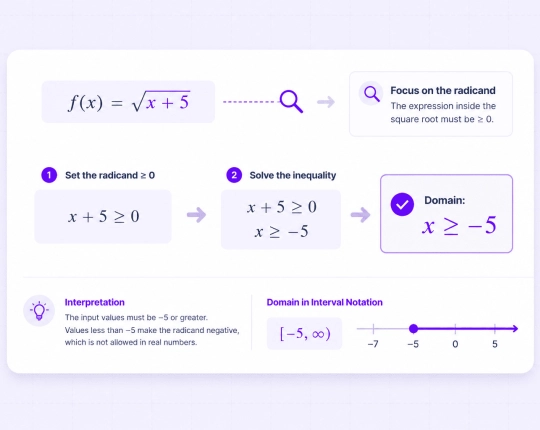
Restrictions You Should Be Familiar with
Certain patterns always create domain restrictions.
Division by zero
When a denominator is zero, then the function is not specified. Example:
- \( f(x) = \frac{1}{x – 2} \)
Domain excludes \( x = 2 \)
Even roots
Square roots require non-negative values. Example:
- \( \sqrt{x – 3} \to x \ge 3 \)
In such cases, a square root calculator with steps can help confirm valid ranges.
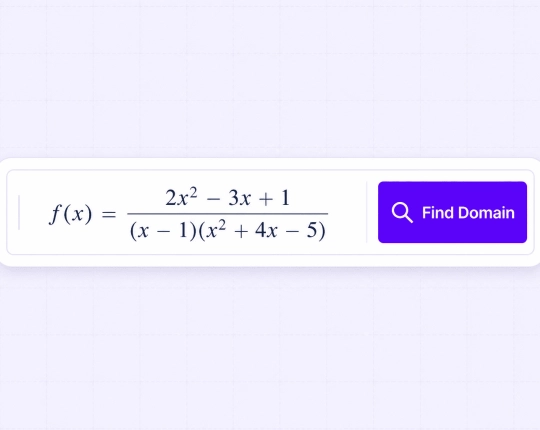
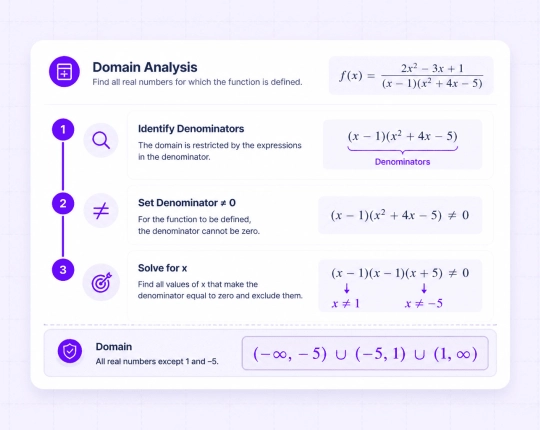
The Domain of Rational Functions and Rational Functions
Rational functions are fractions that include variables as the denominator. Example:
- \( f(x) = \frac{x + 1}{x – 4} \)
In this case, the denominator cannot be equal to zero. Therefore:
\( x \neq 4 \)
The domain includes all real numbers except that point. These restrictions are common and appear frequently in algebra problems.
Interval Notation Made Simple
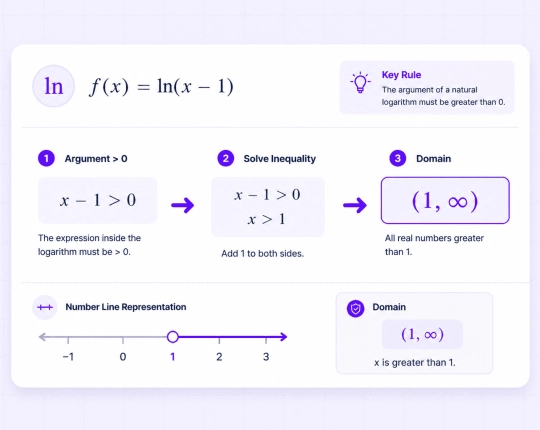
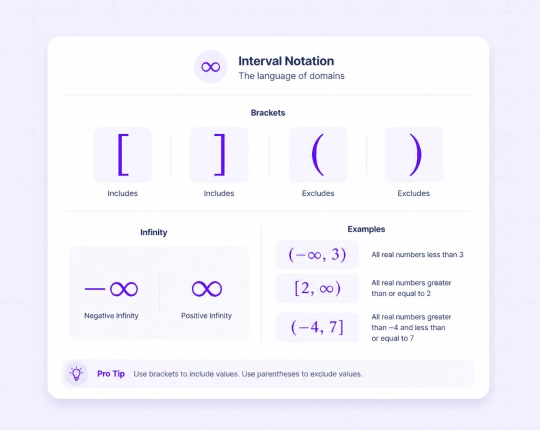
Rather than enscoring allowed values individually, results are written in interval notation. Example:
- \( x \ge 3 \to [3, \infty) \)
- \( x \neq 2 \to (-\infty, 2) \cup (2, \infty) \)
Find Domain Calculator Step-by-Step Example
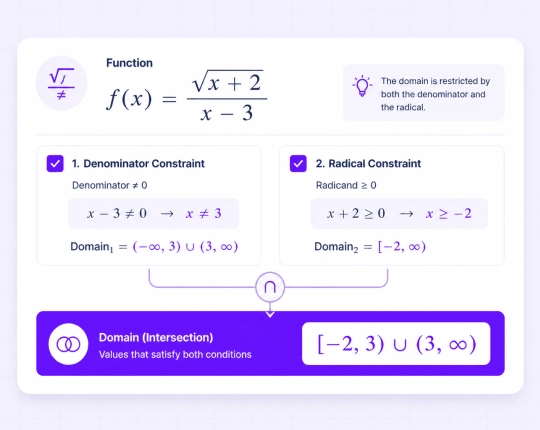
Consider the function: \( f(x) = \frac{\sqrt{x – 1}}{x – 3} \)
Step 1: Square root condition
\( x – 1 \ge 0 \to x \ge 1 \)
Step 2: Denominator constraint
\( x – 3 \neq 0 \to x \neq 3 \)
Step 3: Combine conditions
\( x \ge 1 \) and \( x \neq 3 \)
Final domain: \([1, 3) \cup (3, \infty)\)
A find domain calculator performs these checks instantly and avoids manual errors.
Why Domain Matters in Practice
Domain matters in practice since it defines where a function actually works. A graph only appears where the function is valid, so any undefined values create gaps or breaks. When solving equations, you must remove invalid values to avoid incorrect results. In real-world models, domain limits reflect reality. For example, some variables cannot be negative or undefined. For inequalities with domain restrictions, an inequality calculator can help you define valid intervals more clearly.
How the Calculator Determines Domain
The tool evaluates the function and determines the important items. It filters denominators first and gets rid of values that divide by 0. Then it does roots, logarithms, and other expressions that involve restrictions. Subsequently, all the conditions are synthesized into a final domain. In case of necessity, the built-in algebra solver details the way each constraint was discovered.
All-in-One Math Calculators & Step-by-Step Solvers


Choose your plan
Free plan
- Unlimited use with ads included
- Free access to all AI tools
- Download all responses (answers, presentations, flashcards, etc.)
- Share responses with others
AI-Plus
- Expert reviews on discounted prices
- Ad-free experience to:
- AI detector
- Diagram generator
- PowerPoint generator
- Answer generator
- Flashcard maker
- Notes generator
- Research assistant
- Download all responses (answers, presentations, flashcards, etc.)
- Share responses with others
- Advanced reasoning
Expert help
- Presentations (human-made)
- Homework help
- STEM support
- Writing assistance
- Editing & proofreading

 Unlimited AI homework help

 Diagram Generator, Flashcard Maker, Notes Generator, Research Assistant, Answer Generator, AI Homework Helper & AI Detector