

Taylor Series Calculator
A Practical Way to Work with Taylor and Maclaurin Series

Supports different types of functions
Expanding polynomials, trigonometric functions, exponential functions, and many other popular functions can be done at one location. This is time-saving and easier to compare.
Accurate expansion around any point
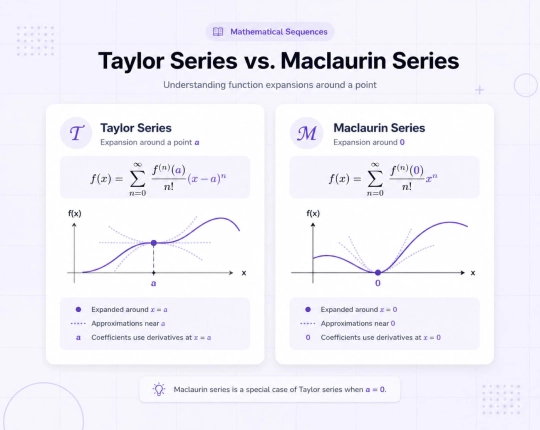
The calculator has the option of selecting a center point of the Taylor series. In case the center is x = 0, then it yields the Maclaurin series.
Handles higher-order derivatives automatically
You do not need to find every derivative by hand. The tool computes them up to the order you choose.
Flexible number of terms
You can select how many terms to include. This helps when you need a shorter form or a more exact result.
Step-by-step explanations
The stages of the expansion are shown clearly. This makes it easier to follow how each term appears in the series.
The Taylor Series Calculator instructions


Featured in




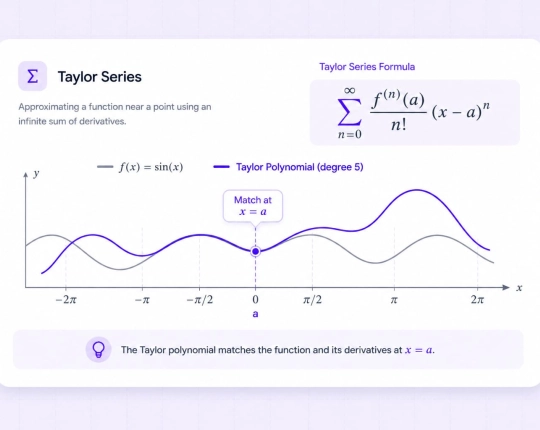
Taylor Series in Practice
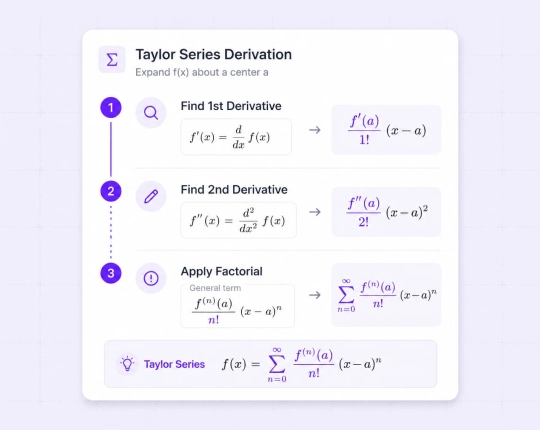
A Taylor series is a function in the form of an infinite sum of terms of its derivatives at a particular point. You do not deal with the original function, but with an approximation by a polynomial. There are further specifics in each term. The approximation can be very near the actual function with sufficiently many terms used. This method is common in calculus, physics, and computer science.
An example is that \( \sin x \) and \( \cos x \) can be written as power series, and are thus easier to calculate in most cases. This concept can be applied to more intricate functions. Assuming you are interested in underlying sequences and patterns, you can use an arithmetic sequence calculator to study simpler arithmetic sequences before transitioning to full expansions. This method is common in calculus, physics, and computer science, and works well as a calculus homework helper when learning series expansions.
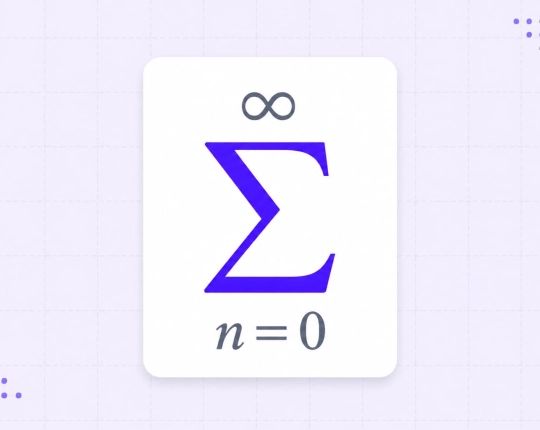
Maclaurin Series Special Case
A Maclaurin series is merely a Taylor series whose center is zero. The function is expanded at \( x = 0 \) instead of expanding around \( x = a \). This simplifies the process in most instances, particularly when it involves common functions such as sin x or cos x. The equations are reduced to smaller and simpler forms.
The concept comes from the work of the Scottish mathematician Colin Maclaurin, who studied these simplified expansions in detail. When working with limits before building a series, a limits calculator can help verify behavior near the center point.
Why Series Expansion Matters
Taylor series provide an approximation of functions when the actual values are hard to calculate.
- Numerical approximation of complex functions: Certain functions cannot be easily evaluated, but can be expanded in series, so calculations are possible.
- Solving differential equations: Series methods are often used when solving differential equations analytically.
- Applications in physics and engineering: Used to model systems, approximate values, and simplify complex formulas.
- Improved numerical methods: Series expansions allow more efficient computation in many algorithms.
A sum of series calculator may be useful to you when you need to sum up several terms to make your work more efficient.
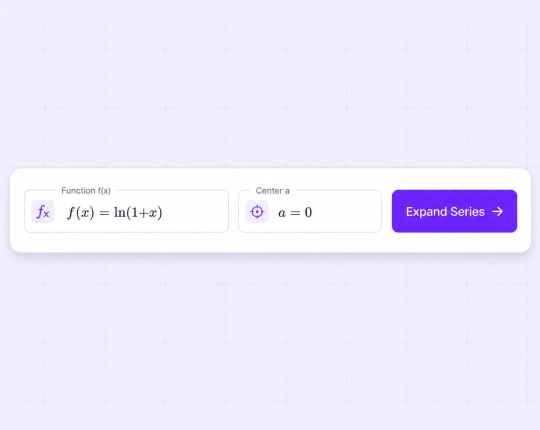
Taylor Series Example
Take a function like \( a \cdot \cos x \). When expanded around \( x = 0 \), it becomes a series in powers of \( x \), with terms that change sign. Each term comes from higher-order derivatives of the function.
As you add more terms, the approximation becomes closer to the real value. For small values of \( x \), even a few terms can give a good estimate. The same idea applies to exponential and logarithmic functions, where series expansions help simplify calculations.
Common Challenges When Working with Series
Even when the formula is clear, mistakes can still happen. Working with derivatives, terms, and notation requires attention at each step.
- Incorrect derivatives
- Wrong center point
- Misunderstanding how many terms are needed
- Issues with convergence or error bound
- Problems with notation or coefficients
To avoid these issues, many use a differentiation calculator to check derivatives before building the series and confirm each step.
Step-by-Step Solvers for Algebra, Calculus & Geometry


Choose your plan
Free plan
- Unlimited use with ads included
- Free access to all AI tools
- Download all responses (answers, presentations, flashcards, etc.)
- Share responses with others
AI-Plus
- Expert reviews on discounted prices
- Ad-free experience to:
- AI detector
- Diagram generator
- PowerPoint generator
- Answer generator
- Flashcard maker
- Notes generator
- Research assistant
- Download all responses (answers, presentations, flashcards, etc.)
- Share responses with others
- Advanced reasoning
Expert help
- Presentations (human-made)
- Homework help
- STEM support
- Writing assistance
- Editing & proofreading

 Unlimited AI homework help

 Diagram Generator, Flashcard Maker, Notes Generator, Research Assistant, Answer Generator, AI Homework Helper & AI Detector